

Football commentary serves as our definitive point-of-reference for all of the happenings in a match. Often a commentator assumes multiple roles, including that of a storyteller, guide and veritable ‘hype man’ (or woman) throughout the 90 minutes.
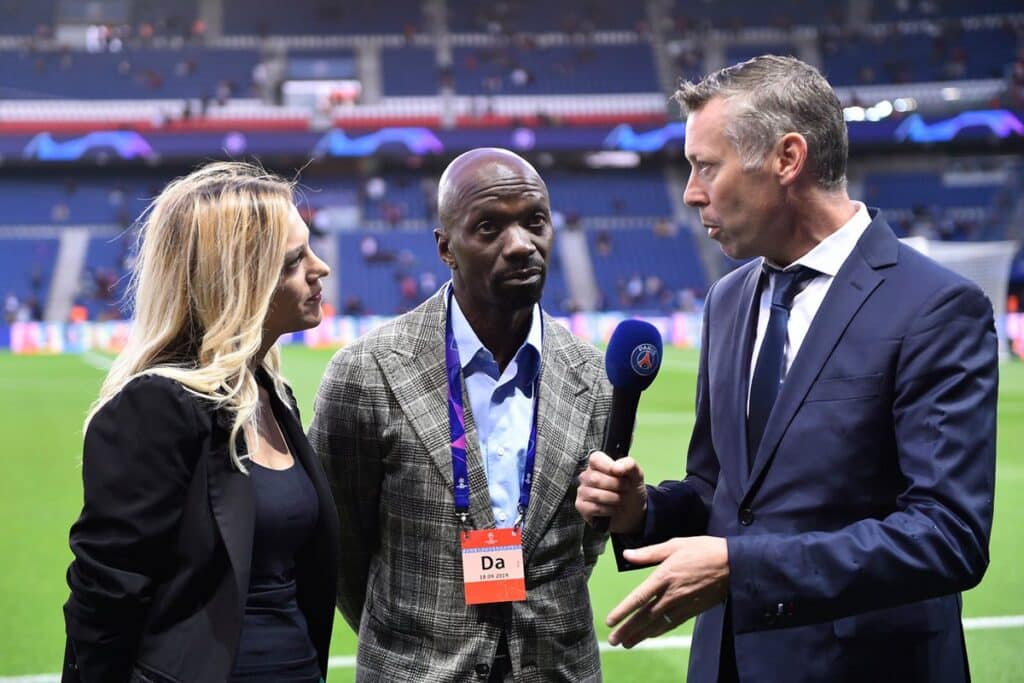
Having previously spent time with beIN SPORTS France as their Ligue 1 World Feed commentator, and also as the World Feed Commentator for Fédération Française de Football (Football Federation France), Canberra-raised Robbie Thomson returned to Australian shores in season 2021-22 to be part of the team covering football at Channel 10.
Throughout an extensive career abroad, Thomson has covered numerous World Cups and has seen his voice broadcast all over the globe. Moreover, Thomson’s years of experience within the world game means he has seen the sport transition from primarily being covered via television, newspaper and radio to taking on a life of its own in the digital age.
Sitting down with Soccerscene ahead of his second season as a lead commentator for Channel 10 and Paramount+, Thomson discussed his career thus far, his learnings from world football, and his anticipation for the A-League Men and Women’s seasons ahead.

In your earlier years, what inspired you to become involved in football broadcasting?
Robbie Thomson: Like with anyone, my dream was to play – not to sit and watch. In the late 1980s when SBS started showing the Italian football on the weekends and production levels started to amp up in the English First Division, I became heavily invested in the game.
We were a whole new generation here in Australia to fall in love with Italian football, which wasn’t unique to us because it was the best league in the world at the time. It had colour; it was well-filmed; and Martin Tyler was commentating there in addition to his work in England. They were great times to be a football fan and probably that is where the seed was planted.
I used to commentate my mates playing soccer games on the arcades, which is where the realisation started that I could mimic the commentators I’d heard on television and perhaps make a career of it.
How did you become involved in Australian football?
Robbie Thomson: Well, it’s not easy to get involved in Australian football. In Canberra, where I grew up and went to University, I played football and wrote match reports for my local club. I went to Melbourne with a bunch of mates and after a year there, a contact had told me that there were part-time jobs going at the Victorian Soccer Federation. I applied for a job which was essentially me calling clubs and answering telephones on Sundays to find out all of the results. That’s how tragic I was at that stage, because I was someone with a degree who by this stage was doing anything just to be involved.
I started meeting people through playing the game down in Melbourne. And then it was David Basheer who was at SBS at the time and was preparing to go to the World Cup for France ’98. SBS had done a lot of work on Italia ’90 and USA ’94 as well, but France ’98 saw a big push from them to get media over there. I’d met David Basheer and he’d taken me under his wing at the time because I knew so much about the NSL – he thought that was odd. And because SBS were so heavily involved in covering the local scene, he gave me a chance. When he went off to France ’98, I took his place on The World Game filing stories during the day. Once he came back, I continued to do anything really.
That was a part-time job and it wasn’t going to lead to anything commentary-wise. So, after a while of having a little taste of what football could do and the jobs that were in it, I packed my bags and headed for Europe.
You’ve spent time all over the world covering football, how significant has your career path been in allowing you to embrace and submerge yourself in global culture? Has football been a catalyst for your journey or was it always your desire to spend time abroad?
Robbie Thomson: I came from an un-football family but it was one that had travelled a lot, being a family of talented ballet dancers who’d travelled overseas as part of companies. As a family we knew that we’d be encouraged to travel and we were fairly open-minded to the world as a result of that. But it was, going back, watching Italian football and seeing the fans that were there – and playing with the Italians, Greeks, and Croatians at my school and at my local clubs in Canberra that really opened my eyes to wanting to travel the world.
It took about 10 years because I moved to France when I was 26. From those first late teen years of falling in love with football, and seeing how international it was, to actually going. I probably would’ve gone to Italy but I had a contact in France where I knew I could stay. From there, I’d always been open to the world and football is a fantastic greeting card and icebreaker.
It’s considered a bit differently perhaps in some parts of Europe. France; it’s not a massive sporting nation and whilst it’s considered culturally significant being that France are world champions, they don’t give it the respect that a fanatical Australian thought they should. In Italy its very much a religion; in Spain its somewhere between the two; in Germany, and even Belgium and the Netherlands, its working class but its really popular; in England its obviously working class and massively popular.

A lot of your recent football experience has been within French football as you said. What are the strategies and approaches you’ve seen adopted by Ligue 1 and the French Football Federation (FFF) to effectively grow the game there and combat that cultural disconnect?
Robbie Thomson: I’ve worked quite closely with a number of clubs and also with the Ligue de Football Professionnel (LFP) and the FFF in France. I was there in the mid-2000s when the LFP really tried to launch itself internationally. At the time I was basically a one-person news feed in English for French football. I’d write match reports that they’d syndicate to newsrooms around the world and commentary notes for the world feed commentators.
At that time the LFP split from FFF and that’s when they started seeing the necessity to start producing English language content. The LFP have been taking their Community Shield equivalent (the Trophée des Champions) overseas for the best part of a decade. The last two were in Israel but I’ve been to Montreal, Tunisia, Morocco, Gabon and all over the place – usually to French-speaking countries or countries with French links.
The FFF have been a little bit slower on the uptake by comparison despite hosting something like EURO 2016 which was a great platform for them. Even though they’ve had teams that have won the World Cup in 98 and 2018 and were a finalist in 2006, it took them years to get their website into English. Basically, like Italy and Spain (outside of Real or Barça), they were years behind and missed that boat. The Bundesliga and Premier League were the frontrunners and AS Roma were the odd exception who got on top of it.
Social media is a huge thing and I think there’s a bit of reticence in Europe towards completely changing the game and the communication around it. There’s a fear that you’re losing your identity and traditions if you’re changing times to reach different markets. There’s a struggle from loyalists to maintain their fervour and passion for the clubs, but the next generation will carry that on in a different way.
Almost 10 years prior to re-joining the A-Leagues banner as a commentator, your voice was heard during the 2011/12 and 2012/13 seasons when Fox Sports owned the broadcasting rights. What do you feel has changed between that period and now?
Robbie Thomson: It’s clearly been through a difficult period. In my absence I kept sort of abreast of what was going on and had former colleagues that were back here. By all accounts the split between FA and APL was very complicated and bitter, and it certainly appears that we’re still feeling the effects of the split because it seemingly was acrimonious. There was so much energy left on the battlefield that now people are struggling to pick themselves up and move forward again.
10 years ago, there was still Frank Lowy and a centralised power and I didn’t think much of this at the time. But clearly in the absence you see now – and not necessarily of Frank Lowy but of someone of a presence and strong leadership with influence – it’s crucial for a sport (and we’re not the only sport obviously) – we’re a sport that needed to have that influence just because we’re up against sports where clearly its in their best interests to keep football small and underdeveloped.
So, that’s the biggest change I think that I can see. Soccer was and is the victim of the fact that it’s not Fairfax Channel 9 or Murdoch News Corp realms. And you can’t compete in the national psyche if you have no presence and if you have no voice. It’s nearly impossible to get any airtime, but it needs a shot in the arm and to not have COVID and the terrible weather that blighted last season. We need to have a good season of football, we need to have a pause and a rewind button, and we need to have people get behind it and somehow try to translate participation numbers and a clear love of European football into a love of domestic football. For kids and adults that are playing they need to see that there’s A-League on – Men and Women – and that it’s worth watching.
As someone who has commentated on and soaked in football from around the world, what are the points of difference between the A-Leagues and football elsewhere?
Robbie Thomson: Well, there are the structural compositions that are obviously different when positioning the A-Leagues in Australian society, because football is a sport but its not the same as an individual sport like golf or tennis, a football team like a rugby league or AFL team represents a community, an area, a city, or a people, and carries their identity. And that’s the thing that’s the hardest to create in Australia.
Perhaps we could look more at how it’s been done in Japan and the USA rather than Europe or South America where the football clubs have been around for over 120 years, because they have a different anchorage in the society and the community. Not talking promotion-relegation, salary caps, structural league differences… the biggest difference in Europe, South America, Africa and football around the world to Australia is that the clubs here are very much a franchise in so far as there is not enough anchorage in community.
There’s not enough identity with the clubs. And maybe that’s a question of time, we’re going into our 18th year and we know that certain clubs do have an identity; that Sydney FC have an identity; Melbourne Victory; the Mariners, it’s more difficult with clubs such as Newcastle who don’t have a solid owner. Brisbane Roar have been cut off from their community; Perth fans when they lose their home ground for a while will feel disconnected; Adelaide has a good identity but could still be stronger. For me, that’s the big difference in terms of cultural importance to a country, that’s where the A-League is lacking.

The A-Leagues have stepped up their content production in the off-season with video season previews and the arrival of the A-Leagues All Access series which is a first of its kind. Can you give us some insight into the motivation behind this content?
Robbie Thomson: To connect. The whole idea is to try and connect to the fans and to the future fans that are coming through, to the young fans that are all across social media. I think that the A-Leagues would’ve tried to run it last season but there was so much putting out fires that it was difficult to get everything up and running.
This weekly behind-the-scenes, ‘Drive to Survive’ all-access style show has been planned since day one. And the idea is we have to consolidate the fans we have. Social media is very pervasive in the world – everyone has a mobile phone and a content device and more and more people are using them – and this is a great way of reaching them. If we can do young, funky, cool content that sounds interesting with video clips that look more and more like the Premier League or European football then it will naturally grow interest.
I doubt very much that Formula One would’ve anticipated the success of ‘Drive to Survive’. In France the ratings for Formula One were through the roof the year after the show’s debut. And Formula One was dying because people saw it as the cars drive themselves. There were no characters, it was seen as this pristine thing that no one could actually relate to in the end. This documentary created all of this underbelly and made people intrigued, and that’s the idea of A-Leagues All Access to make sure we’re consolidating the fans we have now and connecting with the young fans take us into the next decade.
There’s a real desire to ensure that the support content is as high quality as anywhere in the world because there’s no reason it can’t be. We can get more access here than we can say Paris St. Germain players to do this type of thing. And in all honesty, our players are not at the level of Ronaldo, Messi, Haaland or Mbappé, but the football last season was entertaining. It’s just that people didn’t give it a chance or didn’t know it was on. So, if we can shine a light on it and connect with the young fans and bring a few people through the gates, then the football doesn’t need help. It’s about getting fans passionate and loyal to the product.