

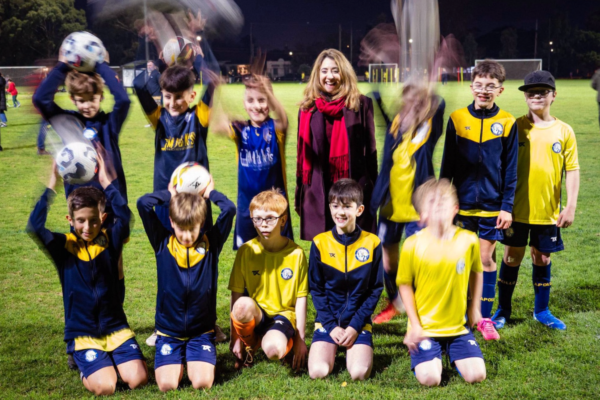



AAFC Chairman Nick Galatas: “We want the best possible national second division”

AAFC Chairman Nick Galatas has outlined his plans for the organisation for 2021, with the continued pursuit of the introduction of a national second division at the top of his list.

Speaking with Soccerscene, Galatas explained that at the core of the organisation’s work on a national second tier, is the importance of producing the best outcomes for the sport.

“It’s about having the best possible national second division,” he said.

“That is front and centre of what we have put forward. What we’ve asked our clubs to put forward is not the minimum they can do, but the maximum they can do. Yes, we can always do less than the best, work below our capacity and set low targets that we can achieve.

“But we think we can do better than that.

“The clubs are assuming the risk, they are putting up the money and their resources, they think they can make it work from within their capability. Let’s use it, why wouldn’t we tap into that resource?”

FA CEO James Johnson recently spoke with Simon Hill on the Shim, Spider and So Much Moore podcast, praising the AAFC’s model and philosophically agreeing with the concept of a national second division with 12-16 teams.

However, Johnson believes that a more pragmatic model is a two-phase system where clubs will play out their local NPL season, with the best sides to then progress into a national-based “Champions League” group stage competition at the back-end of the year.

Galatas believes it is up to AAFC to convince Football Australia that the research they have conducted, in their feasibility progress report, will ultimately show that their model for a national second division is the appropriate way forward for the sport.

“Our job is to show Football Australia what they philosophically think is better, is in fact better and does in fact work,” he stated.

“We are not rejecting the outline of what James put out the other day, it may turn out to be better. We will explore that further and try and look at that and imagine it to its best level and work on that in good faith. If it looks good, and the risk associated with that is so much lower to make it more viable, then great.

“But, our work to date shows that it is not the case.

“The cost to the revenue side of a more limited model and the difficulty our member clubs will have in selling that to their own people, in terms of generating the relevant interest, isn’t worth it, as the savings it involves doesn’t compensate for the forgone revenue and interest. We look forward to seeing the FA model James mentioned in more detail when it’s ready, but we have anticipated such a model in our progress report before settling on our preferred model.”

AAFC hopes to complete its final report on its national second division plans by April, with Galatas anticipating a lot of the year to be occupied by Football Australia’s modelling of the second tier, something the organisation expects to play a notable role in.

Alongside this, they will look to navigate through all the changes to the game that directly affect the NPL clubs they are representing.

The organisation intends to conduct some work on advancing the women’s game in the country in the build-up to the 2023 Women’s World Cup, whilst also keeping abreast with recent announcements from the governing body.

“Going on to the domestic transfer system and the white paper FA has introduced, we are definitely looking at that. We’re preparing our position and contribution to that,” Galatas said.

“Football Australia also recently put out its domestic football calendar, so we are getting our heads around that as well and where we fit in.”

Possible reforms are also set to occur to NPL competition structures across Australia.

“We’ll be working with the member federations and with Football Australia in continuing to evolve that,” he said.

“There have been reviews into structures in Victoria, NSW and one now happening in Queensland, so we are constantly working on that part of it because most of our member clubs are involved in that.”

Galatas, based in Melbourne, believes on the back of the enthusiasm and movement on the second division front, strong crowds should turn out for the NPL season in Victoria.

“A lot of people want to see their teams play, practice match crowds are up from what I’ve heard and hopefully there are bumper crowds for the season.”
Previous ArticleNext Article

Heidelberg United denied qualification to AFC UCL 2

In an announcement made yesterday, Football Australia revealed that, in place of Heidelberg United, Melbourne Victory will now take the AFC UCL 2 spot.

A premature ending

In what is sure to be a disappointing verdict for Heidelberg’s fans, staff and supporters, the NPL VIC side will no longer compete in next season’s AFC CL 2.

The decision comes despite Heidelberg meeting the necessary criteria outlined in Football Australia’s National Club Licensing Regulations.

“We understand that this will be a disappointing outcome for everyone connected to Heidelberg United FC,” said FA Executive Director of Football, Heather Garriock, via press release.

“The club earned enormous respect through its performances this season and should be proud of what it achieved both on and off the pitch.”

Indeed, through defeating several A-League outfits en-route to the Australia Cup Final against Newcastle Jets, Heidelberg did earn widespread respect and admiration across the landscape. Football Australia also strongly advocated for the side’s place in the AFC CL 2 following Newcastle’s qualification to the AFC CL Elite.

But despite the determined efforts of the club’s board to meet all necessary criteria, the Asian Football Confederation (AFC) ruled the side ineligible to compete.


Victory emerge as replacements

Filling the now-vacant position in next season’s competition is Melbourne Victory, who finished 4th in the A-League this year.

As 3rd-place Auckland FC are based in New Zealand, thus falling under the Oceania Football Confederation (OFC), they are also ineligible to compete.

So while the AFC CL 2 will still be arriving in Melbourne next season, fixtures will no longer be built on the underdog success story of Heidelberg’s immense rise from NPL to AFC CL matchdays.

The club, however, will appeal the decision, and has written to Football Australia for further clarity on the Appeals Process.

It remains uncertain whether the appeal will be successful or not, but Heidelberg will undoubtedly enjoy the backing not just of its own staff and supporters, but of the entire Australian grassroots community.

World Cup 2026 build-up: FA urges Victorian Government to overturn live site decision

Football Australia responded yesterday to the decision by Melbourne Arts Precinct not to host live watch parties during this year’s FIFA World Cup tournament.

FA urges reconsideration

Citing safety concerns, Melbourne Arts Precinct announced that live watch parties would not take place this summer.

As a result, many fans and officials are eager to see the decision overturned as they look forward to rallying behind the Socceroos at their seventh FIFA World Cup tournament.

Football Australia revealed yesterday that they are speaking to both the Victorian Government and the Melbourne Arts Precinct to ensure fans across the city can view live matches together.

“The FIFA World Cup is the biggest sporting event in the world and unites Australia’s multicultural communities, while reinforcing our national identity,” explained Football Australia CEO, Martin Kugeler, via official press release.

“Live sites create iconic moments for Australian sports fans. They bring all Australians together to celebrate and cheer our National Teams competing on the biggest stage.”

“Melbourne is one of Australia’s sporting and multicultural capitals, and this decision goes against this tradition.”


Celebration vs safety

While many will be backing the FA in their call to overturn the decision, the motivations behind it nevertheless stand to reason.

With thousands of fans packed into an outdoor, public space like Federation Square, guaranteeing order and safety becomes increasingly difficult to deliver.

During the 2023 FIFA Women’s World Cup, up to 12,000 fans attended the semi-final screening against England. And although the majority were there to enjoy and support, a small minority took the opportunity to light and throw flares.

Therefore, the response from the FA begs an important question in staging live sporting events:

At what point do celebrations compromise safety?


Final thoughts

Football brings people together, and international tournaments allow fans to display pride for their respective nations.

But safety remains an absolute priority in sports – from the athletes on the pitch to the fans in the stadium or, during major tournaments, at popular live sites.

Hopefully, an agreement can be reached which balances both aspects of the game.

Most Popular Topics

Editor Picks

Send this to a friend