
AFF Suzuki Cup postponed due to COVID-19

The ASEAN Football Federation has announced the postponement of the AFF Suzuki Cup due to COVID-19.

The tournament was set to take place between November 31 and December 31 this year but will now be moved to 2021 instead.

The AFF Suzuki Cup is held every two years and is played between the south east Asian countries.

The cup was scheduled to be contested by Brunei, Cambodia, Indonesia, Laos, Malaysia, Myanmar, the Philippines, Singapore, Thailand, Timor-Leste and Vietnam. The latter are the defending champions, while Thailand are five-time winners of the tournament.

The last edition of the cup did not have a host nation, with teams alternating between playing home matches in their own country and away games in other nations.

“Since the onset of COVID-19, the AFF has been closely monitoring guidance from the World Health Organization (WHO), Health Ministries, government agencies, FIFA and AFC,” Major General Khiev Sameth said, the AFF President.

“As you are aware, this pandemic continues to pose enormous health, societal and economic challenges to us all. AFF’s top priority continues to be the health and safety of our football family and mitigating the impact of this pandemic. With the risk of the spread of COVID-19 remaining high, the AFF finds itself in a situation where we cannot proceed safely with the AFF Suzuki Cup 2020.

“While these are unprecedented times for the whole world including our football family and communities, we are confident that we will get through it together with the support of all our stakeholders including our fans, Member Associations, players, coaches, official, media and partners and we would like to thank them for standing united with us in the fight against COVID-19.”

The AFF said that it will be monitoring the situation and will release information on the 2021 running of the event as soon as possible.

“Sportfive supports the decision by the AFF to postpone the AFF Suzuki Cup 2020 to ensure the safety and well-being of all players, partners, staff and fans. While we are disappointed that we are unable to hold the tournament this year, we will work closely with the AFF to monitor the situation and look forward to working with our partners to deliver a great tournament for the fans of ASEAN next year.” Adrian Staiti said – President of Suzuki Cup partner Sportfive.

Australia is an ASEAN country, however it is not a member nation of the AFF.

Previous ArticleNext Article

Gold Coast United FC reveals Burleigh Brewing as new partner

The Queensland-based club revealed on Tuesday that the brewing company will join the GCU and Tally Valley Tigers family as a new partner. 


Forging new connections 

The news of the collaboration is one which should excite local supporters and club members alike. The Queensland-based club displayed their pride at teaming up with Burleigh Brewing in an announcement via social media. 

“How good is this! For GCU, Tally and Burleigh Brewing, this is the partnership that was meant to be,” Gold Coast United said. 

“Deeply rooted in the local community and obsessed about quality, BB founders Peta and Brennan Fielding share the same depth of passion for beer, as we do for football.” 

Two essential aspects of this partnership are evident in Gold Coast United’s announcement: community and quality. Essentially, by joining forces with a local business equally as committed to achieving excellence in their field, it is no wonder why the club is looking forward to tackling the upcoming season with the backing of Burleigh Brewing. 


Pursuing a shared vision 

In any successful commercial partnership, both parties need to not only share a common vision, but pursue it with conviction.

For Gold Coast United and the Tally Valley Tigers, 2026 is shaping up to be a year of unique development across all levels at the club. Following the announcement of a merger in October 2025, the two clubs are eager to encourage and sustain widespread participation in community football. 

Furthermore, by offering opportunities to young talents in the region from 5 to 18 years old, Gold Coast United and the Tally Valley Tigers can provide a setting for sporting prowess and local participation. And by joining forces with Burleigh Brewing – who proudly stand as a community-oriented and family-run organisation – the foundations for a healthy partnership are already there.

“It is with huge thanks to Peta, Brennan, Holli, Sam and the crew at Burleigh Brewing for seeing the same vision that we do for the pursuit of quality, achievement and the bringing together of community,” Gold Coast United added. 

Team spirit after the final whistle 

As a popular brewery and taphouse since 2006, Burleigh Brewing have a 20-year history of providing high-quality products. For them, high standards are a non-negotiable.

Yet beyond offering expertly crafted beer, Burleigh Brewing also understands the importance of its customers. Additionally, with the capacity to host groups and functions up to 600 people, the Gold Coast United fanbase can expect Burleigh Brewing to become the go-to location for socialising and connecting even after the final whistle.


Why A-League Women players believe the next phase of the game must start now

As Australian football enters a new phase of growth and reflection, A-League Women players are seeking to ensure the future of their competition is shaped with them, not around them. A new player-led vision announced last week at Ultra Football in Abbotsford, sets out what those inside the game believe is required for the league to move beyond survival and toward sustainable professionalism.

A shared vision

Ready For Takeoff is a player-driven vision for the future of the A-League Women, developed through consultation with player delegates from every club across the competition. Led by Professional Footballers Australia, the initiative brings together the shared priorities of those currently navigating the league’s semi-professional reality. It outlines what players believe is required to move the competition toward long-term sustainability.

Rather than offering broad aspirations, the document focuses on practical and achievable reforms, spanning professionalism, governance and resourcing. Its emphasis is on creating conditions that allow players to train, recover and compete at a level consistent with a fully professional league. While also building structures capable of supporting future growth.

A-League Women player Dylan Holmes believes the process revealed how closely aligned players’ experiences were across the league. “When we came together, it was clear we all faced very similar challenges but wanted the same things,” Holmes said. “This work is the culmination of those discussions and outlines realistic, tangible steps to take the game to the next level.”

PFA Chief Executive Beau Busch – Image Credit: One Nil

The cost of the current system

Behind the league’s growing visibility, many A-League Women players continue to operate within a system defined by short-term contracts and a largely semi-professional structure. Club commitments are made increasingly more difficult as players must balance additional employment or study, limited training and recovery time, and questions over long-term security. The result is not only personal and financial strain, but broader consequences for the competition’s ability to retain talent and support player wellbeing.

These conditions also shape the league’s development pathways, with young players often forced to make difficult choices about whether a professional career in football is viable in Australia. PFA chief executive Beau Busch said players had been clear about the sacrifices required simply to remain in the game. “We’ve heard from players about the struggle and sacrifices they continue to make to play the game they love, but we can do so much more than this.”

“A fully professional game is crucial to creating the next generation of Matildas and achieving our potential.”

Turning Matilda’s momentum into domestic opportunity

Throughout the launch, speakers repeatedly pointed to the Matildas as both a benchmark and a blueprint for what sustained investment in the women’s game can deliver. PFA chief executive Beau Busch referenced the national team’s commercial success to highlight the opportunity facing the A-League Women, arguing that professionalism at domestic level is essential to converting broader public interest into a viable league product.

The comparison was framed less as imitation than as evidence of latent value. The Matildas’ ability to attract audiences, sponsors and broadcast attention was presented as proof of concept for what is possible when the women’s game is properly resourced. A-League Women player Dylan Holmes echoed that sentiment, saying “when you invest in women, really amazing things will come.” For the A-League Women, speakers argued, the task is to build structures that allow the domestic competition to capture that momentum and present a compelling, sustainable proposition to commercial stakeholders.

The Players’ Vision for the A-League Women – Image Credit: One Nil

A moment for new thinking in governance

Central to the players’ vision is a call for governance structures that are fit for purpose. This is particularly important at a time when leadership across Australian football is in transition. The Ready For Takeoff document argues that the A-League Women’s development has been constrained by a club-majority APL board. It says that this practice does not adequately recognise the specific needs of the women’s game.

Instead, the players advocate for an independent commission model, similar to those governing the AFL and NRL, with transparent rules, appropriate gender representation and mandated expertise in women’s football. The aim, the document argues, is not simply reform for reform’s sake, but the creation of a structure capable of stewarding the A-League Women’s growth. Achieving this in its own right, rather than as an adjunct to the men’s competition.

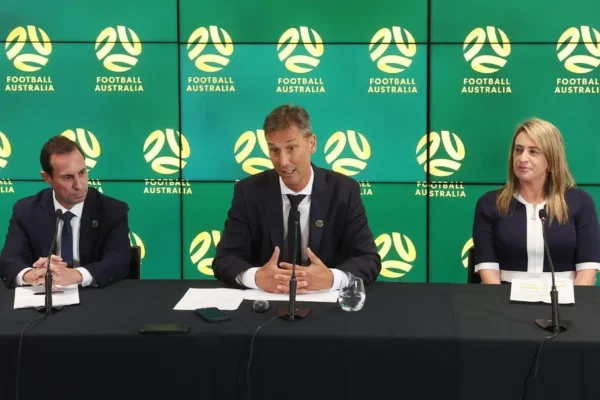
That argument lands at a moment of change. The recent appointment of Steve Rosich as chief executive of the APL and Martin Kugeler as the new CEO of Football Australia, has opened a window for fresh thinking about how the domestic game is governed. For players, the timing presents a rare opportunity: to ensure that new strategies are shaped not only by commercial imperatives, but by the lived realities of those sustaining the league on the pitch.

Most Popular Topics

Editor Picks

Send this to a friend