Assessing the impact of concussion

Concussion in Sport Australia has launched its position statement and website to delve deeper into treating concussion symptoms and developing the best code of practice.

Leading sports medicine experts are aiming to inform players, coaches, officials and parents on the best approach for concussion symptoms.

The Australian Institute of Sport (AIS), the Australian Medical Association (AMA), the Australasian College of Sport and Exercise Physicians (ACSEP) and Sports Medicine Australia (SMA) have all come together to form Concussion in Sport which creates awareness.

Receiving a head knock during sport has long been known as something a player could just shake off and continue playing with in an act of toughness, but with greater research comes better understanding as to why concussion is a serious injury.

If someone has got multiple concussions in their playing career, it could lead to long-term effects – particularly with the brain involved.

Concussion in Sport Australia has a simple message as winter sporting codes begin or soon to start their seasons – if you don’t feel right sit out.

Headaches are prevalent following a concussion and when that occurs following a concussion, it’s best to rest up and not make it worse.

It’s exactly like any injury where if someone feels a bit sore they might not play the next week. Concussion is one of those things that sporting clubs should take extra care with.

Previous ArticleNext Article

Regional carnival puts Football West’s Country Pathway in Focus

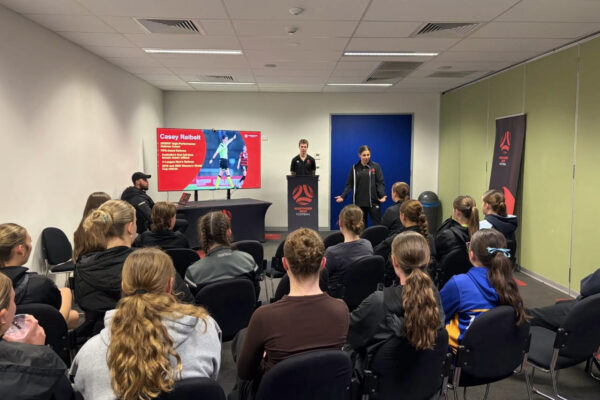
Football West’s first State Regional Carnival has done what many federation pathway initiatives promise but do not always deliver: it brought regional players into a central high-performance environment and made them visible on equal terms, at least for a weekend.

Almost 160 players from six Football West Regional Academy zones: South West, Goldfields, Great Southern, Mid West/Gascoyne, Pilbara and Kimberley, were brought to the Sam Kerr Football Centre in Queens Park for the three-day event last week. For the governing body, the carnival is now being positioned as a formal part of its talent identification and development pathway.

Football West general manager of football David Lewis said the carnival had highlighted the standard of regional football and the role country programs continue to play in the state game’s future. He described the event as an “important part” of the development pathway and thanked players, staff, volunteers and families who travelled from around WA to attend.

From event success to system performance

Western Australia’s structural constraint is distance. Regional players face layered costs that metropolitan players usually do not: long-haul travel into Perth, additional accommodation, time away from school and work, and repeated trips if selected into subsequent camps. Those costs are not incidental. They influence who can stay in the system.

That is why the next stage of this initiative matters more than the launch optics. If identified players cannot progress because the second and third steps of the pathway carry prohibitive financial or logistical burdens, then early identification becomes a limited intervention.

In governance terms, the carnival has shifted Football West’s accountability point. The federation has now demonstrated it can convene regional talent at scale. The policy obligation is to show what proportion of those players can be retained and advanced across the following 12 to 24 months, and on what support settings.

Infrastructure is in Place; Distribution as the Issue

The use of the Sam Kerr Football Centre means WA now has a purpose-built football base capable of hosting large-format pathway activity in one location. That removes one of the traditional constraints often cited in state development systems. Once infrastructure is available, attention moves to distribution: who accesses the environment, how often, and under what conditions.

If Football West wants this carnival to function as a durable pathway mechanism rather than a showcase event, several design questions become central. What are the progression criteria after carnival selection? What travel and accommodation support is available for players invited back into metro-based programs? How is regional representation balanced across age groups and cohorts? What protections exist to prevent early dropout linked to cost rather than capability?

A broader shift in Australian pathway policy

The Football West carnival also reflects a wider trend in Australian football administration. Federations are increasingly moving from ad hoc regional scouting to more formal, event-based talent aggregation tied to defined development structures. The logic is straightforward: centralised assessment improves comparability, increases selector confidence, and reduces the chance that players are missed because of location alone.

Yet national and state systems alike continue to confront the same bottleneck. Identification has improved faster than inclusion in later stages. The policy challenge is less about finding players than funding continuity for players whose families absorb higher participation burdens.

Football West does not need to prove that regional football has quality; that case has already been made repeatedly by player outcomes and now by event scale. It needs to publish evidence that regional players can convert recognition into progression at rates that are not materially depressed by geography or household income.

That means performance should be measured against more than attendance and event satisfaction. Over time, the federation will likely be judged on transition rates from regional carnival cohorts into advanced programs, retention across seasons, gender balance in progression outcomes, and the level of practical support delivered to remote participants.

For now, the inaugural carnival can be read as a constructive step with genuine strategic value. It created a focal point for regional talent and signalled administrative intent. Whether it becomes consequential policy will depend on what Football West builds around it next: transparent progression settings, repeatable support, and a funding model that does not turn distance into exclusion.

World Cup betting boom presents billion-dollar opportunity, and a growing dilemma, for Australian football

The 2026 FIFA World Cup is expected to become the biggest betting event in sporting history, with more than US$50 billion ($76 billion AUD) expected to be wagered globally across the tournament.

Financial services firm Macquarie estimates around US$500 million will be bet on each match, eclipsing the estimated US$35 billion wagered during the Qatar 2022 World Cup. The jump is driven by the tournament’s expansion from 32 to 48 teams and from 64 to 104 matches, alongside the rapid growth of legal sports betting markets in North America.

While much of the attention has focused on the sheer scale of betting turnover, the figures also underline football’s commercial importance to Australia’s wagering industry.

The World Cup has long been one of the country’s biggest betting events, sitting alongside the Melbourne Cup, AFL Grand Final and State of Origin. With Australia qualifying once again and attracting strong national interest, bookmakers have invested heavily in marketing campaigns designed around football’s month-long global spectacle.

TAB recently launched its nationwide “The Cup at TAB” campaign, positioning venues across Australia as communal destinations to watch World Cup matches, backed by research suggesting 61% of Australians prefer experiencing the tournament with others.

Sportsbet has also rolled out a major World Cup advertising campaign built around football’s global appeal, highlighting just how commercially valuable the tournament has become for Australia’s betting operators.

What about Australian Football?

Unlike Europe’s major leagues, Australian football still relies heavily on sponsorship and broadcast revenue to grow participation, develop professional competitions and improve fan engagement. The increased commercial attention generated during a World Cup inevitably benefits broadcasters, venues, hospitality businesses and wagering companies looking to capitalise on football’s largest audience.

SBS has introduced in-game advertising during FIFA’s mandated hydration breaks for the first time at a World Cup, creating additional commercial inventory during live broadcasts while maintaining uninterrupted match coverage.

Yet football’s commercial success arrives amid mounting political pressure over gambling advertising.

The Albanese Government has proposed significant restrictions on gambling promotions, including banning betting advertisements during most live sport before 8.30pm, prohibiting gambling branding at sporting venues and preventing athletes and celebrities from promoting wagering products. While described as Australia’s biggest gambling advertising reforms to date, critics argue the measures still leave significant loopholes.

What does it mean for football?

As betting companies spend millions attaching themselves to the World Cup, gambling harm advocates argue football’s biggest event also becomes one of the industry’s most effective customer acquisition tools.

Macquarie analysts have warned bookmakers face an additional challenge beyond simply attracting World Cup punters. The industry’s long-term profitability depends on converting casual tournament bettors into year-round customers across football, racing and other sports, as well as higher-margin casino products.

That concern has been repeated by gambling reform organisations, which argue global football tournaments expose younger audiences and first-time bettors to increasingly sophisticated wagering products.

For Australian football administrators, the issue reflects a broader commercial balancing act.

The sport continues to chase greater investment to compete with the AFL and NRL for fans, sponsors and media attention. World Cups generate unprecedented engagement, creating opportunities for broadcasters, pubs, clubs, hospitality operators and betting companies alike.

However, as governments tighten gambling regulations and public scrutiny intensifies, football’s commercial ecosystem may also need to evolve. The 2026 World Cup demonstrates football’s extraordinary economic power beyond ticket sales and broadcasting rights. Billions of dollars will flow through betting markets over the next month, reinforcing football as one of the world’s most commercially valuable sports.

For Australia, the challenge is ensuring that the business generated by football strengthens the game itself, rather than simply enriching industries that surround it.

Most Popular Topics

Editor Picks

Send this to a friend