


Australia’s overseas footballers set to benefit from digitally-led nutrition support

Football Australia has announced an extension and expansion of their partnership with Compeat Nutrition – an innovative company that is revolutionising nutrition centred healthcare in performance sports and the general population, through to August 2022.

The partnership supports Football Australia’s endeavours to provide world class environments and support to Australia’s national team players in order to help them cope with performance expectations and to improve holistically as athletes and people both during and after their careers.

Footballers in each of Australia’s women’s and men’s national football teams – from the Westfield Junior Matildas and Joeys to the Westfield Matildas and Socceroos – will have access to Compeat Nutrition’s digital platform, with scaled levels of support to athletes via virtual meetings and one-on-one consultations available also.

The platform – which has been developed to deliver scientific and proven dietetic advice in an environment that builds resilience, helps forge good habits and ensures a truly individualised solution – removes the barriers of geography and time to ensure that Australian football’s elite global player bases have real-time access to 24-7 nutritional support.

Andrew Clark, Football Australia’s High Performance Coordinator, explained that Compeat Nutrition has provided nutritional to the Westfield Matildas, Westfield Young Matildas and Future Matildas for the past two years. And now, following positive feedback and outcomes, the platform has been expanded to a larger pool of players across female and male programs.

“We’ve witnessed some encouraging results and received some positive feedback from our women’s national team players since the platform was introduced to them two years ago,” Clark explained. “In partnership with Compeat Nutrition, we’ve now taken the opportunity to extend the support to a larger pool of players based at clubs in Australia, Asia, Europe, and North America, ensuring that they can access nutritional support regardless of what time zone they are in.”

“We’re always striving to find ways that we can support players while at their clubs, in preparation for their national team duties, and in international qualification and tournament mode. This service will assist many Australian footballers to develop healthy nutritional habits that they can use throughout their careers and in life after football.”

Compeat Nutrition co-founder and leading performance dietitian, Alicia Edge, said Football Australia’s digitally focused approach to supporting footballers based all over the globe was a progressive move that can lead to individual and team performance benefits.

“Football Australia is focused on delivering the best nutritional outcomes and support for their athletes,” Edge said.

“At Compeat Nutrition, we are deeply honoured to have the opportunity to partner with Football Australia in helping Australia’s best footballers at different stages in their careers to better train, compete and recover through their nutritional intake.

“It is so gratifying to build a supportive, mobile environment that Australia’s elite footballers can take with them no matter where they go in the world. By engaging with Compeat, athletes will receive comprehensive education and sustained awareness of the impact of nutrition and wellbeing on performance that is vital for individual and team success at international level.”
Previous ArticleNext Article

Five Matildas figures recognised Among Australia’s Most Influential Women in Sport

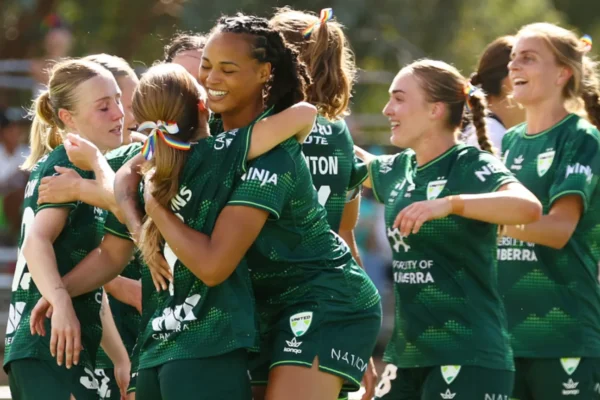
Code Sports‘ annual list of the 100 most influential women in sport is one of the more closely watched measures of where women’s sport in Australia stands. This year’s edition, released against the backdrop of a record-breaking home Women’s Asian Cup, features five women connected to Australian football across its top 100. Their collective presence on the list reflects a sport that is, by almost any measure, in the midst of a significant moment.

Mary Fowler has been ranked the most influential woman in Australian sport for the second time in three years, topping Code Sports’ annual list of 100 as the CommBank Matildas compete in a home AFC Women’s Asian Cup that has already rewritten the record books for women’s football globally.

Fowler’s ranking comes after a year defined as much by what happened off the pitch as on it. An ACL injury in April 2025 threatened to rule the Manchester City forward out of a home tournament with ten months to recover. She returned to club football in February 2026, was named in Joe Montemurro’s squad, and scored on her first start for Australia in 332 days, finding the net in a 4-0 win over Iran at Stadium Australia in front of a capacity crowd.

Sarah Walsh, ranked 14th, has been central to that shift as Chief Operating Officer of the AFC Women’s Asian Cup 2026 Local Organising Committee. The former Matilda has overseen a tournament that has surpassed 250,000 tickets sold, demolishing the previous all-time record of 59,910 set across the entire 2010 edition in China. The opening match in Perth drew a record-breaking attendance of  44,379 fans at a Women’s Asian Cup. It lasted one week before 60,279 people filled Stadium Australia on International Women’s Day for Australia versus Korea Republic.

Those numbers carry weight beyond the scoreboard. They make the commercial and strategic case for continued investment in the women’s game in a way that advocacy alone cannot.

From the Pitch to the Boardroom

Captain Sam Kerr enters the list at 17, having returned from a 634-day ACL absence to score two goals in the tournament, including the opener in Perth on the first night. Kerr’s presence in the squad, and her continued ability to perform at the highest level, reinforces the argument that the Matildas’ 2023 World Cup run was not a ceiling.

Heather Garriock arrives at number seven having become the first woman to lead Football Australia, appointed Interim CEO in 2025 before transitioning into a newly created Executive Director of Football and Deputy CEO role following the appointment of Martin Kugeler as permanent CEO in February 2026. The role was designed to retain her influence within the organisation. With the Socceroos preparing for a sixth consecutive FIFA World Cup and the Matildas mid-tournament, Garriock’s position at the executive level of the sport’s governing body is not incidental.

At number 84, Lydia Williams enters the list in retirement. A proud Noongar woman and recent recipient of Professional Footballers Australia’s Alex Tobin Medal, the organisation’s highest honour for career-long contribution, Williams made her international debut in 2005 and retired in 2024 with more than 100 caps, becoming the first Australian female goalkeeper to reach that milestone and only the second Indigenous footballer after Kyah Simon to do so. She now sits on the board of the Australian Sports Commission.

The transition from player to policymaker matters because the decisions shaping Australian sport in the next decade will be made in rooms that have not always had people like Williams in them. Her presence there is part of the same story the rest of this list is telling.

Winter Futsal League Returns with New Cup Competition

Football NSW Futsal’s Winter Futsal League (WFL) is back for its seventh season, with 12 men’s clubs and six women’s clubs set to compete across the winter off-season.

The Men’s Division kicks off on Sunday 15 March at Valentine Sports Park and affiliate venue The Centre Dural, welcoming back familiar sides including Dural Warriors, Sydney Allstars and Phoenix Futsal alongside new and returning entrants Eastern Suburbs Hakoah, Mascot Vipers and Sydney Futsal. The Women’s Division follows on 11 April, featuring six clubs including newcomers Dural Warriors and East Coast Bulls. Both competitions will conclude with a finals series in July.

Most Popular Topics

Editor Picks

Send this to a friend