




Billy Celeski’s BootLab getting off on the right foot

Former Socceroo and Melbourne Victory star Billy Celeski says cleaning boots is important for players who dream of playing professionally.

The cleaning of boots has becoming something of a time-honoured tradition amongst seasoned professional football players.

For many who have scaled the heights of this great game, the memories of cleaning boots as a youngster was a humbling reminder of where they started, and considered an important lesson in the requirements of discipline and respect that grounded them on their way to the top.

In the modern day, it is not often you see elite youth players cleaning the boots of the professional peers, but former Socceroo and Melbourne Victory star Billy Celeski says cleaning their own boots is an important discipline for players who dream of playing professionally.

It was that thought process that saw Celeski identify a business opportunity and one that he has pounced on with the launch of his new boot-cleaning product, Bootlab 101.

“I wanted something that would teach kids about the importance of respecting the tools of their trade,” he told Soccerscene.

“And that’s what boots are. They are our tools, and as players we have to take care of them.”

The Bootlab 101 Boot Brush is a visually striking product.

It wouldn’t look out of place amongst the high-tech, high-design aesthetic of an Apple store.

But when it comes to Celeski’s Boot Brush, its ingenuity is in its simplicity.

A 300 ml bottle with a squeeze valve attached to a brush.

Simply fill the bottle with water, squeeze to release the water onto the boot and use the brushes to scrub them clean. Simple!

No more dragging muddy boots through the house to laundry and no more excuses from brining muddy boots into the clubhouse.

Celeski – who was a creative force on the field as a player – said however simple its application, the conception, design and manufacture of the brush was meticulously planned and carried out.

“Initially when we looked at what we could do, the research was based on looking at what kids get when they signup for a club or an academy,” he said.

“You get your kit, you get your drink bottle and maybe some merch, which is great, but what are we giving them to teach them about the importance of caring for the tools they use to play?

“I wanted to come up with a device or product that was going to trigger them to ensure they looked after those tools.

“At the end of the day, parents spend a lot of money on registration and boots and being able to take care of those boots is an important lesson for kids to learn about having respect for what their parents do for them, and a good discipline to get into when it comes to respecting themselves as well.”

Celeski employed the services of an industrial designer to bring his vision to life and said that with the product now on the market, the feedback has been great.

The brush is already in the hands of A-League and W-League stars and internationals like Jamie Maclaren and Melissa Barbieri, and Celeski said first impressions have been good.

“We gave a couple out to some professionals just to get some feedback and the flow on from that has been great,” he said.

“The feedback is good and we are getting professionals from overseas who are getting in touch with us and buying the product for themselves.

“Hopefully if we can show that it’s good enough for the professionals, then the clubs and academies and players will want it for themselves as well.”

Celeski said the Boot Lab 101 was working with a number of clubs to make the Boot Brush a part of the kit they provide players.

“We’re speaking to a couple of A-League clubs and there’s a lot of interest from NPL clubs as well, because they have players from under-7s right up to their seniors,” he said.

“We’ve cast the net far and wide and now that the product is out there and people are starting to get it in their hands and see how effective it is we’re getting good feedback.

“Players can clean their boots on the spot and leave all that mud and dirt on the ground where it’s meant to be and out of their clubrooms, their lawns or their laundry.”

With B2B a core focus of Boot Lab 101’s sales strategy, Celeski confirmed his company is looking at the best branding possibilities for the bottles, so that they can be branded with club logos and sponsors.

Boot Lab also offers wholesale pricing for clubs, academies and associations who place large orders.

“The brand is starting to get out there,” he said.

“I feel as it is early days, but the feedback is good and we believe we’ve delivered a quite innovative product that doesn’t really have much in the way of comparable products.

“Once we start announcing some of the clubs we’re working with, I’m confident we will see a domino effect and more will come as a result.”

You can purchase the Boot Lab 101 Boot Brush via the company’s online store. 

Clubs, academies, federations and interested stockists can learn more about wholesale pricing via the Boot Lab 101 website.

Previous ArticleNext Article

Melbourne Victory and BYD drive innovation through new major partnership

Melbourne Victory has officially welcomed BYD as a Major Partner and the Club’s exclusive Motor Vehicle Supplier for the next 12 months. At a partner launch bringing together the two organisations, the focus is on building around innovation, growth and a drive for success. The partnership will place BYD at the centre of Melbourne Victory’s fan experience. The brand will feature on the front of both the A-League men’s and women’s home and away jerseys. This gives BYD a strong presence across matchdays, broadcasts and digital content throughout the season.

The partnership extends well beyond the playing kit. BYD will be integrated across Melbourne Victory’s media, Academy and community assets. The two organisations will also collaborate through Member and pathways programs. This creates opportunities for BYD to connect with Victory supporters across multiple touchpoints.

For BYD, the partnership provides a direct connection with Melbourne Victory’s growing supporter and member base. The automotive brand has built a rapidly expanding presence in Australia and New Zealand. Its partnership with Victory provides another platform to build awareness and engage with Australian consumers. BYD Australia Chief Operating Officer Stephen Collins said the alignment between the two organisations was a key factor behind the deal.

“At BYD we’re enormously excited to welcome the Melbourne Victory into the BYD family as an exclusive automotive partner,” Collins said.

“What really appeals to us was the culture of innovation and the hunger for success.”

That alignment is reflected in the way the partnership will operate. BYD will not simply appear on Melbourne Victory assets. The brand will be connected to the Club’s members, fans, business network, pathways and community programs. Melbourne Victory Managing Director Caroline Carnegie said the partnership reflects a shared ambition for continued growth. She also highlighted the organisations’ common focus on leading, connecting and inspiring their communities. Together, Melbourne Victory and BYD will bring the partnership to life across matchdays, media, community initiatives and supporter experiences throughout the 2026-27 season.

The ball is no longer just being improved it is being connected

The humble football is becoming one of the more technologically advanced objects on a football pitch.

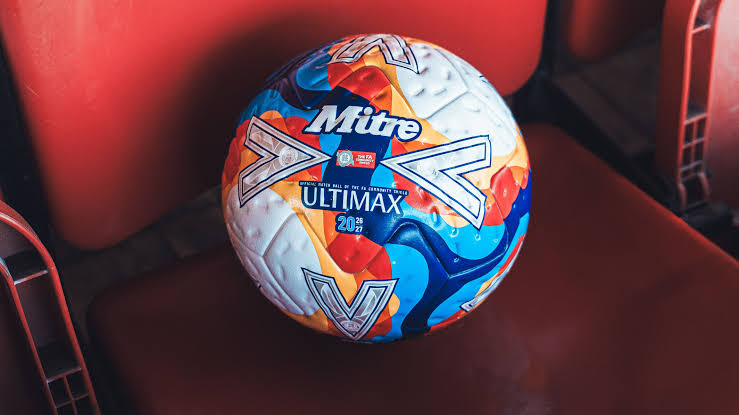
Across the A-Leagues, Mitre’s new Ultimax Pro is focused on improving what happens when the ball is kicked, while LaLiga has taken the next step by turning the ball into a source of live match data.

The contrast shows how football technology is moving in two directions at once, improving the physical performance of equipment while increasingly connecting it to the digital systems surrounding the game.

Refining the Physical Object: Mitre’s Ultimax Pro

The Ultimax Pro, which will be used across the 2026/27 A-League Men and Ninja A-League Women seasons, incorporates Mitre’s HyperFlow, HyperFoam, HyperSeal and Delta Skin technologies.

Its debossed grooves are designed to reduce drag and improve stability in flight, while the cushioning, bonding and surface technologies are aimed at producing consistent rebound, durability and control. The ball carries FIFA Quality Pro certification, reflecting the testing standards required for professional match balls.

The technology is largely invisible to supporters. Its purpose is to make the ball behave more predictably for players, rather than fundamentally changing the football itself.

Connecting the Ball to the Digital Ecosystem: LaLiga’s Sensor-Driven Approach

LaLiga’s approach is different.

The Spanish competition has introduced a radio-frequency sensor developed by KINEXON into its PUMA match ball, with the technology being used across every LaLiga EA Sports fixture this season.

The sensor continuously transmits information about the ball’s position and the precise moment of contact. Around 12 antennas installed in each stadium capture the data and feed it into LaLiga’s wider technology infrastructure.

That gives the ball a role beyond simply being the object of play.

Knowing exactly when the ball is touched can help officials in a variety of situations. Offside, handballs, deflections and other decisions where a difference of milliseconds can affect the outcome could all benefit.

But the more interesting development may sit outside officiating.

LaLiga is using the connected ball to create xBALL, an official data layer that can feed broadcasts, digital products and future second-screen experiences. Data such as shot speed, ball spin and trajectory could all be incorporated into its media and digital products.

The ball is no longer just something that manufacturers compete to make faster, more durable or more responsive. It can also become a source of proprietary data that leagues can use to improve broadcasts, develop digital products and create new ways for supporters to understand the game.

The Ball as Part of Football’s Intelligence Layer

Mitre is refining the physical object. LaLiga is connecting that object to the digital ecosystem of the match.

Together, however, they point to the same direction of travel.

Football equipment is becoming increasingly intelligent.

The evolution is not necessarily about adding technology for its own sake. In the A-Leagues, the objective is consistency: predictable flight, touch and rebound. In LaLiga, the objective is precision and information: knowing exactly where the ball is and when it was touched.

The commercial opportunity comes from what can be built around those capabilities.

As stadiums become more connected, broadcasts become more data-rich and clubs and leagues collect increasingly detailed information about matches, the football itself can become another input into that infrastructure.

It also changes the relationship between equipment manufacturers and competitions.

A match ball used to be primarily a physical product supplied to a league. Connected technology creates the possibility of the ball becoming part of a broader technology stack involving officiating systems, broadcast platforms, analytics and fan-facing digital products.

The A-Leagues are starting with the physical performance of the ball. LaLiga is showing what can happen when that physical object becomes connected.

The next generation of football technology may not be something players wear or referees use.

It may be the ball itself.

Most Popular Topics

Editor Picks

Send this to a friend