


Blacktown City CEO Bob Turner: “The council is exceptional in wanting to build pride”

Ahead of the National Premier Leagues NSW season, Blacktown City CEO Bob Turner chatted with Soccerscene about the NPL 1 side’s 2022 Season Launch and the recent developments being instigated to push the club towards greater growth and expansion into becoming a central sporting hub for the Blacktown region.

The Blacktown City 2022 Season Launch was hosted by Stephanie Brantz and marked a significant milestone moment for the club. The sheer magnitude of the launch well and truly represents a pivotal moment in Blacktown City’s recent history, which is due in no small part to the initiatives being introduced by Turner and the team at the club.

Unveiled at the event were the announcements of Blacktown City’s first ever Senior Women’s team, construction of new $1 million changerooms under the main grandstand thanks to the NSW Government, and full operational control of the side’s home Stadium – Blacktown City Sports Centre.

In addition, Blacktown City unveiled that they had become a Diamond Member of the Greater Blacktown Business Chamber, and utilised the evening to launch their recent induction and to host Chamber members in a restructured Business After 5 format.
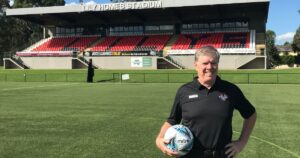
BCFC Bob Turner

Have Blacktown City regularly conducted season launches of this size? Or was this the first time where you’ve actively tried to bring the community together from all over Blacktown?

Bob Turner: They used to hold the launch at Lily’s Function Centre with Vince Camera when he was in control at the club. But we haven’t had one for a number of years, and we just felt with so many good things happening that it would be better to have a real season launch and make a big deal of it.

Blacktown Council came to the party and let us have their Bowman Hall which can accommodate up to 400-500 and is adjacent to the Council Chambers. But more importantly, because of social distancing it helped us to keep spread and thankfully the Mayor, and the Deputy Mayor, a couple of Councillors, and of course Stephanie Brantz – were all there. It just added to the whole credibility of the launch and it was also good to see both the men’s side and the women’s side together on the stage at one time. Which is a huge plus for the club moving forward.

Blacktown City have recently been inducted as a Diamond Member of the Greater Blacktown Business Chamber. What was the process of organising that and how did it feel being able to launch it?

Bob Turner: It’s fortunate that I’m Vice President of the Chamber, so that helps! One of the biggest things I’ve found in my year involved at the club is how do we make a bigger impact for the city of Blacktown. Both for the club, but importantly for the city. Because I think that the city of Blacktown is very sports conscious. It’s a very misunderstood city in my opinion over the last 10 years of being involved in it. It doesn’t have a main sports team that the city takes pride in and I think Blacktown City – by virtue of not just our name but also our history, credibility, stadium and the competition we play in – all are significant factors in being able to build Blacktown City into something elite.

Our goal is no different to when I first joined the Sydney Kings back in 1989. I could see the potential of what the Kings could do for the sport of basketball and also for the city. It was just a matter of time before we made the right inroads to get people to understand that it’s a good product and things took off. So, in my view, after a year of involvement we’ve made huge strides forward in so many different areas and winning on the field is a bonus. It’s everything else – it’s the business of building Blacktown City.

There’s a Women’s World Cup coming up in Australia and New Zealand, and along with that comes all of the excitement and momentum building around women’s football. What was it like for you to launch the first-ever senior women’s team for Blacktown City with such a promising future ahead?

Bob Turner: Last February we announced that I had become involved in the club and one of the first questions that I asked was ‘do we have any women’s players’? We had some junior teams but not anything significant. I said that with the World Cup coming in 2023 the game is going to explode as a result of that, and we need to jump now into that space. Our Head of Football Mark Crittendon had always wanted to build a women’s program, so collectively the new board and Mark decided that we’re going to have a go at this.

We appointed a Head of Women’s Football, David ‘Dok’ O’Keefe, and his background is one of building clubs. His task is very simple: within three years we want to be in NPL 1 and we want the Blacktown women’s team to be as credible as the men. It’s the same culture that Mark has established in the men’s team – where players want to play for the club and they know they’re going to get better by being a member of Blacktown City. In time, we can build the women’s program at the same level.

One of the key ingredients of that is the upgrades to the changerooms which are a bit ancient. We applied for a grant with the State Government to build new changerooms for our women’s program primarily, and we were successful in that grant application. So, now we’re busy preparing to build new changerooms under our main grandstand which was 20-odd years ago they wanted to do. The main benefactor of that will be our women’s program, and it will help us to recruit better young female talent, especially if they know that the coaching, culture, facilities and competition are all right.

Blacktown Women's

What was it like to finally solidify your home ground – Blacktown City Sports Centre – as being controlled by the club?

Bob Turner: Vince Camera from Lily Homes took over the club when it ran into financial trouble around 12 years ago. And he turned the licensed club into a function centre. He took over the stadium, installed the AstroTurf pitch, put in netting for 5-a-sides, improved the corporate suite area and the café, and did so many very positive things. But after 10-11 years he lost his momentum for it and came to us to see if we wanted to takeover the ground.

We started to negotiate that opportunity and in October of last year we took it over. Not only does that give us full control of what we can do to improve the stadium and the changerooms, but also greater revenue streams are now available to us as with running our own competition and hiring our ground out to other clubs, academies and people who want to train. So, now rather than just relying on gameday tickets and sponsorship, we have revenue streams that can help build a solid financial base for the club and make improvements. My end goal is to make our stadium a 4,000-5,000 seat niche venue and a good destination point for people to come and watch good football.

The theme you’ve introduced for Blacktown City this year is ‘Bring it home Blacktown’. Obviously, you’re wanting to amplify the region itself and to give Blacktown the respect it deserves, but what does this theme represent for you?

Bob Turner: Back in 2011, NSW Baseball and the Sydney Blue Sox asked if I would get involved because they needed to restructure. They made the comment at the time that Major League Baseball actually owned the league and I thought that was pretty impressive. If I had never done that, I would’ve been like the vast majority of Sydney residents in that I would never understand Blacktown. But because I went out to the ballpark that is based in Blacktown, got involved in the Chamber and ran a not-for-profit business for a few years in Blacktown, I could really see the opportunity in the misunderstanding of what the city represents. I would often ask people to come out to watch the Blue Sox play and once they found out it was in Blacktown they’d not want to go, like there was some huge problem.

But that reinforced to me that if you live in Blacktown, you like Blacktown. If you don’t live in Blacktown, you’re not going to get it, for a long time at least. The council is exceptional in wanting to build pride in the 400,000 residents in the area and that population will grow to 550,000 over the next 10 to 15 years. If we can capture that through some emphasis on who we are, Blacktown City wins, the city of Blacktown wins and the sport of football wins. That’s really what it’s all about. To me it’s as much a play to help out the city.

Bob Turner Cup

Recently the Australian Association of Football Clubs (AAFC) announced the final report for the National Second Division. Is there a reason why Blacktown City were not part of the final plans put forward?

Bob Turner: No, other than we might not have been communicated to I would think. It’s definitely in our wheelhouse. Blacktown City used to be in the NSL and was a very solid club when that competition was growing. We definitely want to be involved in anything that’s improving the game. My one concern – having been in professional sport all my life – is how to pay for it all? And that’s something that everybody has to consider. Because on paper it all looks good, but remember you have to finance and fund paying players, building competitions, and flying around the country especially in Australia with a jam-packed sports calendar.

Nowadays there’s 50-odd sporting teams in Sydney alone and TV money is not going to answer the call because it’s not that big a country. If you rely only on games and sponsors, or somebody who has deep pockets, eventually those pockets get thin and you get tired of losing money. The future of any competition relies on how you pay the bills and that has to be a number one consideration.
Previous ArticleNext Article

Beyond the Pitch: Miyuki Kobayashi on the Real Challenges Facing Japan’s Women’s Game

Last week, Soccerscene spoke to pioneer of women’s football in Japan, Miyuki Kobayashi, about the game’s development in Japan and the intersection between sporting and social change in the country.


Talent, quality and recent silverware

After Japan’s recent AFC Women’s Asian Cup victory in the final against Australia, the women’s national team solidified its standing as the No.1 team in Asia.

Throughout the last 15 years, Japan’s women’s national team has grown into a formidable opponent, boasting a World Cup trophy, an Olympic silver medal, as well as three AFC Women’s Asian Cups.

The talent is undeniable. The quality is unwavering. And the team shows no signs of slowing down.

But these victories and trophies on the world stage wouldn’t be possible without the leaders behind the scenes – none more so than Miyuki Kobayashi, former WE League Board Member and current JEF United Ladies Scout and Academy Chief.


Laying the foundations

Kobayashi has led the charge for women’s football in Japan, promoting not only a sport which values success, but one which empowers female footballers across the nation.

“At university, not many girls were playing and we didn’t have an official team. I went to the US and the environment was so different,” Kobayashi explained.

“That opened my eyes – women can play. That’s how I started the women’s soccer league when I came back: to make an environment for girls to play.”

Thus, accessibility and opportunity became driving factors behind Kobayashi’s work, not only for those on the pitch, but for those in the dugout.

“I got involved at the JFA (Japanese Football Association) to promote women’s football. We wanted to create the opportunity for women to be coaches.”

“They are coached by men all the time, so even when the top players leave the football world, they never think to be involved.”

Furthermore, as a former coach of JEF United Ladies Youth and General Manager, Kobayashi was intent on employing as many female coaches as possible. It was not merely a personnel change, but a challenge to widespread social attitudes.

“When I started to employ female coaches, the girls’ parents asked why the coach wasn’t a man. But gradually, we started to make it equal – they didn’t talk about the gender, but about the quality of the coach.”


The mission to empower

In 2011, the same year Japan’s women won the World Cup, the domestic league was yet to become professional. Known as the Nadeshiko League, players would work during the day and train in the evenings.

The transition from an amateur to the current professional league required time, resilience and a change in perspective.

“The sports world in Japan is more traditional – it is dominated by men,” said Kobayashi.

“If you want to make the environment even, or (want) more women to come into the (football) world, you can change the mind of the players.”

Since 2021, the WE League has embodied a sense of growth and positive change for the women’s game. In name and nature, it looks to empower players, coaches and all involved in the industry.

“I was in charge of mission achievement for women’s empowerment. We wanted to educate the players, to inspire girls and women who watch the game.”

However, the drive to empower women in football was not without backlash and challenges.

“Some people don’t like that word: ’empowerment’. It’s too strong for them. Some women really appreciate it, but it’s not easy to change the mind of society through football,” Kobayashi admitted.


Growing and attracting talent

Although WE League clubs are accelerating youth development and expanding pathways across U15, U18 and first team football, Kobayashi acknowledged that the overall product must improve to bring foreign players to Japan and entice homegrown talent to stay.

“Most of the national team players go to Europe or North America. I don’t say it’s a problem, but from a young age, girls who can play in the WE League want to go abroad,” Kobayashi outlined.

Indeed, when looking at the starting XI in last month’s AFC Women’s Asian Cup final, only one player – Hana Takahashi – plays in the WE League.

But the key to attracting domestic and international players to the WE League, is aligning financial investment and industry attitudes.

“The reason why women’s football has developed in European countries is the social thinking – you have to be equal and have the same opportunities as men in football. The Japanese way of thinking, especially in the football world, is not that at all,” Kobayashi continued.

“When I speak to people at Spanish clubs, women’s football is not a charity, but an investment.”

“We have assets. We have good, young players, but we’re exporting them, so we need to import too.”

Indeed, Spain is a perfect example of what can happen when investment becomes intentional, not optional. Back-to-back UEFA Women’s Nations League titles, 90% television viewership increase since 2016, and record-breaking crowd numbers reflect what can happen when the industry aligns in vision and commitment.

Japan has the players to compete against any nation in the world. Purposeful investment, combined with its overall quality of players and style, could transform the WE League into a true, global powerhouse.


The vision for the future

Moving forward, Kobayashi hopes that girls progressing through JEF United’s academies develop confidence and resilience, whether as players or people.

“We want to make the girls – even if they aren’t in JEF United – continue playing football and continue to be leaders,” Kobayashi said.

“Some of them have a dream to be a coach or a leader off the field too, so that’s one of the attributes we want to develop.”

This resilience, reflected by the club’s ‘never give up’ philosophy, is testament to the vision of empowerment championed by Kobayashi across the women’s game.

Even in the face of social obstacles and a lack of financial investment, perseverance and hard work is at the bedrock of women’s football in Japan. It is not just that these values exist, but that they are consistently manifested on and off the pitch, which can show future generations that football is a sport for all – men and women alike.


Final thoughts

There is no limit to what the WE League and the national team can achieve if given the resources it deserves. All the ingredients are there: individual quality, a distinct playing style, football philosophy and ambitions to grow.

By following the example of industry leaders like Kobayashi, women’s football in Japan can hopefully continue to make waves of impact – in the sporting landscape and society as a whole.

Football NSW releases $600,000 towards Grassroots Grants to meet Participation Pressure

The Victorian State Government has announced new grants and funding for 11 new community infrastructure projects for local football clubs, totalling $3.8 million.

Sixty-five football clubs across New South Wales have secured a combined total of nearly $600,000 in funding through the NSW Office of Sport’s Local Sports Grant Program. It follows as a result of Football NSW’s scale of demand for community sport support and the growing pressure on clubs struggling to keep pace with surging participation.

The grants, covering 69 individual projects across the Football NSW footprint, will fund facility upgrades, equipment purchases, participation programs and accessibility improvements: the unglamorous but essential infrastructure that determines whether community clubs can function at the level their members require.

The Local Sports Grant Program made up to $4.65 million available statewide in 2025, with $50,000 allocated to each electoral district and individual grants capped at $20,000. Football’s share of nearly $600,000 reflects the sport’s status as the largest participation code in NSW, and the degree to which that status has not always been matched by corresponding investment in the facilities and resources required to sustain it.

Volunteers carrying an unsustainable load

The announcement arrives against a backdrop of mounting pressure on the volunteer workforce that keeps community football operational. Across NSW, thousands of volunteers dedicate significant unpaid time each week to administration, ground preparation, canteen operation and the logistical demands of running competitive junior and senior programs. As participation numbers climb, driven in part by the sustained visibility of the AFC Women’s Asian Cup and the legacy of the 2023 FIFA Women’s World Cup, those demands have intensified without a corresponding increase in the resources available to meet them.

“As the largest participation sport in NSW it is pleasing to see almost $600,000 will be reinvested back into supporting our players, coaches, referees and volunteers to improve the football experience across our community clubs,” said Helen Armson, Football NSW’s Group Head of Strategic Partnerships and Corporate Affairs.

The equity dimension

The distribution of the grants across 65 clubs and 69 projects also speaks to the geographic breadth of football’s footprint in NSW, and to the uneven distribution of resources that has historically characterised community sport in this country. Clubs in outer metropolitan and regional areas tend to operate with smaller budgets, older facilities and thinner volunteer bases than their inner-city counterparts. Grant programs structured around electoral allocation, rather than club size or existing resource base, provide a degree of equity that market-driven funding cannot.

The kinds of projects funded under this program disproportionately benefit clubs serving communities where the barriers to participation are highest. A club that cannot offer adequate facilities or equipment is a club that turns players away, often without intending to.

Football NSW has used the announcement to call on the NSW Government to maintain and extend its investment in the sport. “We urge the government to continue to invest in football,” Armson said, in the midst for a nation-wide push for a $343 million decade-long infrastructure fund to address the facilities gap across the state.

The nearly $600,000 secured through this round is meaningful. Against the scale of what is needed, it is also a measure of how far the investment still has to go.

Most Popular Topics

Editor Picks

Send this to a friend