
Came From Nowhere: the forgotten story of the Western Sydney Wanderers FC

Less than 24 hours after the Central Coast Mariners captured national attention with their historic treble of titles, SBS quietly released a documentary, this film told a similarly, yet arguably more remarkable, football story that has almost disappeared from the collective memory of Australian sports fans.

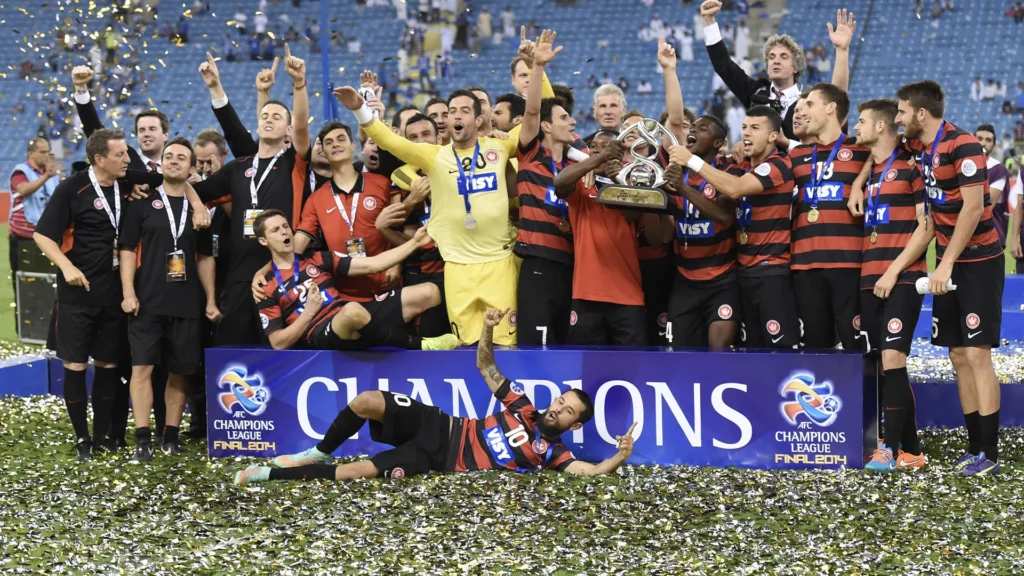
In 2014, only two years after their existence, the Western Sydney Wanderers won the most prestigious club competition available to Australian teams: AFC Champions League.

They achieved this victory in front of 11 of their own fans, due to the travel difficulties and restrictions, and 60,000 enraged Saudi Arabians, overcoming challenges such as bus crashes, hotel raids, public taunts, and laser pointers aimed at their eyes. Despite these obstacles, the Wanderers persevered, becoming the first Australian club to win the continent’s most prestigious trophy.

However, this narrative appears to have faded into the pages of history, scarcely acknowledged in broader discussions concerning pivotal moments or memories that have moulded Australian sports, the question is why?

This is what journalist Marc Fennell sought to explore this question in his latest documentary, “Came From Nowhere.” The film delves into the inception and initial triumphs of one of Australia’s most intriguing, yet currently contentious, football clubs.

“What became very apparent very quickly, and what interested me, were two things,” Fennell told ABC Sport.

“One was this truly incredible, Hollywood-esque, fairytale arc of a team that literally went from no name, no players, nowhere to play, nowhere to train, no coach to winning the highest championship you can as an Australian club.

“Then there was the other side, which was that the active support group had gotten lots of coverage. The RBB (Red and Black Bloc), there were reams and reams of news and footage of them. And I felt like those two things were linked somehow, and they were both stories worth telling, but we were trying to work out: how did they intersect?”

For years, the region had fostered a vibrant football community, nurturing numerous Socceroos who honed their skills at clubs such as Marconi, Blacktown, Parramatta, and Sydney United in the former National Soccer League.

In 2012, when Clive Palmer’s Gold Coast United ceased operations, the opportunity arose for the Wanderers. With the FFA requiring ten teams for upcoming television rights negotiations, but facing difficulty in finding a financial sponsor to establish the team in time for the 2012-13 season, they took matters into their own hands. The FFA secured a $4 million government grant to establish a professional football club in Sydney’s west, essentially from the ground up.

Following numerous community forums and fan surveys held across the region, various topics including club colours, playing style, home grounds, club values, and proposed names were thoroughly discussed and debated. On June 25, it was revealed that the club would officially be named the Western Sydney Wanderers, paying tribute to Australia’s first-ever registered football club, Wanderers FC, established in 1880. The club’s colours were designated as red and black.

During their inaugural pre-season match in St Marys, 4,500 attendees witnessed a small gathering on a grassy hill where a few songs, penned over the previous four months, were practised. This laid the foundation for the Red and Black Bloc, an active supporter’s group integral to the club’s narrative alongside the players.

Despite their first match in the A-League at the old Parramatta Stadium ending in a scoreless game, for the supporters standing behind a banner proclaiming “Football comes home,” the result on the scoreboard was inconsequential. What truly mattered was that they now had a club they could proudly call their own.

“This is a love story between a town and its team, between football and its fans. And every love story has ebbs and flows: it has moments of high euphoria, and then it has bickering and tempestuous fighting,” Fennell said to ABC Sport.

The film then tracks the team’s debut season in 2012-13, starting slow with no goals or wins in the initial month but swiftly gaining momentum. They achieved a league-record of 10 consecutive victories, challenging prominent clubs like their now-local rivals, Sydney FC, as they climbed the ladder.

With each victory, the fan base of the Wanderers expanded. In a remarkable show of support, 10,000 Wanderers faithful journeyed to Newcastle for their last regular season match. Mark Bridge’s two goals contributed to a 3-0 triumph, clinching their inaugural Premier’s Plate in an extraordinary debut season.

The film then delves into its second focal point: the club’s fanbase and the escalating tensions arising between its active supporters and the authorities.

Certain factions of the RBB posed challenges for the local police, exhibiting behaviours such as violence, property damage, intimidation, and the use of flares. This led to an increase in police presence at home games.

The RBB’s customary pre-match procession in Parramatta, along with the use of flares, megaphones, banners, and even profanity, was prohibited. While some viewed these measures as necessary for community safety, others saw it as “eroding the essence of what makes football unique.” Fans felt let down by league officials, perceiving a lack of support.

Tension may have arisen from the Wanderers’ blurring of boundaries between what writer Joe Gorman once termed the “de-ethnised” A-League, the ethnic and multicultural roots of Sydney’s west, was where the Wanderers emerged.

This might also explain why the manner in which its fanbase interacts with the sport through tifos, flares, chanting and marches has faced widespread criticism from the mainstream Australian media, which may not fully understand or feel at ease with the cultures and traditions of a working-class migrant sport that differs from their own.

In the last segment of the film, the focus shifts to the team’s extraordinary journey through the Asian Champions League. Once more, they embrace their underdog status and mindset to triumph over some of the most formidable and accomplished clubs in the region.

Members of the championship-winning team reminisce about the different tactics employed by rival fans to disrupt their visits, including infiltrating their hotels to disturb players, using lasers during games, and even orchestrating a bus accident on a congested freeway on the way to a stadium.

The match that ensued became legendary in football history, now recounted by bleary-eyed Wanderers fans who congregated in a public square in Parramatta at 3am witnessing their club, which had humble origins, rise to become one of the greatest football clubs ever produced in Australia.

The greeting for the team was at least 2000 passionate, chanting fans of the Western Sydney Wanderers flooded Sydney International Airport on a Monday night at 11:20pm, transforming the arrivals area into a vibrant and noisy celebration welcoming home the newly crowned Kings of Asia at the time.

This type of football fan culture is present all around the world which is just another normal day for them, but for WSW fans to take over the Sydney airport is remarkable when you really think about and is what gives hope that football is a sleeping giant in Australia, much to the dismay of mainstream media in the country.

The other Australian sporting codes to see scenes such as those can only dream to have it for their games at the stadiums, let alone greeting their teams at the airport.

“Any future of this sport has to really consider not just things like player development and long-term strategies and diversifying and being clubs for whole communities, but also how fans are folded into that process,” Fennell said to ABC Sport.

“Because fans are engaged with a club, it’s an experience unlike anything else. To be there in the midst of some of those games felt bigger than a Taylor Swift concert, but when they go, the whole thing just deflates.

“Whatever comes next, they have to consider how active support and everyday fans are part of the process of the club, the energy of the club, because that’s the value of it. There is absolutely a link between success and fans, and if you’re not doing well, it’s clear how that diminishes.”

Despite the club’s decline in the past decade following that remarkable achievement, “Came From Nowhere” underscores the fundamental essence of success in football. It urges current decision-makers to refocus on these core principles as they endeavour to rejuvenate a competition that many feel has passed its prime.

Previous ArticleNext Article

Beyond the Pitch: Miyuki Kobayashi on the Real Challenges Facing Japan’s Women’s Game

Last week, Soccerscene spoke to pioneer of women’s football in Japan, Miyuki Kobayashi, about the game’s development in Japan and the intersection between sporting and social change in the country.


Talent, quality and recent silverware

After Japan’s recent AFC Women’s Asian Cup victory in the final against Australia, the women’s national team solidified its standing as the No.1 team in Asia.

Throughout the last 15 years, Japan’s women’s national team has grown into a formidable opponent, boasting a World Cup trophy, an Olympic silver medal, as well as three AFC Women’s Asian Cups.

The talent is undeniable. The quality is unwavering. And the team shows no signs of slowing down.

But these victories and trophies on the world stage wouldn’t be possible without the leaders behind the scenes – none more so than Miyuki Kobayashi, former WE League Board Member and current JEF United Ladies Scout and Academy Chief.


Laying the foundations

Kobayashi has led the charge for women’s football in Japan, promoting not only a sport which values success, but one which empowers female footballers across the nation.

“At university, not many girls were playing and we didn’t have an official team. I went to the US and the environment was so different,” Kobayashi explained.

“That opened my eyes – women can play. That’s how I started the women’s soccer league when I came back: to make an environment for girls to play.”

Thus, accessibility and opportunity became driving factors behind Kobayashi’s work, not only for those on the pitch, but for those in the dugout.

“I got involved at the JFA (Japanese Football Association) to promote women’s football. We wanted to create the opportunity for women to be coaches.”

“They are coached by men all the time, so even when the top players leave the football world, they never think to be involved.”

Furthermore, as a former coach of JEF United Ladies Youth and General Manager, Kobayashi was intent on employing as many female coaches as possible. It was not merely a personel change, but a challenge to widespread social attitudes.

“When I started to employ female coaches, the girls’ parents asked why the coach wasn’t a man. But gradually, we started to make it equal – they didn’t talk about the gender, but about the quality of the coach.”


The mission to empower

In 2011, the same year Japan’s women won the World Cup, the domestic league was yet to become professional. Known as the Nadeshiko League, players would work during the day and train in the evenings.

The transition from an amateur to the current professional league required time, resilience and a change in perspective.

“The sports world in Japan is more traditional – it is dominated by men,” said Kobayashi.

“If you want to make the environment even, or (want) more women to come into the (football) world, you can change the mind of the players.”

Since 2021, the WE League has embodied a sense of growth and positive change for the women’s game. In name and nature, it looks to empower players, coaches and all involved in the industry.

“I was in charge of mission achievement for women’s empowerment. We wanted to educate the players, to inspire girls and women who watch the game.”

However, the drive to empower women in football was not without backlash and challenges.

“Some people don’t like that word: ’empowerment’. It’s too strong for them. Some women really appreciate it, but it’s not easy to change the mind of society through football,” Kobayashi admitted.


Growing and attracting talent

Although WE League clubs are accelerating youth development and expanding pathways across U15, U18 and first team football, Kobayashi acknowledged that the overall product must improve to bring foreign players to Japan and entice homegrown talent to stay.

“Most of the national team players go to Europe or North America. I don’t say it’s a problem, but from a young age, girls who can play in the WE League want to go abroad,” Kobayashi outlined.

Indeed, when looking at the starting XI in last month’s AFC Women’s Asian Cup final, only one player – Hana Takahashi – plays in the WE League.

But the key to attracting domestic and international players to the WE League, is aligning financial investment and industry attitudes.

“The reason why women’s football has developed in European countries is the social thinking – you have to be equal and have the same opportunities as men in football. The Japanese way of thinking, especially in the football world, is not that at all,” Kobayashi continued.

“When I speak to people at Spanish clubs, women’s football is not a charity, but an investment.”

“We have assets. We have good, young players, but we’re exporting them, so we need to import too.”

Indeed, Spain is a perfect example of what can happen when investment becomes intentional, not optional. Back-to-back UEFA Women’s Nations League titles, 90% television viewership increase since 2016, and record-breaking crowd numbers reflect what can happen when the industry aligns in vision and commitment.

Japan has the players to compete against any nation in the world. Purposeful investment, combined with its overall quality of players and style, could transform the WE League into a true, global powerhouse.


The vision for the future

Moving forward, Kobayashi hopes that girls progressing through JEF United’s academies develop confidence and resilience, whether as players or people.

“We want to make the girls – even if they aren’t in JEF United – continue playing football and continue to be leaders,” Kobayashi said.

“Some of them have a dream to be a coach or a leader off the field too, so that’s one of the attributes we want to develop.”

This resilience, reflected by the club’s ‘never give up’ philosophy, is testament to the vision of empowerment championed by Kobayashi across the women’s game.

Even in the face of social obstacles and a lack of financial investment, perseverance and hard work is at the bedrock of women’s football in Japan. It is not just that these values exist, but that they are consistently manifested on and off the pitch, which can show future generations that football is a sport for all – men and women alike.


Final thoughts

There is no limit to what the WE League and the national team can achieve if given the resources it deserves. All the ingredients are there: individual quality, a distinct playing style, football philosophy and ambitions to grow.

By following the example of industry leaders like Kobayashi, women’s football in Japan can hopefully continue to make waves of impact – in the sporting landscape and society as a whole.

The Participation Boom Councils Didn’t Plan For Is Hitting Football Hard

Football in Australia isn’t being held back by passion, participation, or community support. It’s being held back by local government failure. From a CEO perspective, the warning signs are no longer subtle — they’re screaming. Confidence towards councils is collapsing, clubs are done believing the rhetoric, and the people carrying the game every weekend are telling us the same thing: councils don’t understand football, don’t consult properly, and don’t plan for growth. This isn’t opinion anymore. It’s measurable. And it should embarrass every policymaker in the country.

Football in Australia isn’t struggling because of a lack of passion. It isn’t struggling because communities don’t care. And it certainly isn’t struggling because participation is declining.

Football is struggling because, at the local government level, confidence is collapsing. What is more, the people closest to the game can feel it.

Soccerscene’s latest survey on council readiness and football planning shows something deeply confronting: trust in councils is at its lowest point, and clubs no longer believe the rhetoric. Councils frequently speak about “supporting the world game” and “investing in community sport,” but the data tells a different story.

The people building the game every weekend, people such as presidents, coaches, volunteers and administrators, are telling us councils do not understand football demand, do not consult effectively, and do not plan for long-term growth. And that’s not an emotional opinion. It’s now measurable.

In our survey, over 61% of respondents said their council has limited or no understanding of football participation demand. Consultation outcomes were even worse: 74% said council consultation is inconsistent or ineffective. And when asked if facilities are being planned with long-term growth in mind, the answer should stop every policymaker in their tracks: more than 71% said planning is short-term or non-existent.

Results graphic from Soccerscene’s January industry survey:

This is not a small problem. This is a national warning sign.

Football is not a niche sport. It’s the world’s sport

Councils across Australia are making decisions as if football is still an emerging code, competing for scraps. That thinking is decades out of date.

Football is not only Australia’s largest participation sport in many communities – it is also part of the global economy of sport, the largest sport market on earth, and a cultural engine that connects Australia to Asia, Europe, Africa and the Americas.

When councils underinvest in football infrastructure, they’re not just failing local clubs. They’re failing an entire economic pipeline: participation growth, player development, coaching pathways, community engagement, multicultural integration, women’s sport, health outcomes, events, tourism, and commercial opportunity.

And yet, football is still treated as the code that should “make do”.

The Glenferrie Oval case: a perfect example of the imbalance.

Take the redevelopment of Glenferrie Oval and the historic Michael Tuck Stand in Hawthorn.

This is a major project with a total estimated investment of approximately $30 million, with the City of Boroondara allocating $29.47 million over four years to transform the site into a premier hub for women’s and junior AFL.

Let’s be clear: there is nothing wrong with investing in women’s sport. In fact, it’s essential.

But this investment is also a symbol of something football people have been saying quietly for years: councils understand AFL. Councils prioritise AFL. Councils know how to justify AFL.

They don’t do the same for football, despite its participation scale, multicultural reach, and global relevance.

Across the country, football clubs are being told there is “no funding,” that “planning takes time,” or that facilities “can’t be upgraded yet.” Meanwhile, we see multi-million-dollar grandstands, boutique ovals, and legacy infrastructure funded and delivered for other codes.

Football isn’t asking for special treatment.

Football is asking for fair treatment based on reality.

Councils are stuck in a domestic mindset – while football is global.

Here is the core issue: local councils are making decisions through a domestic sporting lens, while football operates in a global one.

Football isn’t just a Saturday sport. It’s a worldwide industry with elite pathways, commercial frameworks, international investment, and an ecosystem that Australia must compete within.

If councils don’t understand this, they will keep making decisions that shrink our competitiveness.

And this is where the stakes become real.

Australia is not only competing against itself. We are competing against countries like Japan and South Korea, who treat football as a national asset. They don’t leave football infrastructure to fragmented local decision-making without a clear national framework. They invest strategically, align education with delivery, and build systems that create long-term advantage.

We cannot keep pretending we are in the same conversation globally while our local facilities remain stuck in the past.

Clubs are carrying the burden – and it’s breaking the system.

The survey results point to a harsh reality: football clubs feel like they are carrying the weight of growth alone.

When asked what the biggest council-related challenge is, nearly 49% said funding is not prioritised, while others pointed to poor facility design, limited engagement, and slow planning processes.

This isn’t just an inconvenience.

It is creating volunteer burnout, club debt, stagnation in women’s participation, and barriers to junior growth. It is forcing clubs into survival mode – patching up grounds, sharing overcrowded facilities, and trying to grow in spaces that were never designed for modern football demand.

And when planning is short-term, the problem compounds. Councils aren’t just falling behind- they’re building the wrong solutions.

So what do we do? We stop reacting and start leading.

Football cannot keep waiting for councils to “get it” organically. That approach has failed.

What we need now is a national strategic response that is structured, intelligent, and relentless.

This is where football must learn from high-performing football nations  not just on the pitch, but in governance, philosophy, and decision-making.

A powerful example is Korea’s “Made in Korea” project, which was built to identify structural gaps, align stakeholders, and create a unified development philosophy. It wasn’t just a technical framework, it was a national alignment strategy.

Australia needs the off-field equivalent.

A National Football Facilities & Readiness Taskforce.

I believe the time has come to establish a National Football Facilities & Readiness Taskforce, made up of the most capable minds across the game and beyond it.

Not another committee. Not another meeting group.

A taskforce.

It should include leaders from football, infrastructure, urban planning, commercial strategy, government relations, and corporate Australia. We should be selecting the most intelligent and effective people in the country, not based on titles, but based on outcomes.

This taskforce should have one clear mission:

Educate, influence, and reshape how councils plan, consult, and invest in football infrastructure.

Alongside a taskforce, we need long-term strategic working groups embedded across the states, designed to:

educate councils on football participation demand and growth forecasting

standardise best-practice facility design and future-proofing

create consistent consultation frameworks

align football investment with economic, health and multicultural outcomes

build a national narrative that football is an asset rather than a cost

Because right now, the survey shows councils aren’t prioritising football for economic reasons. In fact, only 2.56% of respondents said councils should prioritise football due to economic benefits. This is not because it isn’t true, but because councils haven’t been educated to see football that way.

That is a failure of strategy, not a failure of the game.

This is bigger than facilities – it’s about Australia’s place in the world game.

If we want to be taken seriously as a football nation, we must build a country that treats football seriously.

Not just at elite level.

At local level – where the entire pyramid begins.

The message from the survey is blunt: football’s confidence in councils is collapsing. But within that truth is also an opportunity.

Because when trust hits its lowest point, change becomes possible.

The next step is ours.

We either continue accepting a system that doesn’t understand the world game – or we build one that does.

Most Popular Topics

Editor Picks

Send this to a friend