


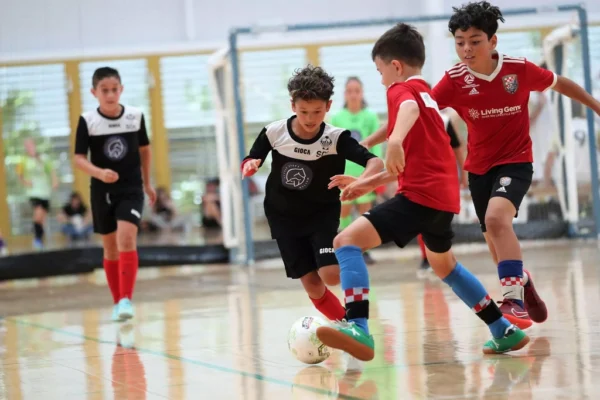

Canterbury Junior Football Club the first recipients of grassroots grants

Canterbury Junior Football Club are the first recipients of grants to be launched at Dolcissimo Restaurant in the Sydney suburb of Haberfield.

Canterbury Junior Football Club are the first recipients of the new Superstar Sports grassroots football cash grants, to be launched on Friday (March 5) at Dolcissimo Restaurant in the Sydney suburb of Haberfield.

The grants are valued at $300 and will be awarded to a grassroots club every three months by a former player who made it to elite levels including NSL, A-League, W-League, Socceroos and Matildas.

Canterbury Junior’s President James Hondros will accept the first grant at the quarterly “Football Fraternity Lunch” held at Dolcissimo Restaurant on March 5. Hondros will be presented with a cheque by former club junior and Socceroo Peter Katholos.

The grants are part of the widely acclaimed Grassroots Football Project, in conjunction with sponsors Superstar Sports and Zenith Football Pathways.

“Our club is honoured to be the first recipients of these generous grants,” Hondros said.

“To have our cheque presented by Peter Katholos makes it more special.  He is one of three Socceroos we are very proud of, the other two being Ernie Campbell and Dennis Yaeger – thanks to all concerned.”

Canterbury Junior Soccer Football Club was formed in 1923 due to an initiative by Andy Burton who met with a group of enthusiasts and sat on a rock pile situated on a vacant block where Canterbury Hotel now stands. Jack Daley was elected President, Andy Burton Secretary and Tom English Treasurer.

Later in the year, Hurlstone Park was created and was followed up by the formation of the Canterbury and District Soccer Football Association (CDSFA). The now Canterbury Juniors were regarded as Canterbury Park with a playing strip of blue and gold vertical stripes and the namesake for the home ground.

Local district competitions were commenced as All Age and U/16 years which saw Canterbury Park win both these competitions run by the CDSFA.

“What a great way to start this scheme – Canterbury are a club rich with history, also having produced three Socceroos,” Grassroots Football Project creator Greg Werner said.

“I’d like to thank our sponsors for their support, and we look forward to our second award announcement in June.”

The awards will begin in Sydney with plans to nationally roll-out in the coming months.

“We are proud to be behind these grants. Superstar Sports was established to help cut costs of equipment for my club APIA Leichhardt, but the enquiries from other clubs have been a welcome surprise,” Superstar Sports’ Tony Raciti said.

“It’s time for some serious players in the sportswear market who are focused on helping junior sport, and not milking it. Congratulations Canterbury.”

Previous ArticleNext Article

Football South Australia renews partnership with Datacord as Community Football Commitment Deepens

Football South Australia has announced the renewal of its partnership with Datacord, continuing a relationship that has grown steadily since the South Australian print and document solutions provider first entered the football community as naming rights sponsor of the Collegiate Soccer League Division 1.

That initial agreement, which saw Datacord align with one of Adelaide’s most historic amateur competitions, marked the beginning of what has since developed into a broader commitment to South Australian football at every level. The renewed partnership extends Datacord’s involvement beyond the CSL and into the wider Football SA ecosystem, with clubs across the state now able to access exclusive offers and preferred pricing on photocopying, managed print services and tailored business solutions.

The practical value of that access should not be understated. Community football clubs operate on tight margins, relying heavily on volunteer administrators managing everything from registration paperwork to grant applications. Cost-effective print and document solutions reduce the operational burden on those volunteers, a small but meaningful contribution to the sustainability of clubs that form the backbone of the game in South Australia.

“George is a great supporter of sport in South Australia and we are delighted to have Datacord as a supporter of football,” said Football SA CEO Michael Carter. “Service is second to none and we highly recommend their services to the business community within the Football Family.”

For Datacord Managing Director George Koutsoubis, the renewal reflects a genuine investment in the community rather than a transactional commercial arrangement. “It is important to support the local community, and Football South Australia is the perfect place to start spreading the word about Datacord and what we do for the South Australian community,” he said. “We are locally owned and operated, and I think it is a great partnership to be part of.”

Football NSW releases $600,000 towards Grassroots Grants to meet Participation Pressure

The Victorian State Government has announced new grants and funding for 11 new community infrastructure projects for local football clubs, totalling $3.8 million.

Sixty-five football clubs across New South Wales have secured a combined total of nearly $600,000 in funding through the NSW Office of Sport’s Local Sports Grant Program. It follows as a result of Football NSW’s scale of demand for community sport support and the growing pressure on clubs struggling to keep pace with surging participation.

The grants, covering 69 individual projects across the Football NSW footprint, will fund facility upgrades, equipment purchases, participation programs and accessibility improvements: the unglamorous but essential infrastructure that determines whether community clubs can function at the level their members require.

The Local Sports Grant Program made up to $4.65 million available statewide in 2025, with $50,000 allocated to each electoral district and individual grants capped at $20,000. Football’s share of nearly $600,000 reflects the sport’s status as the largest participation code in NSW, and the degree to which that status has not always been matched by corresponding investment in the facilities and resources required to sustain it.

Volunteers carrying an unsustainable load

The announcement arrives against a backdrop of mounting pressure on the volunteer workforce that keeps community football operational. Across NSW, thousands of volunteers dedicate significant unpaid time each week to administration, ground preparation, canteen operation and the logistical demands of running competitive junior and senior programs. As participation numbers climb, driven in part by the sustained visibility of the AFC Women’s Asian Cup and the legacy of the 2023 FIFA Women’s World Cup, those demands have intensified without a corresponding increase in the resources available to meet them.

“As the largest participation sport in NSW it is pleasing to see almost $600,000 will be reinvested back into supporting our players, coaches, referees and volunteers to improve the football experience across our community clubs,” said Helen Armson, Football NSW’s Group Head of Strategic Partnerships and Corporate Affairs.

The equity dimension

The distribution of the grants across 65 clubs and 69 projects also speaks to the geographic breadth of football’s footprint in NSW, and to the uneven distribution of resources that has historically characterised community sport in this country. Clubs in outer metropolitan and regional areas tend to operate with smaller budgets, older facilities and thinner volunteer bases than their inner-city counterparts. Grant programs structured around electoral allocation, rather than club size or existing resource base, provide a degree of equity that market-driven funding cannot.

The kinds of projects funded under this program disproportionately benefit clubs serving communities where the barriers to participation are highest. A club that cannot offer adequate facilities or equipment is a club that turns players away, often without intending to.

Football NSW has used the announcement to call on the NSW Government to maintain and extend its investment in the sport. “We urge the government to continue to invest in football,” Armson said, in the midst for a nation-wide push for a $343 million decade-long infrastructure fund to address the facilities gap across the state.

The nearly $600,000 secured through this round is meaningful. Against the scale of what is needed, it is also a measure of how far the investment still has to go.

Most Popular Topics

Editor Picks

Send this to a friend