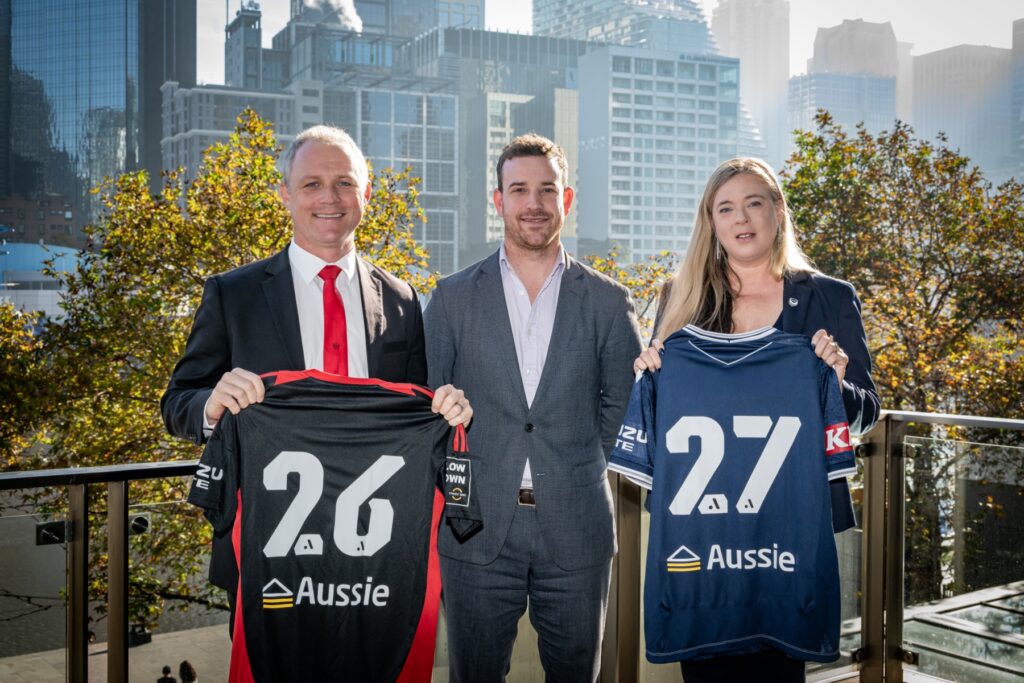


Caroline Carnegie has been leading Melbourne Victory FC through their rebuild before the start of the new A-League season as Managing Director of the club. In an exclusive interview with Soccerscene, she discusses the challenges faced so far, making a better A-League, and how clubs can re-engage lapsed fans.
What has been the biggest challenge of being Managing Director of Melbourne Victory so far?
Caroline Carnegie: There are a lot of challenges at the moment. There are the broader COVID-related challenges which everybody is experiencing, and then there’s the club-specific ones. Without sugar-coating it, we obviously had our poorest season on record last year. So coming in there were a lot of challenges that we needed to deal with and a lot of them centred around member sentiment and fan engagement. There was also making sure that across all our stakeholders we were communicating our direction and what was happening at the Club. I think our fans and members are pretty realistic. Although we certainly want to win silverware every year, we know it won’t be the case every season, which means we need to be really clear with everyone about what we want to achieve and the direction of the Club, which we have lacked a little bit certainly over the past couple of years.
Since stepping into the role, I have tried to make sure that we challenge the way we’ve been thinking about our business and how we go about delivering on and off the pitch. This means everything from the smallest to the biggest detail has been or is being stress tested, and we are all really testing ourselves as to whether we’ve been doing things in the best way or we can be a little bit more progressive, and to make sure that we put our members and partners first in everything we do moving forward. One of the things I was keen to do early was to put a true Director of Football in place, which I did first up with John Didulica. It is a role that the Club has needed for a while, and appointing JD has meant we now have a consistent whole of football approach from top to bottom with men and women.
While we can’t implement it all in 30 seconds, our planning is around making sure that all of our programs are truly elite and we progress our academy programs to be able to provide a true pathway into Melbourne Victory senior men’s and women’s over time, and also to make sure that we treat our men’s and women’s elite teams with equality. We know if you support Melbourne Victory you support our teams. Our men or women and our business is trying to make sure we promote that in all aspects of what we do.
Another example of trying to listen and deliver what our people want was the decision to return all of our home games to AAMI Park – which was so well received by our members and fans. They had been calling out for that move for a really long time and I am glad the Club could deliver it and we cannot wait to make AAMI our fortress this season – and beyond of course. The move to do that was also important so we could show all our stakeholders that we are listening, and everybody is working very hard at the Club to position Melbourne Victory at the top of everything we do.
We are also excited that we will have a member’s forum a little closer to the start of the season – hopefully in person – to provide our people with a chance to have their thoughts and feelings about the Club heard and to share them with our team.
How much input did the A-League clubs have with the re-branding of the A-League and the W-League under one banner?
Caroline Carnegie: They had a lot to do with it. APL is now owned by the Clubs since unbundling occurred earlier this year, and the Board of APL includes Club Chairmen. The Board and the Clubs were involved in the decisions and it was great that we could be the first league to come out and show true equality in naming our men’s and women’s leagues consistently.
How important is it to have a dividing identity and geography between the three Melbourne teams?
Caroline Carnegie: It’s really important. It is important for all teams – not just the Melbourne clubs – to have a clear identity and target demographic, and geographically separating just helps us to be individually stronger. It creates an environment where we can also promote the game on a broader scale and build a little ‘cross town’ rivalry at the same time.
What initiatives are Victory and the A-League taking to re-engage lapsed fans?
Caroline Carnegie: From a league level you’ll see a lot of changes to start with. We’ve just come through the unbundling process from FA which means at APL there is definitely a big focus on making sure that everything is reviewed, and a new and fresh approach is undertaken. It is really exciting to see what the team there is doing, and great that our Club can be a small part of that.
At Victory, as I said before, we are spending a lot of time trying to make sure we communicate better and in a more transparent and targeted manner with our people. We want our family to know who does what at Victory, what our plans are and the direction we are heading. You should have started to see that so far in the off-season with the level and quality of engagement, even through our social channels.
We have made sure our player announcements are different and we are creating really exciting, dynamic content that speaks to our fans, and our membership campaign was another great example of that.
We have adopted a member-centric approach, and hopefully our fans can see that and want to jump on board and join the movement. After a couple of difficult years for everyone, we certainly continue to need their support and we are looking forward to seeing them at AAMI Park in Round 2.