Soccerscene the only online publication dedicated to the Australian and international football industry. It serves as a practical guide for those involved in the business of running a football club and bringing readers up-to-date research and development across all football matters providing insights, discussion and information related to topics that matter.
City Football Group showcase mixed Annual Report despite success
City Football Group (CFG) have recently recorded losses of £112 million ($215 million AUD) for the 2022/23 financial year despite generating a record-breaking revenue of £877.1 million ($1.68 billion AUD)
It has been confirmed that the multi-club ownership – in which of most notably of Australia’s own Melbourne City, Japanese outfit Yokohama F. Marinos, MLS staple New York City, and LALIGA’s Girona FC have risen considerably.
In comparison to the year prior and recording up until June 30, 2023, have the group’s revenue climbed by £172 Million ($331.25 million AUD) matchday revenue figures of £100.8 million ($194.8 million AUD) with commercial activities generating mass figures of £417.4 million ($803.85 million AUD). Broadcast income totals were tallied at £453.8 million ($873.95 million AUD), while City’s profit hit £80.3 million ($154.65 million AUD) a rise from the year prior in which was recorded at £41.7 million ($80.31 million AUD) – during their maiden treble-winning season.
So, the question begs. How are CFG bleeding losses? It must be acknowledged that CFG have introduced clubs within multiple countries across the globe throughout the last few years that have slowly shifted the group of its financial focus. Italian outfit Palermo, Brazilian side Esporte Clube Bahia, and Indian Super League Mumbai City combined cost CFG a grand total of £77 million ($148.29 million AUD) The group has established quite the immense portfolio, with now 12 clubs underneath the city umbrella. The powerhouse which is the mantle piece of the group continues to account for the majority of the revenue accumulated by the contingent.
Their Manchester club both on and off the pitch have continued to make ground-breaking, trailblazing manoeuvres. Their recent target of generating revenue of £712.8 million ($1.3 billion) set a new premier league record. In comparison to other clubs within the umbrella, New York City FC and Girona FC reported an annual turnover of almost £50 million ($96.29 AUD), less than 15% of Manchester City’s total revenue generated.
If you’ve ever sat through a club’s end-of-season review, you’ll know the drill. A coach pulls out a folder of notes, someone half-remembers what a player was like back in Round 3 and a parent quietly wonders what they actually got for their rego fees beyond a team photo. Football club platform Majestri says it has a fix for that, and it’s built directly into its Player Assessment module.
Why clubs bother assessing players in the first place
According to Majestri, clubs run player assessments for one of three reasons – usually more than one at once. Some are chasing genuine development, using the data to lift the level across their high-performance squads. Others are after a fairer way to pick teams, putting every player on the same measurable scale so selection is based on evidence rather than a coach’s gut feel about who “looks the part.” And for clubs operating under a Football Australia or state federation licence, assessments at set intervals often aren’t optional – they’re a compliance requirement, with the paperwork to prove it when asked.
Whatever the motivation, Majestri’s pitch is the same: don’t let that assessment data die in a spreadsheet on someone’s laptop.
Build your own assessment, your way
There’s no one-size-fits-all template here. The Assessment Designer lets technical directors set their own criteria, sort them into whatever categories their coaching staff already use – think core skills, possession, defending, attacking – and decide what each point on the rating scale actually means. Crucially, every criterion also gets a comment field, because a bare number rarely tells the full story of a player’s development.
The Assessment Module Builder, showing an NPL Juniors assessment with a 1-10 rating scale banded from under performing through to excelling and role-specific criteria grouped into core skills, possession, defending and attacking. Source: Majestri.
Build it once and it’s reusable every time that assessment cycle comes around, so every player and every coach – is working off the same yardstick.
Something for the parents to actually take home
One of the more relatable pain points Majestri is targeting: most families never see much tangible return from a season of fees beyond a team photo. Player Assessment addresses that with report cards – colour-coded against the same scale coaches used, grouped by category with averages calculated automatically, and delivered as a PDF or an interactive web page a parent can read without needing a coaching badge themselves.
A report card for an under-15 player, colour-coded from under performing to excelling, with a score for every criterion and a group average across core skills, possession, defending and attacking. Source: Majestri.
Turning the numbers into something useful
The real value, though, sits in what Majestri calls the Player Analysis Lab. This is where clubs can plot a player against their team-mates or an entire age group across two categories at once, spotting clusters and outliers at a glance. Every score gets read against the group average – so a “7” actually means something in context – and clubs can report at the broad category level or drill into individual fields underneath. The results can be filtered down and exported for selection meetings or grading purposes.
The Player Analysis Lab comparing seven players across under-15 and under-16 squads, with a scatter plot, a sortable table of scores against the player average, and controls for choosing which categories and fields to report on. Source: Majestri.
The admin side nobody enjoys, made easier
Beyond the flashy analytics, there’s a practical layer built for the volunteers actually running the process:
Sweep monitoring – a quick view of which assessments are done and which are still outstanding, organised into defined assessment periods so progress can be tracked against peers.
Individual development plans – every player gets a personalised plan, and clubs can group common improvement areas to run cross-team training sessions that lift the whole club rather than just one squad.
Access control – coaches and technical staff can only see assessments for the teams they’re responsible for, and completed assessments are only visible to people linked to that player’s registration.
“Hard numbers to draw on when you review coaching staff and curriculum – and something tangible for the players and parents who pay the fees.” – Majestri
The bigger picture
Majestri frames all of this as sitting on top of the club’s own data – assessment results live on each player’s profile inside the platform rather than in a spreadsheet that walks out the door when a technical director moves on. For committees, it also means hard numbers to lean on when reviewing coaching staff or curriculum, rather than relying on anecdote.
It’s a fairly clear read on where club administration software is heading: less about digitising paperwork for its own sake, and more about making the data clubs already collect actually work for player development, team selection and compliance without adding to the workload of the volunteers who run the show.
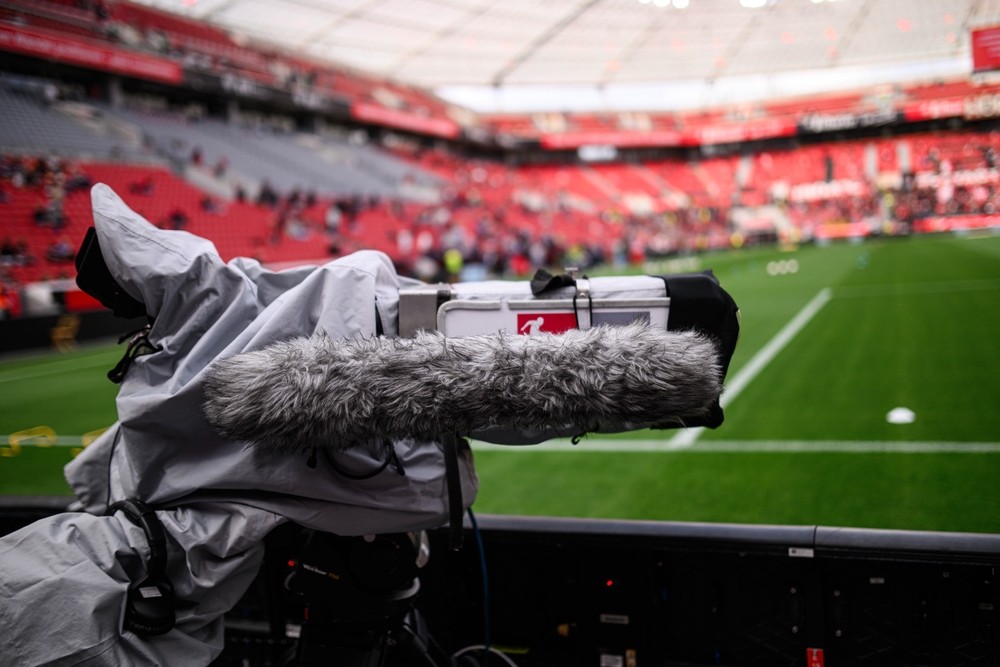
AI-powered camera technology has moved another step closer to mainstream sports broadcasting. This comes after it was deployed for the international tactical feed of the Franz Beckenbauer Supercup between Borussia Dortmund and Bayern Munich.
The system, supplied by Broadcast Solutions, combined Studio Automated’s AI camera automation platform with an Egripment HotHead 3 remote head during the fixture at Signal Iduna Park on 22 August. The Bundesliga and host broadcaster Sportcast have regularly used the season-opening match as a testing ground for new technologies.
Rather than simply tracking the ball or individual players, Studio Automated’s technology analyses the wider match scene and uses broadcast production principles to determine framing and camera movements.
The system was used to operate a camera positioned on the stadium’s main camera gantry. As a result, the footage was available as part of the international tactical production.
The deployment is significant because it demonstrates how AI camera operation can move from trade-show demonstrations into live professional broadcast environments. The companies first showcased the integrated technology at SportsInnovation earlier this year.
The system operates on standard on-premises hardware and does not require cloud connectivity or a calibration process. Its low-latency operation also allows the remote head to respond in a way designed to replicate the movement of a conventional manually operated camera.
Importantly, the technology does not replace the wider production team. The automated camera operates as another source within a multi-camera environment. In this setup, the production team retains control over which images make it to air. This positions AI as a tool for expanding production capabilities rather than removing the role of existing broadcast teams.
For broadcasters and production companies, the potential extends beyond major Bundesliga fixtures. Automated camera positions could help reduce the operational requirements associated with remote and lower-cost productions. At the same time, they can maintain a higher standard of coverage.
Broadcast Solutions will continue showcasing the technology with Studio Automated and Egripment at IBC 2026 in Amsterdam. At this event, the companies will demonstrate integrated workflows for sports production.