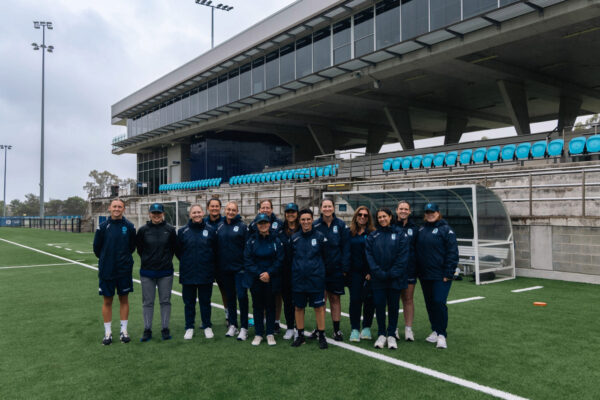
FFA forced to cut 70% of staff

Due to the ongoing COVID-19 situation, Football Federation Australia has had its hand forced, standing down around 70% of their workforce.

Many Australians have lost their jobs as a result of the coronavirus. Now, the FFA has been forced to cut costs in an attempt to stay afloat during this crisis.

FFA CEO James Johnson described the decision as unfortunate, with not much choice but to make this tough decision.

“These developments impact many forms of revenue for FFA, including national registration fees, broadcast fees, sponsorship, ticket sales and government funding, so we have needed to adjust our operations to ensure that we can remain operational, forcing us to take the unfortunate decision to stand down approximately 70 per cent of our workforce.

“We have an incredible team here at FFA, and I am immensely proud of the work everyone does for football in this country. We have explored ways to retain as many staff as possible, including reducing essential roles to part-time, and asking staff to take annual leave and long service leave. Unfortunately, a number of staff members will have a period of leave without pay.”

Although the 70% cut seems like a high number, it is possible that there could be more should the situation worsen in the coming days.

At the time of writing, over 4,000 Australians have tested positive for COVID-19 with numbers expected to grow exponentially.

Whilst over 200 people have thankfully recovered, 17 people have lost their lives, with a Tasmanian woman in her 80’s the latest victim.

These staff cuts aren’t decisions that companies would make willingly. Obviously, this situation is unique, confusing and utterly terrifying and we don’t envy the decisions that are made by higher-ups.

On the flip side, it’s extremely saddening to see so much of our Australian soccer workforce be told that they are not required at this time.

Many of them would rely heavily on their employment, as do millions of Australians in other industries. Unfortunately, the FFA is the latest to succumb.

They’ve done the right thing by as many people as possible, as per Johnson’s statement. Many have been asked to take annual or long service leave, until this all blows over.

However, Johnson went on to add that there would still be a contingent of staff that would go without pay, going to show just how serious this situation is.

This news comes as the A-League finally postponed their season to avoid any players contracting the coronavirus.

The A-League was the final national competition in Australia to call off their season until further notice, with players, staff, officials and coaches now left in limbo.

Only eight days ago, the Australian Football League made the same decision after one round of fixtures. The NRL, despite initial intentions to go ahead with their season as per normal, eventually followed suit.

This situation is dire and there was always going to be a large number of people in the sporting industry that would unfortunately, lose their jobs.

Again, these extremely challenging circumstances have led many employers to bite the bullet and let employees go. Johnson and his team wouldn’t have made these cuts on a whim.

That’s not to say that we shouldn’t feel for those in these tough predicaments. All we can say is that during these times, stay home, stay safe and above all else, look after each other.

As a community, we can get out on the other side of the tunnel. It may be bleak now, but together, through common sense and perseverance, we can reach the light.

 

Previous ArticleNext Article

Stop Complaining, Start Building: Why Proactive Clubs Always Win

It’s a tale as old as time in grassroots sport: your club is stuck in a “time warp” facility, sharing a severely overused pitch with another code, while a club a few suburbs over just scored millions of dollars in council funding.

It is incredibly frustrating. The disparity in local government funding, the draconian facility-sharing arrangements, and the feeling that your sport is constantly fighting an uphill battle in certain heartlands can make committee members want to throw their hands in the air.

But when faced with this reality, your club has a choice. You can go on a rampage of advocacy – bitching, moaning, and focusing on everything the council or state sporting body isn’t doing – or, you can focus on what you can control.

The Post-COVID Divide

Think back to the clubs that emerged from the COVID-19 lockdowns. During that time, every club faced the exact same external restriction: nobody could play.

However, two distinct types of clubs emerged.

The first type went dark. They complained about the government, complained about the lack of support from their Peak Bodies, and disconnected from their members. They took years to recover.

The second type of club stayed connected. They acknowledged the reality but focused entirely on what they could do. They posted backyard drills on TikTok, sent training plans to parents, and kept their community engaged. As soon as restrictions lifted, they were on the front foot, miles ahead of the competition. Same environment, entirely different mindset.

The Circle of Control

In business and in sport, there is a circle of concern (things you care about but can’t change) and a much smaller circle of control (your own thoughts, behaviours, and operations).

If you have signed a 10-year lease on a substandard facility, that is your playing field. You aren’t going to change it tomorrow. So, how can you win given the rules you have?

·  Run a tight ship financially.

·  Pay your rent on time.

·  Communicate brilliantly with your members.

·  Streamline your governance.

Government likes to back a winner. If you spend your time spinning up the flywheels of good marketing, membership growth, and volunteer connection, you build a small business that clearly has its act together. When it comes time to advocate for better facilities, you aren’t just a complaining club—you are a highly successful, proactive community asset that councils will want to support.

Is your club stuck in a cycle of complaining? It’s time to take control of what you can. Contact CPR Group today to find out how our clubMENTOR program and strategic planning services can put your club on the front foot.

Northern NSW Football Calls in SAPA as Participation Surge Sparks Big Plans

Northern NSW Football has commissioned Sports Advisory Partners Australia to lead the development of its 2027 to 2029 Strategic Plan, a process that will shape the direction of one of Australia’s most significant regional football markets at a moment when the game nationally is navigating unprecedented growth and structural complexity.

The engagement, announced this week, will see SAPA conduct extensive consultation across NNSWF’s registered participants, member zones, standing committees, board of directors and executive leadership before delivering a final plan scheduled for release in September. The firm brings to the project a track record that spans Football Australia, the A-Leagues, AFL, Rugby Australia, Golf Australia and the Oceania Football Confederation.

NNSWF CEO Peter Haynes said the organisation intended to be deliberate and ambitious about what the next plan would ask of the sport in the region.

“This plan will do more than that,” Haynes said. “It will play a critical role in shaping the future of football in our region. We are going to be bold, ambitious and take this opportunity to really push our sport forward to reach its potential.”


Building on a period of significant growth

NNSWF’s current 2024 to 2026 Strategic Plan has already delivered measurable outcomes across participation, competition strength and community engagement, and has done so against a national backdrop that has made the job of growing football both easier and more demanding simultaneously.

The 2023 FIFA Women’s World Cup and the recent AFC Women’s Asian Cup in Australia have driven participation surges that are being felt at the regional level as acutely as anywhere. Northern NSW, which covers a vast and diverse geographic footprint from the Hunter Valley to the Queensland border, has seen women’s and girls’ football registrations climb sharply, reflecting a trend Haynes flagged publicly during Football Australia’s recent push for a $343 million NSW grassroots infrastructure fund, in which he noted that participation across the region was at record levels and still rising.

That growth creates a specific strategic challenge. Momentum is relatively easy to generate in the wake of a major tournament. Sustaining it across a three-year planning horizon, through the inevitable post-event cooling of public attention, against ongoing pressure on club volunteers and community facilities, and in competition with other codes for government funding and ground access, requires a more deliberately constructed framework than goodwill alone can provide.

The 2027 to 2029 plan will need to answer questions that the current plan did not have to confront at the same scale: how to absorb participation growth without degrading the quality of the experience for existing players, how to build the referee and coaching pipelines that expanding competitions demand, and how to make the case for infrastructure investment in regional communities where football’s political leverage is real but not unlimited.


The Regional Dimension

Regional football in Australia occupies a structurally distinct position within the national game. It sits outside the metropolitan NPL systems that tend to attract most of the administrative attention and commercial investment, and serves communities where football is often the largest club-based sport and where the absence of adequate pathways has historically meant talented players relocating or disengaging entirely.

NNSWF’s decision to invest in a professionally developed strategic plan, rather than producing one internally, signals an awareness that the next phase of growth requires external rigour and benchmarking against what is working elsewhere. SAPA’s familiarity with the organisation, cited by Haynes as a factor in the appointment, also suggests a desire for continuity of thinking rather than a wholesale strategic reset.

SAPA Executive Director Sam Chadwick said the firm was focused on producing something actionable rather than aspirational.

“Our goal is to deliver a clear and actionable strategy that will guide continued growth and long-term success for the game,” Chadwick said. “Northern NSW Football has built a strong platform through its 2024 to 2026 Strategic Plan and we are delighted to support the next phase of its journey.”

Community at its Centre

NNSWF Chairman Mike Parsons emphasised that the process would be driven by community voice rather than imposed from above, a commitment that carries practical as well as symbolic weight in a region where the diversity of football communities, from coastal clubs to inland associations, means that a single strategic framework must accommodate significantly different local realities.

“This will be a strategy for the entire football community and it is vital that we hear from as many voices as possible,” Parsons said. “Through genuine consultation and collaboration we will ensure the next strategic plan reflects the needs and aspirations of our community while positioning our game for continued success.”

Consultation opportunities will roll out across the coming months. The 2027 to 2029 Strategic Plan is scheduled for release in September.

Most Popular Topics

Editor Picks

Send this to a friend