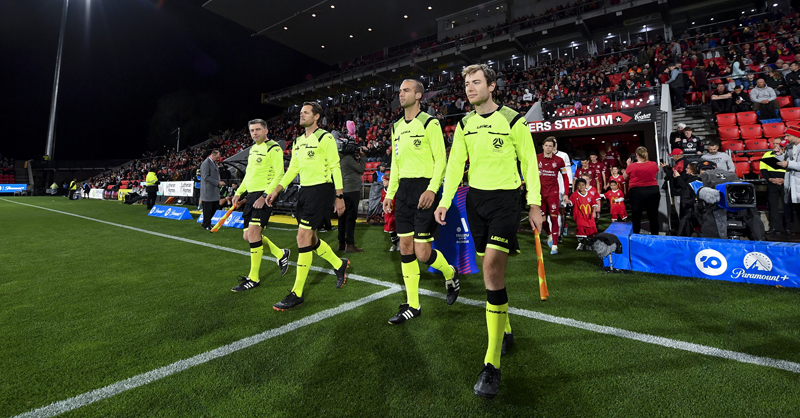
Image Credits: Football Australia
The clearest image yet of Australian football’s refereeing crisis arrived on Wednesday night as Sydney FC and Melbourne Victory met in an Australia Cup semi-final at Jubilee Stadium.
A first ever Big Blue in the competition – and towards it’s pointy end – should have been a showcase event for Australian football but instead, the referees were in the spotlight. Not because of the quality of their officiating, but because of the dire situation the game finds itself in and it’s present need to resort to international imports.
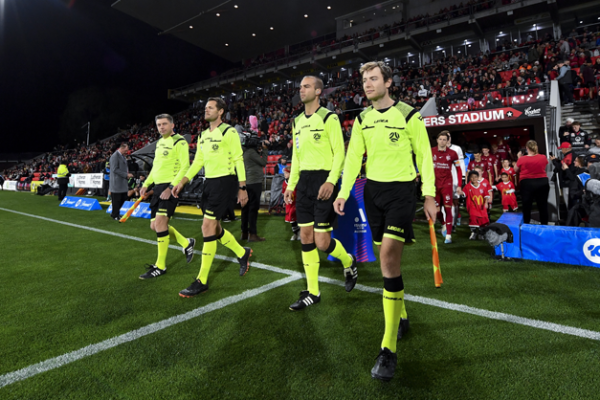
Four Singaporean referees were in charge of the fixture, which Victory won 2-0. Australian referees had refused appointments because of their ongoing dispute with Football Australia. The issue is no longer theoretical. Australian referees are not simply threatening industrial action – their absence has already changed how major matches are delivered. That is a governance failure on the part of Football Australia and the Australian Professional League.
What are the referees fighting for?
Around 90 elite Australian match officials are currently without contracts. That includes referees, assistant referees, fourth officials and video match officials working across the A-Leagues and Australia’s national competitions. The previous contracts expired last month. Some officials are also waiting for outstanding payments from A-League trial matches.
The Professional Football Referees Association (PFRA) has set three main requirements:
- It wants the existing contracts extended until June 30, 2027, or until a new agreement or independent refereeing structure is established.
- It wants all outstanding match fees and expenses paid.
- It wants a professional refereeing structure that does not place elite officials directly under the APL, which is controlled by the clubs they officiate. A new central structure is what the referees are demanding and should get.
Evgeny Vizelman, chairman of the PFRA, believes that whilst the strike action is extreme, it is necessary to protect Australian referees.
“We do not take the decision to stop officiating matches lightly,” Vizelman told Sydney Morning Herald last week.
“Our referees are being asked to perform in one of the most scrutinised roles in Australian sport without basic certainty around their employment and, in some cases, without even being paid for work already completed. That is not acceptable.”
Football Australia and the APL have been working towards a new structure, but one in which the two organisations contract separately for Australia Cup and A-League matches. The referees believe that is the wrong model.
Their concern is simple: The APL is 67.7% owned by the A-League Club Unitholders. Essentially, the clubs are appointing their own referees. That creates a perceived conflict.
If the referees sit under Football Australia as a regulator, it ensures there is no conflict of interest and that A-League clubs have no opportunity to influence the referees they may be appointed to matches.
England shows another way
England has already built the structure Australia is struggling to create. Professional Game Referees, or Pro Ref, is the central body overseeing refereeing across the Premier League, EFL, WSL Football and FA competitions. It is funded by those aforementioned competitions.
The important distinction is those competitions do not each run their own separate professional refereeing workforce. Pro Ref manages the system. It oversees appointments, development, training and performance. For the 2026-27 season, its new Professional Referee Group will service the Premier League and EFL Championship.
Officials work within the same professional structure and can be selected across competitions. That centralisation brings consistency. It also allows referees to be treated as a professional group rather than a collection of officials contracted separately by different competitions.
Whilst it is centralised, the system is not perfect. England has also recognised the need for greater independence in assessing referee performances due to Pro Ref being owned and funded by leagues and, as a result, the clubs they represent. However, as the body is also owned in part by the English FA, the governing body can oversee practices.
Pro Ref has also implemented world-leading officiating practices. Its Key Match Incidents panel includes former players and coaches, alongside representatives from the Premier League and Pro Ref, and reviews major decisions independently each week.
Pro Ref now has dedicated development groups, specialist coaching, sports science, psychology and performance analysis. 37 Pro Ref officials are currently on the FIFA International List. That does not prove centralisation alone creates better referees. But it shows what happens when refereeing receives a professional structure, long-term investment and consistent management.
Australian football needs to collaborate
This is where the Australian dispute becomes bigger than referees. Football Australia and the APL have been unable to secure agreement over who funds the referees over a long period of time, leading to this standoff; it comes at the same time as the APL’s difficulty in negotiating a new CBA with the players’ union.
Both organisations have a role in running their respective parts of the Australian game, but again an industrial dispute has the game appearing in shambles on the eve of another domestic season.
The most frustrating part of this dispute is that everyone needs the same thing. Football Australia and the APL need referees; there is no doubt the refs deeply value their employment at the elite level. With due respect to Wednesday’s flow-in Singaporean officials – themselves from a valued partner member through our shared position in the AFC – nobody wants to see the circumstances under which they were required on Wednesday continue any longer.
The PFRA dispute should therefore be treated as more than an industrial disagreement. It is an opportunity to fix the structure. Australia should learn from the principle behind Pro Ref and the English system. Centralise, professionalise and protect the officials who manage the game.