


Football Australia introduces new independent review process

Football Aus

Football Australia have announced the development of an independent complaint management process to enable current and former footballers and staff to bring forward concerns about alleged abuse, harassment or bullying in relation to Football Australia’s national teams and the A-Leagues.

Under the agreement, Sport Integrity Australia will receive, assess, and manage all complaints, ensuring all concerns are heard and assessed independent of Football Australia. Details are expected to be available in the coming weeks.

The National Sports Tribunal will have jurisdiction to hear any disputes that fall within the scope of the complaints process, through mediation, conciliation, or arbitration.

Football Australia initiated discussions with SIA with a view to establishing an independent mechanism to supplement the governing body’s complaint handling process under its Member Protection Framework.

Football Australia CEO James Johnson outlined that his organisation treated matters of abuse seriously and had a “zero tolerance” approach.

“The wellbeing of our diverse community is our priority, and we’re committed to safe, inclusive environments for all footballers and staff. There is no place for abuse, harassment or bullying in our sport and it’s incumbent on organisations like ours to take the lead when it comes to dealing with these issues head-on,” he said”

“We understand that society’s expectations have shifted, and it’s vital that our sport reflects those expectations. With this in mind, we approached Sport Integrity Australia recently and we’re pleased with this timely announcement that the proposed process will enable anyone with concerns to come forward, with the confidence that their concerns will be heard and assessed independently.”

Sport Integrity Australia CEO David Sharpe addressed the importance for complaints to be handled outside an individual sport.

“I welcome the proactive approach from FA to address these issues independently. Having an independent body to hear complaints is critical to giving athletes and staff confidence that their concerns will be heard openly and that they will be treated fairly. Nothing can be swept under the carpet,” he said

John Boultbee, CEO of the National Sports Tribunal, added: “The involvement of the independent National Sports Tribunal as the ultimate appeal body, ensures those concerned are provided the most independent and thorough processes from the time of the complaint through to its ultimate resolution.”

Further details regarding the process, scope and timeframe will be available in the coming weeks.

Previous ArticleNext Article

FA and the ABC partner to cover AFC Women’s Asian Cup 2026™

Football Australia and the Australian Broadcasting Corporation (ABC) have announced a partnership ahead of the AFC Women’s Asian Cup Australia 2026, which will see the tournament made accessible to listeners through live audio of all CommBank Matildas games.

What will the partnership include?

Australians looking to follow the tournament throughout the coming weeks will be able to do so with ease, now that Football Australia and the ABC have entered into partnership.

Through ABC Sport and ABC Listen, audiences can follow a minimum of 17 matches. This includes every match played by the CommBank Matildas, as well as selected key fixtures during the Group Stage, and all matches in the knockout stages.

Further, Football Australia CEO, Martin Kugeler, outlined the value of making the tournament and the Matildas’ matches available to the nation.

“This is an important partnership that ensures live audio coverage of the CommBank Matildas and the AFC Women’s Asian Cup 2026™,” said Kugeler via official press release. 

“The CommBank Matildas are one of the most supported teams in the country, and the live audio broadcast on ABC will allow everyone in the nation to get behind the CommBank Matildas and follow their quest to become Asian champions.”

Ultimately, this partnership is not simply about broadcasting football matches; it is about making the tournament accessible and encouraging all across the nation to support the CommBank Matildas and women’s football as a whole.


Growing and sustaining the buzz

While many will remember the disappointment of the quarter-finals in the tournament’s last iteration in 2022, this year’s build up contains immense optimism.

“The AFC Women’s Asia Cup is a significant tournament on the global football calendar, and the ABC is pleased to bring it to audiences across Australia as the exclusive audio partner for the event,” explained ABC Managing Director, Hugh Marks.

“With Australia playing host, it’s even more important that audiences across the country can follow the tournament to cheer on our mighty Matildas.”

The partnership between Football Australia and the ABC ensures that football fever can spread to audiences across the broader ABC network, which includes eighty metro stations, 40 local stations and over 60 station on ABC Listen. 

Indeed, Australia’s role as host is a huge opportunity for players, fans and the game’s governing bodies to create a real, nationwide buzz for the women’s game. What remains important, however, is that this buzz continues to grow long after the tournament ends. 


The Future of Football with Bill Papastergiadis

In our first episode of Unfiltered, our conversation with Bill Papastergiadis quickly cemented why he’s the National Chairman and Managing Partner at Moraine Agnew Lawyers, President of the Greek Community of Melbourne, President of South Melbourne FC, and a board member across several organisations.The episode serves as a lens for examining the deep interconnections between football, community, governance, and the tangled politics beneath Australia’s sporting landscape.

Football and the Ties That Bind

For Australian football stakeholders, the implications are clear. Football’s true power isn’t just what happens in the technical area or at the board table; it’s how sport can unify diverse cultures and channel rivalries into positive outcomes. Papastergiadis reflects on his own journey, where law and leadership blend seamlessly into community-building: “All of the things we work in have an interconnection…my job as a lawyer relates to my work at South Melbourne Hallas.” Clubs are, in this sense, social institutions, able to support not just athletes, but families, grassroots volunteers, and community partners.

Yet, the podcast doesn’t shy away from highlighting how politics shapes the game, for better and worse. “Football brings out the best in us and sometimes not the best in us,” Papastergiadis admits. Behind every bid for a stadium, every negotiation with government or governing bodies, there’s manoeuvring, advocacy, and, at times, division. As he puts it, “People are trying to use whatever skill or relationship they have to get their club where they want it to be. They will describe that as political. Politics is really part of our lives.”

The Fight for Access

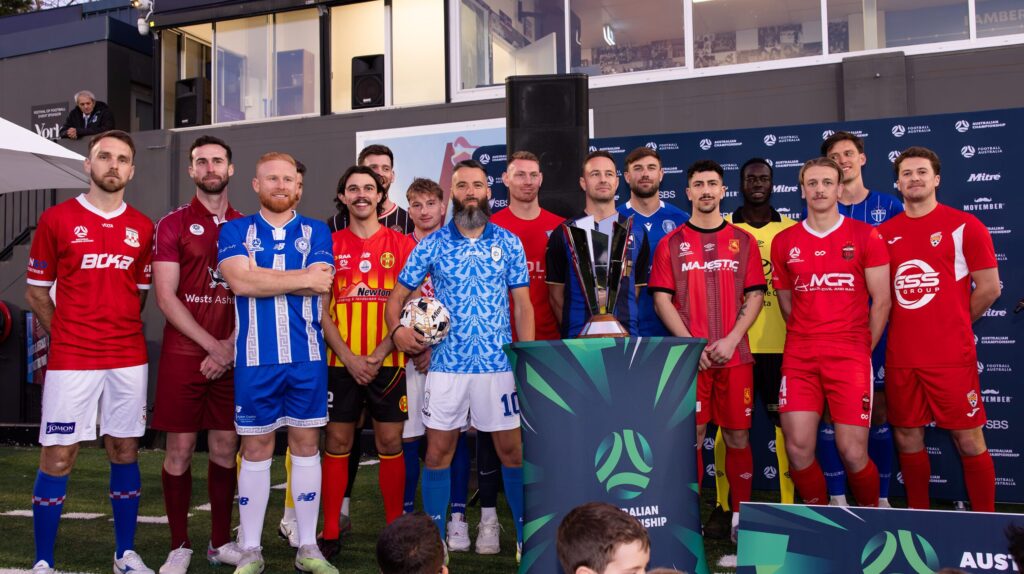
It’s in this way that the episode’s most substantial industry analysis emerges. The conversation turns to the national second tier- the newly launched Australian Championship, and the legacy of locking NPL clubs out of the A-League.

“I hope it’s fixed. We will agitate for it to be fixed. Not because for the sake of South Melbourne, but for the sake of every club in this country. They all deserve…to aspire, to dream and to bring out the best in themselves and to progress. You can’t stop that in humanity.”

Papastergiadis credits Football Australia and Football Victoria’s recent efforts to re-introduce competition between historic clubs:

“Every club went another level in terms of player engagement, fan engagement, creating a better experience, match day experience for their supporters. Everything went up because we introduced competition again.” Fan attendance soared by up to 600% in one season, and clubs invested in both players and match-day infrastructure. For commercial operators, administrators, and sponsors, this speaks to a simple truth: when doors open, football’s audience answers.

Community, Identity and Social Cohesion

The episode also asks hard questions about identity and inclusion, both for clubs and communities. Papastergiadis doesn’t downplay the tensions that can arise from tribalism or historical rivalries, yet he champions the need for clubs to embrace their heritage within a multicultural framework. “We’re an Australian club, first and foremost (…) we do have, however, a history and it’s a history that gives meaning and purpose to the club. Let’s not deny that, but let’s make sure that history is conveyed in a way which promotes social cohesion, which doesn’t exclude others.”

He draws a direct line between football, ethnic history, and social progress, arguing that attempts to erase cultural identity or punish clubs for their backgrounds was a regressive move rooted in Australia’s old racism. “The demise of the National Soccer League was racist in its execution and to deny those clubs the opportunity to continue to participate solely because of their historical background, particularly when those clubs are what football was built on.”


View this post on Instagram


A post shared by Soccerscene (@soccerscene.au)

Industry Lessons and the Path Ahead

Politics will always be embedded within football’s machinery. But, as Papastergiadis notes, the impacts are not inevitably negative, provided that industry leaders focus on engagement, transparency, grit, and trust-building. His advice for clubs working with councils is clear: “Invite them to your events. Invite them to your club presentations. Invite the counsellors to matches. Organise lunches. Through that process, they will find that doors will open. (…) Trust is built over time.”

If anything, this episode illustrates that the future of Australian football rests on industry’s willingness to marry grit and ambition with cultural sensitivity and openness. “The journey is more important than the outcome. We should encourage people to feel good about the particular journey, that daily journey they’re involved in.”

For listeners, football stakeholders, and policymakers, Papastergiadis’ reflections and stories, some poignant, some political, all rooted in decades of experience, are both a window and a challenge. Open the doors, listen deeply, agitate constructively, and let football’s dreams flourish.

Dive into the full episode for more stories, leadership lessons, and insight on shaping Australian football’s next chapter.

Our episode is now out on Spotify, listen here.

Most Popular Topics

Editor Picks

Send this to a friend