


Football NSW grants webinar to aid clubs and associations

FNSW

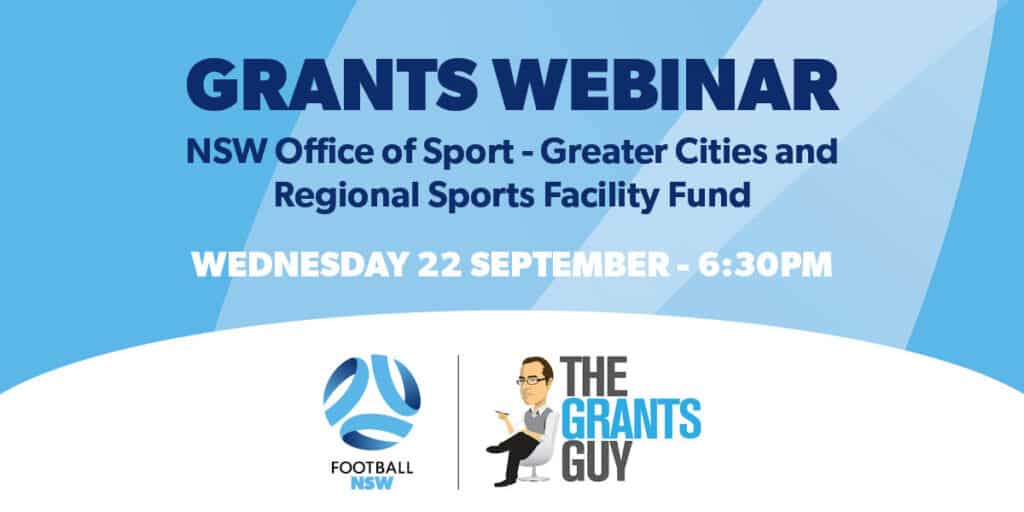
Football NSW in conjunction with ‘The Grants Guy’ are set to premiere a free Grants Zoom online webinar next Wednesday (September 22) at 6:30pm – 7:30pm.

FNSW clubs and associations will be provided with valuable information through the grants webinar, especially for applying for funding which have assisted many teams in the past in their pursuit of seeking facility upgrades amongst various other beneficial elements.

The webinar will provide a practical guide to grant writing for any football club seeking to attain funding by applying for the Greater Cities Sport Facility Fund and the Regional Sport Facility Fund in particular.

Both grants will be explained through the practical step by step webinar, and guidance will be provided as to how to apply for the Grants.

The following topics will be discussed:

  • How to apply for the grant – the do’s and don’ts
  • Eligibility & Answering the Question
  • Project Assessment, Evaluation, Rationale, Methodology
  • Budget & Acquittal
  • Getting Grant Ready and Planning your Club’s Application

For the Greater Cities and Regional Sport Facility Fund, the second and final round of the $100 million grant is available, with grants of up to $1 million offered to sport and recreation organisations and councils.

In Round 2, up to $46 million is available for projects that improve sports facilities and recreational spaces and enable more people to participate in sport and active recreation.

Grants from $100,000 up to $1 million are available for a range of projects including lighting, amenity buildings, clubrooms, change rooms and grandstands.

Round 1 resulted in $54 million awarded for 91 projects, with over $10 million awarded to football projects.

Round 2 is the final round of the program with applications closing at 12pm, on October 8, 2021.

Register for the webinar today by clicking here.

For any further questions please contact Football NSW’s Government Relation, Infrastructure and Funding Manager Daniel Ristic via email on danielr@footballfacilities.com.au.

Previous ArticleNext Article

Premier League clubs record huge losses despite record revenue

A report from Deloitte says Premier League clubs are facing a growing financial challenge after combined pre-tax losses reached $1.8 billion (948 million pounds) in the 2024-25 season.

The figure marks a huge rise from the $258 million (135 million pounds) recorded the previous season. It comes despite clubs generating record revenue of $13 billion (6.8 billion pounds).

Revenue keeps rising

Premier League clubs increased their revenue by 8% during the season. Commercial income and matchday revenue both climbed. Broadcast income also increased. But higher revenue has not translated into stronger profits.

Wage costs rose by $730 million (381 million pounds). Player transfers also played a major role in the rise in losses. Only eight clubs reported an operating profit. That was down from 13 clubs the season before.

Spending drives losses

Transfer spending remains one of the biggest pressures on Premier League finances. Clubs continue to invest heavily to compete for trophies and European places. But those costs can quickly outweigh the extra revenue generated by success.

Net debt also increased. It reached $6.9 billion (3.6 billion pounds) in 2024-25. That was up from the previous season.

The financial pressure is not limited to the Premier League. Only three Championship clubs in the second tier reported a profit.

A warning for English football

The Premier League remains the financial powerhouse of English football. Its clubs generated $13 billion (6.8 billion pounds) in revenue. The Championship generated $1.8 billion (942 million pounds).

But Deloitte warned that football cannot rely on simply adding more matches to create future growth.

European competitions have expanded. The international calendar has also become more crowded. Yet there are concerns that the market could become saturated.

Clubs face tougher choices

The figures highlight a difficult balance for Premier League clubs. They need to spend to remain competitive. But rising wages, transfer fees and debt are putting greater pressure on their finances.

New regulations will also change how clubs manage their spending from 2026 onwards. The focus is now shifting towards sustainable growth and stronger commercial income.

The Premier League remains the richest domestic league in Europe. But these figures show that wealth does not guarantee profit.

For clubs across England’s top flight, financial discipline is becoming just as important as success on the pitch.

NSW Government opens $4.65 million Local Sport Grant Program

The NSW Government has opened applications for the 2026–27 Local Sport Grant Program, with up to $4.65 million available to support grassroots sporting organisations across the state.

The program will provide grants ranging from $2,000 to $20,000 for incorporated not-for-profit sporting clubs and associations.

Funding is aimed at increasing participation, improving governance and enhancing community sporting facilities.

Applications opened on 27 July and will close at 1pm on 24 August 2026, with successful applicants expected to be announced in December 2026.

The Local Sport Grant Program forms part of the NSW Office of Sport’s ‘Everyone Plays Here’ strategic plan.

The plan is designed to strengthen community sport by supporting initiatives that encourage regular participation and improve long-term member retention.

Funding is also available for projects that reduce barriers to participation and create more inclusive sporting environments, particularly for women and girls, multicultural communities, people with disability, First Nations people and members of the LGBTQIA+ community.

In addition to participation initiatives, the program will support projects that improve the financial sustainability and governance of community sporting clubs, while also investing in the quality, adaptability and environmental sustainability of sporting facilities across New South Wales.

Successful projects must be completed by June 2028, with applicants required to meet the eligibility criteria outlined in the program guidelines.

The NSW Office of Sport has encouraged eligible organisations to submit applications before the closing date, with grants awarded through a competitive assessment process.

Most Popular Topics

Editor Picks

Send this to a friend