
Football Queensland launches new school partnership

Football Queensland has maintained its commitment towards uniting football by announcing a new partnership with The Great Public Schools’ Association of Queensland (GPS).

The move comes as part of Football Queensland’s School Strategy, designed to improve the sporting experience for school participants.

After months of discussions, Football Queensland and GPS have reached a Memorandum agreement that will see match referees and fresh development opportunities for referees and coaching supplied to GPS schools across the state.

Similar articles:
Football Queensland announces independent governance review of the sport
Heidelberg United: Modernising youth development with SoccerPLAY

“We are delighted to be working with GPS and school football and look forward to delivering quality outcomes for participants of school football,” Football Queensland CEO Robert Cavallucci said.

“It is critical we continue to unite football in the state whilst constantly looking for innovative ways to improve the experience wherever football is played and this partnership enables us to do that, creating consistency in refereeing across school and club football.”

GPS was founded in 1918 and has been able to administer sporting and cultural activities for nine secondary schools in Brisbane, Ipswich, the Gold Coast and Toowoomba. Football has been part of the association’s focus since 1991.

“The new partnership with Football Queensland will deliver tangible benefits for our member schools, allowing us to improve the quality and support of match officials and coaches across the GPS network and encouraging growth in participation,” GPS Competition Administrator Katie Veitch said.

“We look forward to working with Football Queensland to further strengthen the delivery of GPS football as we provide exciting opportunities for our participants and their football development moving forward.”

“One of Football Queensland’s strategies will be the delivery of free referee courses to build capacity within GPS schools and mentoring match officials during school games, reflecting FQ’s commitment to growing the number of referees in the state through increased development opportunities,” Cavallucci said.

“We will also be making coach education courses available to GPS school coaches to ensure their young players are benefitting from the best possible guidance.

“Football in Queensland United is a critical strategic objective, and we can only achieve this by bringing together and welcoming communities into the football family.

“A united game with a shared purpose, demonstrating we are the largest participation sport across Queensland, FQ will advocate football with a stronger position across all levels of government.”


Previous ArticleNext Article

Mito, Nagasaki and Chiba step up: will they prove themselves in J1 football?

The Meiji Yasuda J1 100-Year Vision League begins in a matter of weeks.

Mito Hollyhock, V-Varen Nagasaki and JEF United Chiba will all feature in Japan’s top flight following their second-tier campaigns last season.

Mito’s historic breakthrough and Nagasaki’s return

For Mito, it marks uncharted territory. The Ibaraki outfit have never played first-division football, having operated exclusively in J2 since their founding 26 years ago. Last year’s title, secured on goal difference after a 70-point haul, changes that.

Arata Watanabe anchored their attack despite an injury-interrupted season. He netted 13 times and created seven more. Sho Omori provided width and service from left-back, appearing in every match and registering the team’s highest totals for passes and crosses.

Nagasaki return after an eight-year absence. Their second-place finish came in their inaugural campaign at PEACE STADIUM Connected by SoftBank. Takuya Takagi, who previously guided them into J1 in 2017, regained control midway through last season. His side dropped just one match in 19 under his leadership. 

Matheus Jesus carried the attacking burden. The Brazilian struck 19 goals and was named J2 Player of the Year. His output alone accounted for much of Nagasaki’s upward trajectory.

Chiba’s journey back has taken 17 years. Once part of the J. League’s inaugural cohort in the early 1990s, relegation in 2009 began a prolonged exile. Third place in the regular season sent them into the play-offs.  A 4-3 comeback from three goals down against RB Omiya Ardija in the semi-final preceded a 1-0 victory over Tokushima Vortis in the final. Carlinhos Junior’s winner in the final capped one of the most dramatic promotion campaigns in recent J. League history.

Each club brings distinct narratives into the top flight. For Mito, Nagasaki and Chiba, survival will mean validating years of ambition, while success could redefine their place in Japanese football. Momentum from promotion campaigns will be tested when fixtures commence in early February.

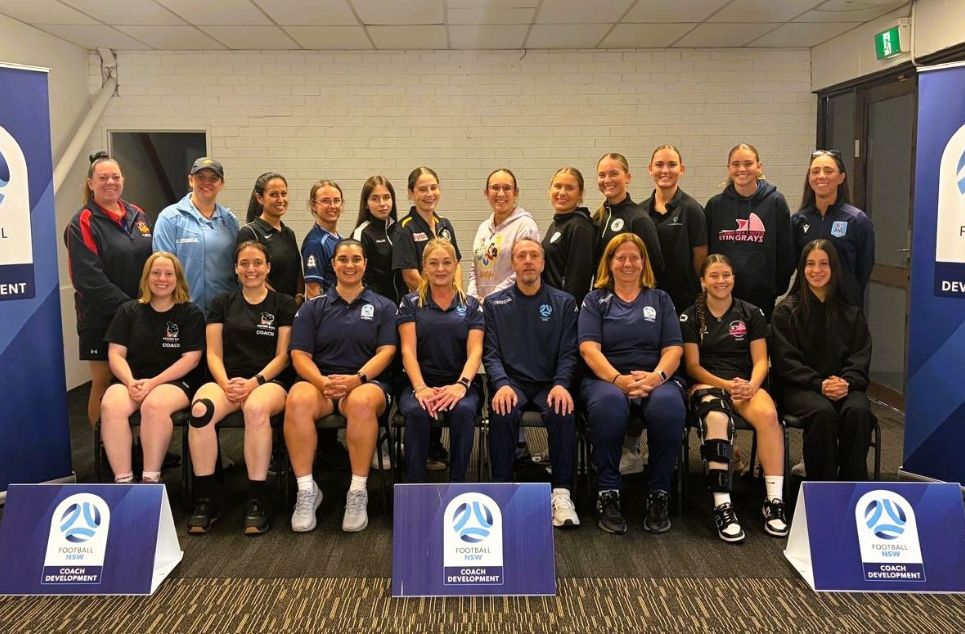
Coach Education Exchange unites Football NSW and Japan FA

The education program was a roaring success for the 14 coaches who made the trip, demonstrating Japan’s high-quality infrastructure and development systems from which football bodies across Australia can take inspiration. 


A valuable partner

The 2026 FNSW Japan Coach Education Exchange comes as the latest display of the strong connection between footballing worlds in Australia and Japan. 

14 Football NSW coaches travelled to Japan for unique insights into what makes the J-League and WE League tick. With both of these leagues being renowned for their distinct footballing identities, elite development pathways, and technical excellence, the program serves as a valuable opportunity for Football NSW to gain new ideas and know-how moving forward. 

During the visit to Japan, the coaching cohort visited several different clubs, including: 

  • Cerezo Osaka
  • Tokyo Verdy
  • JEF United Chiba
  • Urawa Red Diamonds
  • Gamba Osaka

Learning from international expertise

The trip was not, however, merely about uncovering the secrets to club or commercial success. 

Visits to the JFA Academy Sakai emphasised Japan’s commitment to creating elite pathways for talented young players across the country. They believe in nurturing players not only to be talented footballers, but to be confident leaders through their education and lodging system. 

“He or she being gifted does not always have his or her talent blossom. By providing those who have a talent with a good environment and encouraging them to make efforts, we nurture players who can shine in the world,” they explain via the JFA official website

Further meetings with Director of Coach Education at the JFA, Kimura Yasuhiko, as well as Head Coach of Japan’s Men’s National Team, Hajime Moriyasu, highlighted the wealth of knowledge which Australia can access during collaborations with the JFA. 

“The opportunity to meet and hear from a national team head coach operating at the highest level of international football proved both humbling and motivating, underscoring the value of global connection and shared learning in coach development,” Football NSW said via press release. 

Following the success of the 2026 FNSW Japan Coach Education Exchange, the objective should now be to transform insights into action. For Football NSW, or any other football association in Australia seeking to develop the game for current and future generations in the region, the lessons learned from international partners must be applied with real conviction and commitment.


Most Popular Topics

Editor Picks

Send this to a friend