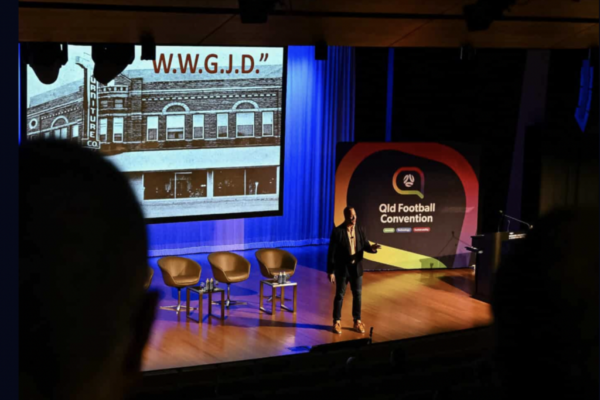
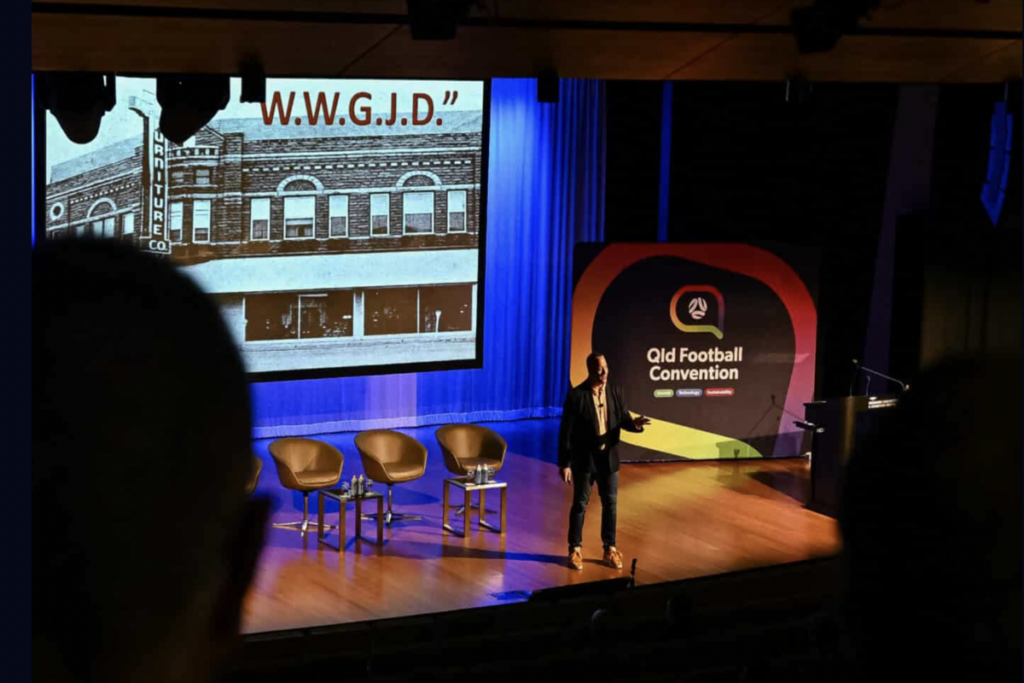
Football Queensland’s third annual convention was held at Brisbane Convention and Exhibition Centre from October 9-11th, bringing together thought leaders, key administrators and change-makers for an immersive learning and networking experience, providing the chance for discussion on the challenges and developments shaping the game’s future.
Soccerscene CEO Stace Ioannidis is optimistic about the sport’s future following the event – describing an atmosphere of growing awareness surrounding the convention as it progresses year-on-year.
Attending the conference for the business’s second year in a row as media partners, Soccerscene took part in high-level debate surrounding key pillars of growth, sustainability – covering governance and transformation – and technology.
Guest speakers including Robbie Kruse, former Socceroo and UEFA Champions League forward; Football Australia’s Head of Referees, Jon Moss; and Moregold Performance Consultant’s Wayne Goldsmith.
They were joined by Emma McKeon, Australia’s most decorated Olympian, and Tony Wilson, Founder of Performance Lab.
Addressing participants on the convention’s opening day, McKeon’s ‘Champion Mindset’ talk touched on resilience, goal setting and coping with setbacks. Drawing on a remarkable career comprising 14 Olympic medals, McKeon emphasised the power of converting small gains into extraordinary results.
Socceroos icon Mark Bosnich said the convention ‘wowed’ him, comparing it to Sydney’s Royal Easter Show in terms of excitement and attendance; he is eager to replicate similar at Football NSW, and highlighted the importance of bringing like-minded organisations together to ensure the sport harnesses its full potential.
Attendees were even the beneficiaries of a well-timed epic, as Saturday evening’s Australia Cup final was streamed onto a giant projector. South Melbourne’s triumph provided a healthy dose of football atmosphere as the convention took in the historic occasion together.
AI’s impact
StepOut AI joined FQ for its convention as official Performance Analysis Partners, driving conversations around how performance intelligence can be integrated into player development, talent identification and improvements to measurement of progress.
Tom Laxton, State Technical Director at Football Queensland, highlighted the importance of data in scouting – calling it a ‘baseline of real, true performance information without bias.’
StepOut AI aims to empower clubs, nurture talent, and build a ‘stronger development ecosystem across Queensland’.
Laxton described this new partnership as a ‘utopia’, with the goal of evolving into an integrated system where data will be readily available on players across the state.
Growth
Keynote speaker Tony Wilson delved into mindset, next-level leadership and high-performance culture. Having worked in clubs across Australia and the United States, Wilson’s experience builds on performance science coupled with practical leadership strategies to avoid burnout.
Former Premier League referee Moss followed with a discussion on building better coach-referee relationships, exploring how clearer communication, mutual respect and collaboration can contribute to more positive environments.
Improved Facilities
Sustained participatory growth across the sport reveals a need for improved infrastructure. Soccerscene met with convention partners Musco Lighting, who are working with stadiums and high school soccer facilities to control light spills and visibility.
Warwick Waters, spokesperson for convention partner Bild Group, highlighted the company’s synthetic playing surfaces – both natural and hybrid – and their impact on improving facilities for players, so that pitches across Queensland can maximise their number of participants.
He was joined by representatives from Sport Eng, sports field design and construction specialists, and Field Turf, Australia’s leading synthetic turf manufacturer.
The latter business recently shared the results of a 14-year study proving that athletes playing on surfaces with higher infill weight experience a lower incidence of ankle injuries during high school games. This data was gathered from 4,275 games across 104 schools, concerning a turf design system Field Turf has utilised for the past 25 years.
Sustainability
Wayne Goldsmith’s panel ‘Why Coaches Quit’ led a discussion on coach training and retention.
Posting on LinkedIn ahead of his scheduled talk, Goldsmith lamented the loss of ‘knowledge, relationships and culture’, which disappears when a coach resigns.
Goldsmith frames the retention of great coaches as an active choice clubs can make, rather than being attributable to pure luck – and that clubs which succeed in achieving this can expect better growth than those with higher staffing turnover.
Goldsmith has worked across elite and grassroots sport, consulting for organisations including Tennis Australia, USA Swimming, NZ Rugby and the Brisbane Lions.
What’s next?
Soccerscene is excited to apply the teachings and feedback gathered at Football Queensland’s 2026 Convention in our ongoing media debates, and are looking forward to continued collaborations with new business contacts in the broader football space.