

Football Victoria provides update on FootbALLways

In a recent release from Football Victoria, president Kimon Taliadoros provided an update on the new long term, strategic plan for Football Victoria.

The FootbALLways plan, which has been implemented since March 2019 aims to secure the future of soccer in Victoria for at least, the next three years.

As mentioned in March, the plan aims at five specific objectives:

  1. Enabling Victorian clubs to thrive while providing great experiences to ALL
  2. Expanding and improving facilities of ALL types and providing infrastructure to increase access, utilisation and sustainability
  3. Provide the best opportunities for ALL to access and enjoy programs, competitions and pathways
  4. Increase engagement and advocacy of football to change perceptions and promote positive outcomes
  5. Provide our people with continued opportunities to develop and be leaders for culture, high performance, social change

In the update written by Taliadoros (which can be found at the bottom of this article), he and FV are still committed to the objectives. A big part of the plan was to be more inclusive so that everyone could enjoy the sport of soccer.

With the FIFA Women’s World Cup on the horizon, this is the perfect time to emphasise this. As a business, you want to adhere to S.M.A.R.T objectives.

S.M.A.R.T stands for Strategic, Measurable, Attainable, Relevant and Timely. Well, they’ve certainly met the criteria on the latter. Young girls in Victoria who play soccer will want to see the likes of Sam Kerr, Steph Catley and Lisa De Vanna during this year’s World Cup.

If they are made to feel as if they can reach that level one day, they’ll be motivated to try and do so. And that is exactly why this plan exists.

The plan also outlines what FV plan to do in regards to upgrading facilities and infrastructure. In the last two weeks, we’ve reported on how the state governments have begun investing more money into such facilities, with namely the Victorian government putting in $22 million last week.

FV has received more than $140 million in funding from the government since 2017, as mentioned by Taliadoros in the update. But with overpopulation becoming an increasingly bigger issue in Australia, Taliadoros admits more is needed to fulfill the requirements set out by the plan.

As laid out in the plan and in the recent update, Taliadoros and FV are extremely committed to seeing this through to the very end. They’ve made a great start and in time, we’re sure the future will be bright.

FootbALLways update post:

https://www.footballvictoria.com.au/news/update-fv-president-kimon-taliadoros

The plan in full:

https://www.footballvictoria.com.au/sites/ffv/files/2019-03/Football%20Victoria%20Strategic%20Plan%202019-2022.pdf

 

Previous ArticleNext Article

Football Has the Audience. Does It Have the Commercial Strategy?

Soccerscene has launched Survey 4: Commercial Confidence in Football, calling on clubs, sponsors, governing bodies, commercial leaders and football industry professionals to assess whether the game is making the most of its enormous commercial potential.

Football has the audience, participation base and community reach to be one of Australia’s most powerful commercial platforms. But does the industry have the commercial strategy, professionalism and infrastructure required to turn that potential into sustainable growth?

That is the question at the centre of Soccerscene’s latest industry research.

The survey examines how attractive grassroots football is to potential commercial partners, what industry professionals believe is limiting football’s commercial potential, and whether clubs are presenting themselves professionally enough to sponsors.

It also explores what sponsors value most when engaging with football – from community reach and participation scale to brand alignment, values and purpose – as well as whether improved facilities could directly contribute to stronger sponsorship outcomes.

Is football fully capitalising on its commercial opportunity?

Football continues to provide brands with access to highly engaged communities across grassroots, community and elite environments. Yet the commercial landscape remains fragmented, with clubs operating with vastly different levels of resources, capability, governance, media infrastructure and commercial expertise.

Soccerscene’s survey is designed to capture the industry’s perspective on where the opportunities exist – and where football may be leaving commercial value on the table.

The research will look specifically at four key areas:

  • Commercial attractiveness – How attractive is grassroots football as a commercial partnership?
  • Commercial barriers – What is holding football back from reaching its full commercial potential?
  • Club professionalism – Are clubs presenting themselves effectively and professionally to sponsors?
  • Sponsor value – What are sponsors really looking for when they invest in football?

The survey also asks whether better facilities would have a direct impact on sponsorship outcomes, highlighting the potential relationship between infrastructure, commercial presentation and investment.

Have your say

Soccerscene is encouraging football clubs, sponsors, commercial professionals, governing bodies, administrators, media professionals and industry stakeholders to participate.

The findings will contribute to Soccerscene’s ongoing program of industry research, designed to provide a clearer picture of the challenges and opportunities facing football and the organisations operating within it.

Take the Survey: Commercial Confidence in Football

Complete the Commercial Confidence in Football Survey here

The survey will close on 30 August 2026 at midnight, with responses received before the deadline included in the final analysis.

Football has the audience. The question is whether it has the commercial strategy to match.

Football Queensland’s Logan hub plan rejected by council

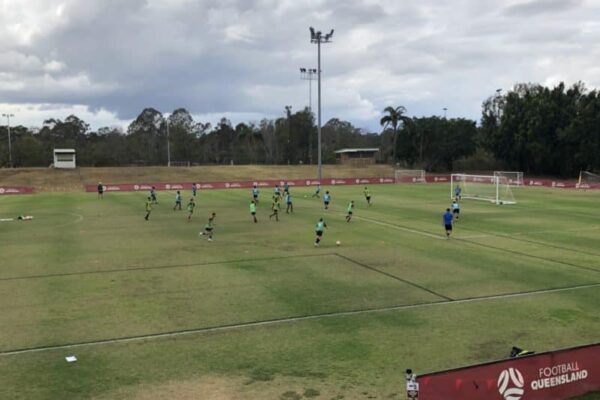
Football Queensland’s plans for a major new football hub at Meakin Park have been rejected by Logan City Council. The proposed $76.1 million redevelopment aimed to create a state home for football in Queensland.

Council unanimously rejected Football Queensland’s request for longer-term leases and additional land at the Slacks Creek site. The decision leaves the organisation’s current leases in place. The proposed development would have delivered new playing fields, elite training facilities and a dedicated home for Football Queensland.

Three-stage development

The first stage of Queensland Football’s development carried an $8.5 million price tag. It would upgrade fields, lighting, drainage and irrigation across Meakin and Mappas parks. The goal was to create a six-field, international-standard training venue.

The second stage represented the largest investment. Football Queensland planned to spend $55.3 million on a new headquarters at the adjoining Queens Park site. The facility would include a Women and Girls Academy, sports science facilities, sports medicine and strength and conditioning services.

A third $12.3 million stage would add an indoor futsal academy and two synthetic fields. Football Queensland said the project could create a major football precinct for the region. It also saw the facility playing a role in Queensland’s preparations for Brisbane 2032 and beyond.

Lease decision creates roadblock

Queensland’s governing body sought a 25-year lease with an option for another 25 years. Chief executive Robert Cavallucci said longer tenure was essential to secure government funding and move the project forward. The organisation has around three years remaining on its existing leases.

Council took a different view. Concerns included community access, funding certainty, future costs and the level of use at the existing facilities. Councillors also questioned whether a long-term arrangement would deliver enough benefit to Logan residents and grassroots clubs. Logan Council has now ordered a review of Football Queensland’s performance under its current lease.

Grassroots football at the centre

The decision highlights a wider issue for football infrastructure. Major facilities can provide elite pathways, sports science and high-performance opportunities, but unless councils can ensure local players and clubs can access the fields, they will be rejected.

Meakin Park already serves several sporting organisations, including football users and community sporting groups. Football Queensland said it had invested almost $2 million at Meakin Park and Mappas fields. It also argued the precinct operates at around 130 per cent capacity. For Queensland football, the challenge now is finding a model that can deliver high-performance facilities while expanding access for the community.

The proposal may have been rejected, but the need for better football infrastructure remains. With participation growing and Brisbane’s 2032 Olympic Games approaching, the debate over where and how Queensland builds its next generation of football facilities is unlikely to disappear.

Most Popular Topics

Editor Picks

Send this to a friend