Soccerscene the only online publication dedicated to the Australian and international football industry. It serves as a practical guide for those involved in the business of running a football club and bringing readers up-to-date research and development across all football matters providing insights, discussion and information related to topics that matter.
Football Victoria’s fifth year of Community in Business looks to reinvigorate business partnerships in the state
Football Victoria will also be celebrating the five-year anniversary of CIB in 2021, a program which was the brainchild of current FV Head of Commercial Anthony Grima and prominent business identity Professor Greg Stamboulidis.
FV’s Community in Business network was established after extensive research was conducted in 2014 on sponsorship data. At the time around 2,000 businesses invested commercially into grassroots community football in Victoria, with significant financial contributions made to over 350 clubs in the state.
Grima further explained to Soccerscene the origins of Football Victoria’s Community in Business program.
“It was created to provide a platform for businesses, football clubs and their sponsors, media and all levels of government to unite in their shared passion for the world game,” he said.
“It really was born out of one of those ‘write on the napkin’ type moments over a coffee in Ivanhoe. The idea just grew legs from that very moment. It seemed right and we knew the grassroots game needed it.
“We knew that this shared passion would lead to the development of meaningful relationships between the vast range of stakeholders in football and provide them with affordable and effective opportunities to connect with one another for mutual benefits and returns; and at the same time achieve important outcomes for football in Victoria.”
The membership-based program had its launch event in late November 2015, on the back of the Socceroos Asian Cup success earlier in that year.
“We were thankful to have the then Socceroos Head Coach Ange Postecoglou and Socceroos legend Josip Skoko, amongst others, to launch the new community initiative,” Grima said.
“Approximately 100 guests of the Victorian football community were invited to help us launch the new initiative. The event was hosted by George Donikian, who we are also very grateful to, being our inaugural MC and first Honorary Member.
Since then, the Community in Business brand has continued to grow exponentially, with over 100 businesses in any given year signing up as members to fund the program.
A major drawcard of these events are the special guests who attend the multiple functions across the year.
“Our feature guests continue to reflect the ethos of supporting every level of the game,” Grima said.
“We make sure that we are always celebrating Victoria’s football achievements, by unifying the achievements of football past, present and future in this country and the diversity of our great game.”
Guests from over the years include Harry Kewell, Graham Arnold, Craig Johnston, Archie Thompson, John Aloisi, Lisa De Vanna, Melissa Barbieri, Tony Vidmar, Paul Wade, Craig Foster, Les Murray and many more.
Other notable events over the course gave members the opportunity to meet former Manchester United and Liverpool players such as Wes Brown, Louis Saha, David James, Emile Heskey and Steve McManaman.
Occasions such as this couldn’t be possible without the assistance of event organisers, who the federation works alongside.
“A big thanks must go to the team at MSE Events,” Grima said.
“The events are very thoughtfully considered and planned, as much as possible, around special events where the celebration doesn’t end at the luncheons.
“For example, when Brazil and Argentina were in town, we gave all our members free tickets to these matches.”
Grima believes that without the support from clubs, businesses and the football community as a whole, the program wouldn’t be where it Is today.
“I am personally proud of how far the program has come,” he said.
“It is called Community in Business because it is a network that is owned and valued by the community. We are all in the business of making this community great. Together we can achieve more for our game, unified as friends in football.
“Community in Business continues to demonstrate how business and community can work together to achieve extraordinary outcomes for our game.”
More information on Football Victoria’s Community in Business program can be found here.
If you’ve ever sat through a club’s end-of-season review, you’ll know the drill. A coach pulls out a folder of notes, someone half-remembers what a player was like back in Round 3 and a parent quietly wonders what they actually got for their rego fees beyond a team photo. Football club platform Majestri says it has a fix for that, and it’s built directly into its Player Assessment module.
Why clubs bother assessing players in the first place
According to Majestri, clubs run player assessments for one of three reasons – usually more than one at once. Some are chasing genuine development, using the data to lift the level across their high-performance squads. Others are after a fairer way to pick teams, putting every player on the same measurable scale so selection is based on evidence rather than a coach’s gut feel about who “looks the part.” And for clubs operating under a Football Australia or state federation licence, assessments at set intervals often aren’t optional – they’re a compliance requirement, with the paperwork to prove it when asked.
Whatever the motivation, Majestri’s pitch is the same: don’t let that assessment data die in a spreadsheet on someone’s laptop.
Build your own assessment, your way
There’s no one-size-fits-all template here. The Assessment Designer lets technical directors set their own criteria, sort them into whatever categories their coaching staff already use – think core skills, possession, defending, attacking – and decide what each point on the rating scale actually means. Crucially, every criterion also gets a comment field, because a bare number rarely tells the full story of a player’s development.
The Assessment Module Builder, showing an NPL Juniors assessment with a 1-10 rating scale banded from under performing through to excelling and role-specific criteria grouped into core skills, possession, defending and attacking. Source: Majestri.
Build it once and it’s reusable every time that assessment cycle comes around, so every player and every coach – is working off the same yardstick.
Something for the parents to actually take home
One of the more relatable pain points Majestri is targeting: most families never see much tangible return from a season of fees beyond a team photo. Player Assessment addresses that with report cards – colour-coded against the same scale coaches used, grouped by category with averages calculated automatically, and delivered as a PDF or an interactive web page a parent can read without needing a coaching badge themselves.
A report card for an under-15 player, colour-coded from under performing to excelling, with a score for every criterion and a group average across core skills, possession, defending and attacking. Source: Majestri.
Turning the numbers into something useful
The real value, though, sits in what Majestri calls the Player Analysis Lab. This is where clubs can plot a player against their team-mates or an entire age group across two categories at once, spotting clusters and outliers at a glance. Every score gets read against the group average – so a “7” actually means something in context – and clubs can report at the broad category level or drill into individual fields underneath. The results can be filtered down and exported for selection meetings or grading purposes.
The Player Analysis Lab comparing seven players across under-15 and under-16 squads, with a scatter plot, a sortable table of scores against the player average, and controls for choosing which categories and fields to report on. Source: Majestri.
The admin side nobody enjoys, made easier
Beyond the flashy analytics, there’s a practical layer built for the volunteers actually running the process:
Sweep monitoring – a quick view of which assessments are done and which are still outstanding, organised into defined assessment periods so progress can be tracked against peers.
Individual development plans – every player gets a personalised plan, and clubs can group common improvement areas to run cross-team training sessions that lift the whole club rather than just one squad.
Access control – coaches and technical staff can only see assessments for the teams they’re responsible for, and completed assessments are only visible to people linked to that player’s registration.
“Hard numbers to draw on when you review coaching staff and curriculum – and something tangible for the players and parents who pay the fees.” – Majestri
The bigger picture
Majestri frames all of this as sitting on top of the club’s own data – assessment results live on each player’s profile inside the platform rather than in a spreadsheet that walks out the door when a technical director moves on. For committees, it also means hard numbers to lean on when reviewing coaching staff or curriculum, rather than relying on anecdote.
It’s a fairly clear read on where club administration software is heading: less about digitising paperwork for its own sake, and more about making the data clubs already collect actually work for player development, team selection and compliance without adding to the workload of the volunteers who run the show.
Football can't police its way to a better future. It needs to build a culture of belonging, accountability and membership that lasts beyond any one administration.
Security manages risk. Membership builds culture. Football Victoria’s greatest legacy won’t be another policy – it will be a connected football community that outlasts today’s administrators.
Every time crowd trouble makes headlines, football tends to reach for the same solutions: more police, more security, stronger sanctions and another statement condemning the behaviour.
But football membership could offer another layer of accountability by creating a stronger relationship between supporters, their clubs and the game.
The recent South Melbourne and Preston Lions fixture has once again placed supporter behaviour under the spotlight. The match finished 0-0, but the football was overshadowed by the actions of a small group of supporters. Football Victoria condemned the behaviour and launched an investigation, while Preston Lions also condemned the conduct and indicated it would cooperate with authorities.
Those responses are necessary. The overwhelming majority of supporters attend football to support their clubs and should be able to do so in a safe and welcoming environment.
But incidents such as this should force a bigger conversation. Instead of continually asking how we punish those responsible, perhaps we should be asking how we build a football environment where accountability is embedded into the relationship between the supporter, the club and the game.
England confronted this challenge more than three decades ago.
Following the dark era of football hooliganism throughout the 1970s and 1980s, English football underwent a fundamental transformation. All-seater stadiums, CCTV, intelligence-led policing, professional stewarding and Football Banning Orders all played important roles in changing the match day environment.
But one principle sits underneath many of those reforms: knowing who your supporters are.
Football became less anonymous, and accountability became more achievable.
Football Membership Makes Accountability Possible
A membership card alone will never eradicate hooliganism. England did not solve football violence simply by introducing membership; it built an integrated system of policing, stadium management, intelligence, sanctions and supporter engagement.
Football membership can, however, strengthen that system.
When someone becomes a member, they are no longer simply an anonymous person purchasing a ticket. They have a relationship with the club. In Australia, that relationship can be even stronger because club memberships commonly provide prepaid match admission and voting rights.
That creates both privileges and responsibilities.
If a member repeatedly breaches a club’s code of conduct, there should be meaningful consequences beyond being removed from one match. Membership can be suspended, voting rights revoked and access to tickets, digital services and other member benefits restricted where appropriate.
The objective isn’t to punish supporters collectively. It is to give clubs and governing bodies the tools to identify, manage and sanction individuals while protecting the overwhelming majority who simply want to support their team.
Membership doesn’t replace policing. It strengthens accountability.
Australian Football Already Has the Foundation
Australian football does not need to start from scratch.
Our existing club membership structures already provide a direct relationship between supporter and club. Members can have voting rights, prepaid gate admission and a formal stake in the organisation they support.
The problem is that the relationship often ends at the turnstile.
Football Victoria has an opportunity to take that existing foundation and build something much bigger: a connected football membership ecosystem across Victorian football.
Imagine every supporter receiving a Football Victoria Membership ID linked to their club membership, ticket purchases, attendance, volunteer history, coaching and referee accreditation, junior participation and other interactions with the game.
That identity could become the gateway to the entire football experience.
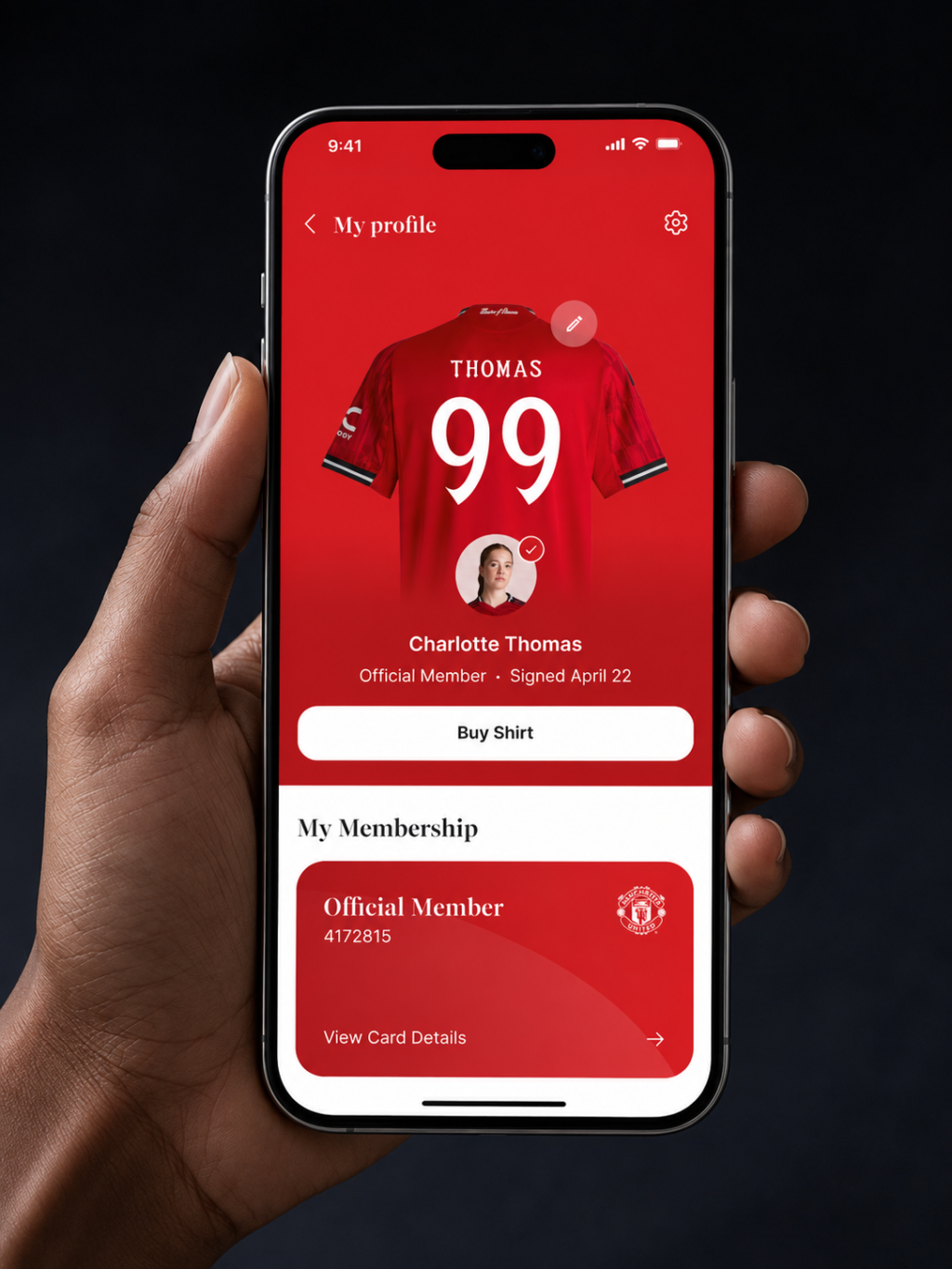
Visual reference: Manchester United digital membership platform. What could a connected Victorian football membership experience look like?
One Membership. One Platform. One Football Community.
A centrally managed digital platform could provide members with access to live-streamed matches, club news, fixtures, results, exclusive content, merchandise, hospitality, voting, community programs and other services.
For clubs, it would create a direct and trusted relationship with their supporters.
For Football Victoria, it would create a statewide football network. For supporters, football membership becomes more than an annual transaction; it becomes their digital identity within the game.
This is where the proposal moves beyond supporter behaviour and into commercial sustainability.
Football Membership Is a Commercial Asset
The biggest misconception in Australian football is that membership is simply a marketing product.
It is not.
Football membership can become one of the game’s greatest commercial assets.
Every club talks about attracting sponsors, but sponsors increasingly want more than a logo on a shirt or perimeter board. They want access to audiences, measurable engagement and data.
A club with a strong membership base can demonstrate a genuine, identifiable community. It can communicate directly with supporters, promote merchandise and hospitality, measure engagement and provide sponsors with a more compelling proposition.
Now scale that across Victorian football.
Club websites, live streams, fixture pages, newsletters, digital memberships and content platforms collectively become a significant commercial inventory.
Football Victoria could develop statewide commercial partnerships across that network while allowing clubs to maintain their existing local relationships.
Every live stream, digital banner, fixture page, newsletter and member portal becomes valuable commercial inventory.
Revenue generated through that central digital ecosystem should be transparently redistributed across the game.
Football Victoria generates new commercial income. Participating clubs receive a share based on an agreed model that could consider active memberships, digital engagement, live-stream audiences and commercial performance.
That changes the economics.
Clubs are no longer operating entirely as individual commercial islands. They become part of a larger football marketplace where growth in membership and engagement creates value for the entire game.
Building Football’s Digital Infrastructure
The opportunity isn’t simply another membership database.
It is football infrastructure.
Imagine a single platform connecting club memberships, voting rights, match admission, live streaming, club news, supporter communications, merchandise and participation across the state.
It could also give Football Victoria a much clearer picture of the football community.
Not just registered players, but members, supporters, volunteers, coaches, referees and families actively engaged with clubs.
That data matters.
When football is competing for facilities, funding and political attention, credible evidence of community demand is far more powerful than assumptions or isolated attendance figures.
A connected football membership system could give policymakers a clearer understanding of the people behind the game and the scale of the community being served.
The South Melbourne–Preston Fixture Should Be a Catalyst
The recent fixture should not simply become another disciplinary matter that disappears once sanctions are handed down.
It should prompt a broader examination of whether Victorian football has the systems required to create stronger supporter accountability.
There is a legitimate place for security, policing, stewarding and sanctions. But these should sit within a broader framework that connects clubs with their members and gives supporters a genuine stake in the culture they help create.
The goal should not be to turn football into a sterile environment. Passion is one of the game’s greatest assets.
The goal is to protect passionate support while making it increasingly difficult for a small minority to hijack the experience for everyone else.
Football membership can be part of that solution.
A Legacy Beyond Today’s Administrators
Football administrators often ask themselves how they will be remembered.
Will it be another strategic plan? Another governance review? Another infrastructure announcement?
Those achievements matter, but systems create legacies.
The administrators who transformed English football are not remembered simply because they installed CCTV or introduced stronger sanctions. They are remembered because they helped fundamentally change how football operated.
Football Victoria has the same opportunity.
Imagine being the administration that built Australia’s first integrated football membership ecosystem: one that strengthens supporter accountability, creates recurring commercial opportunities for clubs, provides government with credible participation data, increases sponsorship value and connects supporters with their clubs through one trusted platform.
That is a legacy.
Football doesn’t need another reactive policy after the next crowd incident. It needs infrastructure—not just concrete and steel, but digital, commercial and community infrastructure capable of supporting the game for decades.
Because the greatest asset in football isn’t the grandstand, the sponsor or even the competition.
It is the people who choose to belong.
If Victorian football has the courage to transform football membership from a ticketing product into the foundation of accountability, community and commercial growth, it can do more than respond to the next incident.
It can change the way football is experienced, governed and commercially sustained for generations.
History shows us that football doesn’t change after one incident.
It changes when leaders have the courage to build systems that make the next one less likely to happen.