



Football West achieves incredible growth of player registrations

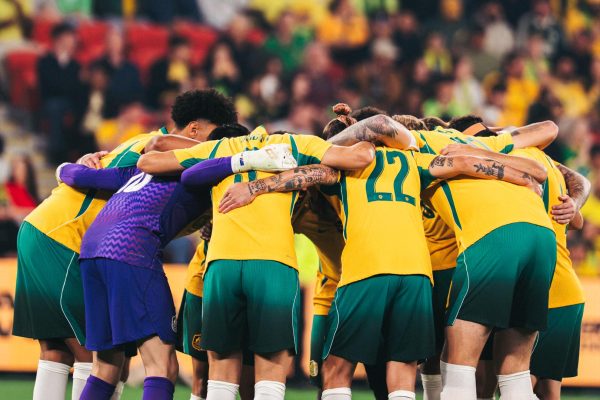
Football West have confirmed that player registrations in the state have reached an all-time high after passing the 50,000 mark for the first time.

The number of players in Western Australia registered on Play Football currently sits on 50,231 – 18% up on the same time in 2023 and also includes over 10,000 female players, another record figure and 34% increase from last year.

There are also 3,806 registered coaches in 2024, a massive 74% increase of last year’s figure which stood at 2,226 coaches.

Referee numbers are also 25% higher than at the same time 12 months ago, 408 in 2023 while in 2024 it is 510.

Football West CEO Jamie Harnwell was ecstatic to confirm this new milestone being hit in the state amongst other participation records.

“These numbers are incredible, and we are delighted to share them with the WA football community,” Harnwell said in a statement.

“We were expecting a spike after the success of the FIFA Women’s World Cup. However, this is a wider success story and the result of much hard work done across clubs, associations and the Football West team over a number of years.

“We also know that there is a lot of work to be done to ensure these record numbers are not a one-off, rather part of a long-term growth that sees football continue to be the No1 participation sport in Western Australia.

“This includes tackling the extra demands on clubs by providing adequate facilities, including more female-friendly facilities. This will help attract new people and hopefully see them develop a lifelong love of football.

“This is why Football West is currently carrying out a new facilities audit across the state. We are also working closely with the State Government and the Local Government Authorities to identify key areas required for investment.”

Football West are doing a fantastic job in providing adequate funding at grassroots levels for facilities, encouraging the youth to play the sport and ensuring that across all divisions of participation there are more willing to sign up.

As Harnwell mentioned, it’s much more than the sudden boom of the Women’s World Cup that was expected but rather years of hard work and great decisions that have led to these promising statistics and the plan now is to sustain this growth to hopefully become the most played sport in the state.

Previous ArticleNext Article

Ernie Merrick: ‘There are many clubs that would be fantastic additions to the A-League’

Ernie Merrick will be forever recognised as a key figure through the A-League’s golden early years. Appointed Melbourne Victory’s foundation manager in 2004 he led the club to not just silverware, but legitimacy and respect in a serious sport city.

A Scottish migrant and PE teacher by trade, Merrick was the youngest of the NSL’s managerial crop when he started with Preston in 1987 in the era of Thomson, Arok & Matic; when he finished with Newcastle in 2020 he was the elder statesman in the A-League age of Postecoglou, Popovic and Arnold.

For the places the game took him and all he achieved – including time as national team manager of Hong Kong – Victory supporters can comfort themselves in the fact that for whatever they feel towards Merrick and his iconic group of players, that feeling is mutual.

‘Yes, definitely,’ Merrick told Soccerscene Unfiltered when asked if managing Victory was the highlight of his career.

‘I think success is [fans] having identification with players, especially. We had Victorian boys playing for Victory.

‘That second year I was determined to have a complete pre-season. Archie Thompson bought me a birthday cake with 200 candles and said “Ernie, we’ve had 200 training sessions. We should celebrate this” – so he was looking forward to a big year, and we won the Grand Final 6-0.’

Nearing 20 years on, Victory and the A-League in general haven’t managed to drive forward as would have been hoped. Unsurprisingly that comes as painful to Merrick, as does the change in landscape regarding his other great passion and contribution in player development. 

‘I’m disappointed, as would most people be, that it’s struggled so badly. To me, there’s something missing,’ said Merrick of the current state of the A-League.

‘Those players we produced at the AIS and VIS went on to be the golden generation. Unless the league is fixed, there’s going to be ongoing problems with the financial status of things.

‘You just cannot earn enough money from selling a youngster, who you might get a million for, who then becomes worth several million in a few years if he does well. Maybe there’s a bit too much of selling players early.’

As someone who gave enduring service across Australia’s two domestic leagues, his voice holds weight in the consideration as to whether it’s time to now blend the, in today’s hyper-corporate landscape.

‘South Melbourne and Preston are two clubs that are perfect for the A-League, I think, down the track. They’ve set up, they’ve endured, they’ve been resilient, they’re playing good football and they’ve got a home base with a home crowd, which is far better than starting a club up from scratch.

‘All those players coming through those squads and the number of supporters they’ve got would be a huge addition. In Sydney too, there’s Marconi – there are so many good clubs around that I think would make a great addition to the A-League.’ 

Merrick also spent thirteen years as head coach at the Victorian Institute of Sport. He feels modern player development is an equation we still haven’t got right, post the closure of the AIS’ football program in 2017.

While many argue the move to club-based academy structures has seen Australia fall more in line with global practice while still producing players of quality, Merrick still feels there is merit in a national high performance program, in addition to club academies.

He was in the process of setting up state academies through the Member Federations during his time as Football Australia’s chief football officer from 2022-25. While the Victoria project was short-lived, academies in Tasmania, Western Australia and South Australia continue to run, but it appears the broader expansion of the concept has been abandoned.

‘I think both systems should work [together] equally well. When I started with the FA program clubs thought they would lose players to us, but I didn’t take any of their players. We offered the opportunity of a high-performance program to other youngsters.

‘We could develop players completely; we weren’t restricted to playing 4-3-3 to combine with the way the first team were playing. We provided more of a rounded education, and good players can play in any system.

‘We managed to affect the coaches involved so they were up to date with the latest information on methods of coaching, etc.’

Catch the full chat with Ernie Merrick on Soccerscene Unfiltered: from being two-footed by a 15-year old Kevin Muscat to his enthusiasm for the future of the Socceroos, his memories of Wellington and Newcastle, and plenty more…

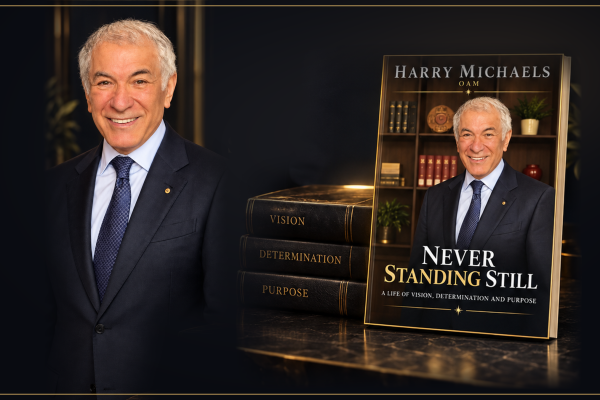
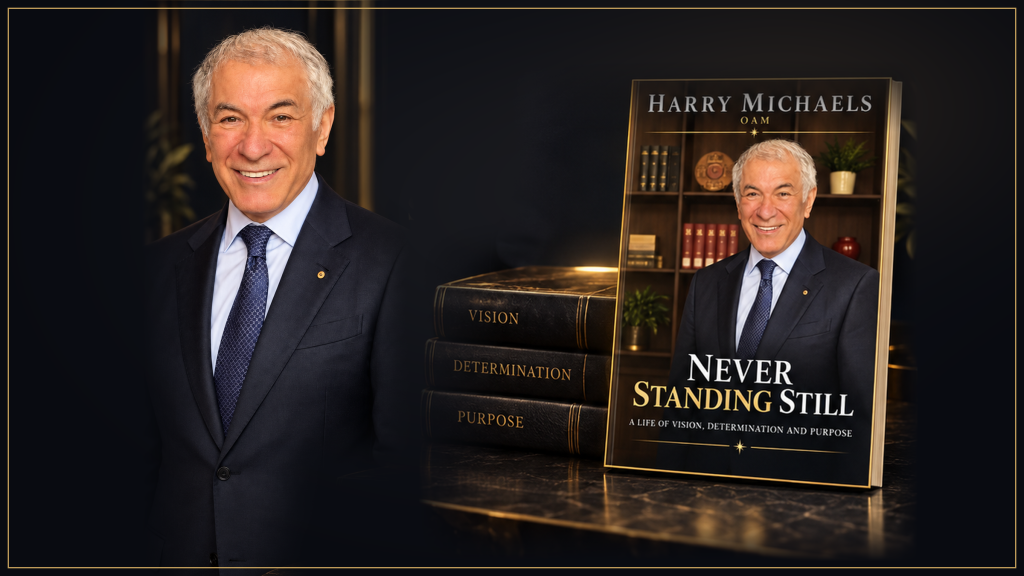
Harry Michaels – Never Standing Still

It’s hard to imagine that so much life experience can be packed into one person’s voyage of discovery but in the case of Harry Michaels it has all materialised.

Michael’s recently, published autobiography is the fascinating account of a man who was determined to succeed in life, whatever the obstacles.

Significantly, his early life at the age of nine was smeared with the tragic loss of his father. Many people would have found it extremely difficult to ever recover from such a bitter experience but not Harry Michaels.

Incredibly, something in the makeup of this young man encouraged him to achieve greatness in honoring the life of his father.

There is a constant message in the book that Michaels would honor his father’s memory forever by achieving perfection in his life endeavours.

Michaels achieved many milestones in his life and football was to become a central theme after he first kicked a ball with his peers in the narrow streets of Cyprus, followed by playing in the school team when he stayed with his aunt in London for a few years after his father’s death.

Australia is the lucky country and when Michaels and his family migrated to Australia, this country was to become infinitely better for it.

In a relatively short space of time, Michaels and his family adjusted to life in their adopted country and when Harry acquired a part in the Channel Ten sitcom, Number 96, the sky was the limit for his future plans.

He became a household name in the living rooms of Australian television viewers and eventually succeeded in entering the cut-throat world of production with the Greek Variety Show.

His biggest success was with Aerobics Ozstyle which originated in 1997 when he witnessed some people doing exercise routines for a television show on the beaches of California and subsequently instigated a pilot television show in Australia.

Currently, it is experiencing a huge revival on Youtube.

Michael’s great love for football naturally led him into the broadcasting arena of the world game and from 1982-2006, he covered NSL and international matches for SBS, including the 1993 World Youth Cup in Australia, Australia v Argentina World Cup qualifier featuring the immortal Diego Maradona, the 1997 World Cup qualifier between the Socceroos and Iran and 2005 elimination match in Sydney between Australia and Uruguay which received some of the highest ratings of any sporting contest ever televised in Australia.

Perhaps, the most dramatic event of all was the coverage of the Pratten Park riot in 1985 at a match between Sydney Olympic and Sydney City.

If this wasn’t enough, Michaels also financed Wollongong Wolves in the 1988 NSL season and was successful in attracting the talents of Paul Mariner, Alan Brazil and Trevor Francis to the club as guest players which led to the first major title won by an Illawarra club since South Coast United led by the mercurial, Jim Kelly, won the 1963 NSW State League grand final in front of a record Australian club attendance of 30,500.

He was the President of Sydney Olympic from 1991-1993 and made a major impact on the club.

Michaels never wanted to be praised for his contribution to football and very people knew he introduced Ericsson Australia, Nanda Spaghetti, Coca Cola, Winfield, Beach Fashions, and Westend Beer Company as sponsors of the NSL, while never asking for any financial reward.

Also, when the broadcasting company which produced the A-League faltered half way through the 2023/24 season, it was Harry Michaels who stepped in to fill the void.

Ironically, Harry was not asked to tender for the broadcasting rights in the following season.

It was something he found hard to accept but successful people like Harry don’t dwell on such events and seek the next challenge.

Hence the title of his book, ‘Never Standing Still’ is a true reflection of a man who let’s no barrier stand in the way to achieve his next goal where others would have given up long before.

Appropriately, his true worth and contribution to the community was duly recognised when he was awarded the Order of Australia Medal in 2004 for his services to broadcasting and football.

This book should be read by all people who want to be inspired by a story where adversity was converted to positives and all football administrators who would learn how the man Harry Michaels became a winner and a highly respected public face in Australian society for his unselfish community contribution.

Most Popular Topics

Editor Picks

Send this to a friend