


Football West welcomes $35m major investment from WA Government

Football West have welcomed the West Australian Government’s announcement of a major investment into football.

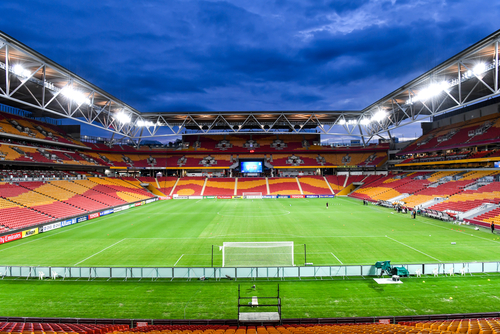
WA Premier Mark McGowan has revealed that HBF Park – the home of Perth Glory – will receive a $35 million upgrade in preparation for the 2023 Women’s World Cup, following the commencement of works for a $32.5m State Football Centre in Queens Park.

The upgrades at HBF Park will include replacing the halogen lights with a shift to modern LED lighting, upgrading the pitch through removal, levelling and turf replacement, new player bench areas, and upgrades to the existing power supply – including a new switch room.

In addition, the funding will cover temporary infrastructure, such as additional seating and facilities for players, media and supporters to cater for the World Cup.

The range of upgrades will allow the historic Perth venue to meet FIFA requirements to be a host venue in the upcoming World Cup, as well as providing benefits for future events.

The State Government also confirmed that work on the State Football Centre had commenced, with the $32.5m facility jointly funded by Federal and State Governments.

WA’s first ever Home of Football is due for completion before the 2023 Women’s World Cup. The elite facility will be the capable of hosting visiting international teams as a training ground, as well as grassroots football and junior development programs. It will also be the new headquarters for Football West.

McGowan spoke on the potential positive impacts of the planned improvements to HBF Park.

“Securing games in the 2023 FIFA Women’s World Cup is a massive win for Western Australia. This investment in HBF Park will provide some much-needed upgrades to our premier soccer and rugby venue, while also enabling further temporary fit-outs for the World Cup games,” he said.

“This will be the biggest football event Perth has ever seen – providing global exposure for Western Australia and giving fans, young and old, lifelong memories of the world’s best in action.”

Football West CEO James Curtis added: “The State Football centre will support all players across Western Australia as they progress on the pathway. Hopefully we can see future players like Sam Kerr come through and train at that facility and make their way to the Matildas.”

“When we look at the investment for HBF Park, we know that when the Women’s World Cup comes here in 2023 the experience for football fans across WA will be something else. What it is all about is seeing some of the world’s best footballers come here to play in Perth, and we are looking forward to hosting them and having the community turn up and really get behind the sport.

“We know on the back of the Olympics, we know how popular women’s football is, and people are very excited for 2023 to happen.”

Artist Sketch
A detailed artist’s impression of the State Football Centre was released along with the announcement.
Previous ArticleNext Article

Football West’s NAIDOC ball competition turns Indigenous art into a road safety message, and a rare form of representation

Football West has opened its 2027 NAIDOC Ball Design competition, inviting members of Western Australia’s Aboriginal and Torres Strait Islander communities to submit artwork that will end up printed on 500 footballs and distributed to schools, clubs and communities across the state. It is a small competition with a modest prize, a $1,000 voucher and a set of ten footballs for the winner. But what it is actually doing sits somewhere more significant than a design contest.

The 2027 edition is a joint initiative between Football West, the Insurance Commission of Western Australia and, for the first time, Football Futures Foundation. The winning design will carry the Insurance Commission’s Belt Up road safety message alongside the artwork, with the footballs distributed during NAIDOC Week, which runs from 4 to 11 July next year.

Football Futures Foundation CEO Michael Kerr framed the partnership as an extension of work the Foundation already runs across the state.

“Through programs such as Dreamtime Spirit and Yilkari, supported by former Matildas goalkeeper Lydia Williams, we are working alongside Aboriginal and Torres Strait Islander communities to create football opportunities that are culturally safe, community-led and built around genuine belonging,” Kerr said.

A message that travels further in a football

Road trauma in Australia isn’t evenly distributed. Indigenous Australians are consistently found in national research to be two to three times more likely to be killed in a road transport crash than non-Indigenous Australians, a disparity driven in part by higher rates of pedestrian and passenger injury and compounded by the realities of remote and regional life, longer travel distances, older vehicles, and limited access to emergency care when something goes wrong. Seatbelt non-use remains one of the most consistent contributing factors in that gap.

The Insurance Commission has invested more than 2 million dollars in the Belt Up campaign over its seven years, and its Chief Investment Officer, Steve McKenna, has been explicit about who the message is aimed at.

“About 170 people die on the road each year in Western Australia,” McKenna said. “About 60 per cent of those are male. Of that total, 17 per cent aren’t wearing seatbelts when they die.”

Generic road safety advertising struggles to reach communities where trust in government messaging is not automatic and where the delivery channel matters as much as the message itself. A football, carrying artwork made by a member of the community it is meant to reach, distributed through a sport that already has deep informal roots in many Aboriginal communities, moves in a way a billboard cannot. That is not incidental to the campaign. It is the entire design logic.

Whose stories get told

Jarnda Councillor-Barns, the Ellenbrook artist who won the 2026 competition, used the colours of the Aboriginal and Torres Strait Islander flags in her design, with circular patterns representing gatherings and connecting pathways representing the journeys, knowledge and skills each player carries.

“I really wanted to amplify the stories that are in the Football West community, whether you’re based metro or rural like I was, and how everyone in a team comes with their own stories,” Councillor-Barns said.

Her own football story reflects exactly the kind of informal, community-rooted participation the competition is built to recognise. She grew up in Broome playing social games whenever she could, and has family connections to the Jambinu team, a regional Indigenous women’s side based in Geraldton, despite never being formally registered with a club herself.

“Soccer is a sport that brings people from all walks of life together, creating a larger family built on respect, teamwork and shared passion,” she said.

Football West’s David Williams, a former Socceroo who now heads the National Indigenous Boys Under-16s program, said initiatives like this had value beyond the artwork itself.

“For the creativity of artists to be involved with sport goes a long way,” Williams said. “The more initiatives we have with this kind of stuff, the better.”

That is a modest way of describing what is, functionally, a form of representation that Indigenous communities in Australian sport have not always had. Governing bodies commission Indigenous rounds, jerseys and acknowledgements regularly. Fewer hand the creative authorship, and a public platform for it, directly to community members with no requirement that they already hold a formal position within the sport.

Insurance Commission Chief Investment Officer Steve McKenna, reflecting on the 2026 winning design at its unveiling, saw something in it that spoke to the broader purpose of the exercise.

“You see the Socceroos playing, and look across the team, and a ball like this, the designs, it reflects what Australia’s all about,” McKenna said.

In the meantime, five hundred footballs carrying a community-made design and a road safety message will reach further into regional and remote Western Australia than most government campaigns manage on their own. Whether that message changes behaviour on the roads that data suggests still needs the most attention is the harder, longer question the competition cannot answer by itself.

WA Government and Virgin Australia Partner to Bring Discounted Flights for Italian Football Series in Perth

The Western Australian Government has partnered with Virgin Australia to offer discounted airfares to Perth ahead of a three-match series featuring AC Milan, Inter Milan, Juventus and Palermo, in a move that reflects how state governments are increasingly using major sporting fixtures as tools of tourism and economic strategy.

Subsidising travel costs rather than simply promoting the matches signals a shift in how state governments are approaching major sporting events. WA Tourism Minister Reece Whitby positioned the series within the state’s broader Winter of Unmissable Sport strategy, framing the partnership as a way to fill hotels, support local businesses and generate visible economic activity across a single week of programming. That logic places football alongside other major events states have used to justify public investment in visitor attraction, where the return is measured in tourism spend rather than ticket revenue alone.

A bet on Australia’s appetite for European football

Touring Italian clubs is not a routine occurrence in Australia, and Sport and Recreation Minister Rita Saffioti’s comments point to an underlying assumption behind the investment: that the existing fan base for European football in Australia is substantial enough to justify a state government underwriting travel costs to fill a stadium on the other side of the country.

Australian audiences for international football have grown considerably over the past decade, driven by streaming access, diaspora communities and the rising visibility of leagues once difficult to follow locally. State governments positioning themselves to capture economic value from that growth, rather than leaving it to broadcasters and travel operators, marks a change in how football’s commercial footprint in Australia is being treated by policymakers.

It also raises a question likely to recur as more international club fixtures are scheduled in Australian cities: whether public subsidy for travel around marquee football events delivers economic value beyond the host city, or whether the benefit is concentrated narrowly within the host state’s tourism and hospitality sectors. Virgin Australia’s involvement reflects the commercial logic on the airline side, with the partnership forming part of a broader push to connect Australians with major domestic and international destinations.

For the domestic football industry, the series is a reminder that international club football is competing for the same audience attention as the A-Leagues and grassroots competitions. Whether that competition proves complementary or extractive, in terms of where football-related spending in Australia ultimately lands, is a question state and national football bodies are likely to watch closely as similar fixtures become more frequent.

Most Popular Topics

Editor Picks

Send this to a friend