


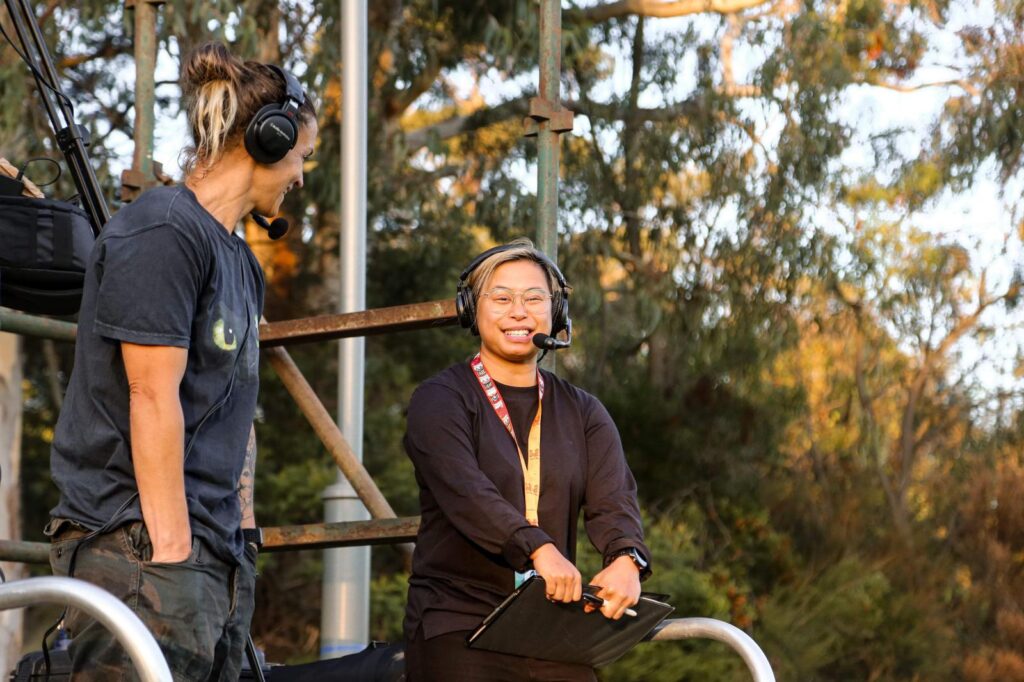
Hanh Tran: “I have a passion for providing a voice for women in sport”

Hanh Tran is a familiar voice across Football Victoria, having served as the original Series Futsal women’s broadcaster. Hanh has become well intertwined within women’s football across the state.

An advocate for women’s football, she has effectively singlehandedly shone a spotlight upon women’s futsal.

Throughout her established commentary career, Hanh has had broadcast involvement in finals, cup competitions and League matches across both indoor and outdoor women’s and men’s football competitions.

Speaking to Soccerscene, she discussed topics including being a commentator, what her dream is as a commentator, and the changes she would like to see in Australian womens football.

Tell me about yourself as a commentator.

Hanh Tran: I have been commentating on women’s soccer for a little over 5 years.  I first began commentating on woman’s futsal for the Series Futsal Victoria Women’s league, played at Futsal Oz.

At the time the Men’s competition had weekly commentators calling their game and the women’s did not.  I was also a player for the women’s league at the time.

I felt that the woman needed a voice to help boost and build their game, so I then made the initiative to jump on the mic and give commentating a try with the encouragement from owner Peter Parthimos I was in the box commentating my first week after.

In the beginning, it was all voluntary work and was more than happy to provide my time each week as it was something that I loved doing and the players enjoyed watching the game with commentary on it.

In late 2019 Football Victoria held an information seminar for women in media. This opened a huge door for me to help bring my commentating to a new level and provide me with a new challenge.

I was invited to join the Football Victoria commentary team for the upcoming 2020 season of NPL and NPL Women’s.

Unfortunately, due to COVID, I couldn’t make my debut to call the NPLW games that year. Fast forward to 2021 and I have been on the roster for most of this season calling the NPLW games.

I have a passion for providing a voice for women in sport, where at times there has been a male broadcaster calling female games. I feel the industry is in the progression of providing opportunities for diversity.

Growing up, I played every sport that was provided to me and loved being part of the community of sport.

When I watch I hear sports on the TV or radio, I’m so intrigued by the commentators and the way they capture the audience and entertain us in their own unique way when calling the game. I’m always listening out to different techniques and phrases that they use.

I remember watching the Matilda’s vs Vietnam in the Olympic qualifying match and made myself a personal goal to one day commentate a Vietnamese vs Australia football game.

Being from a Vietnamese background, that would be a dream come true. To represent Vietnam, Australia and be the voice for women’s football.

I want to be the pioneer of a Asian background and be a role model for future generation of commentators and media personnel.

What is something with women’s football you’d like to see change?

Hanh Tran: I would love to see more promotion and increasing the exposure of women in the media and to boost diversity in the industry.

I found there was a lack of content to champion and showcase the female players; and most of these outlets were hosted mainly by men.

More games being streamed, especially VPLW. More podcast, reels, panel shows. Pre game and post game interviews.

Advertisement of the players and their clubs, introductory videos of the clubs and teams, similar to USA college basketball and NFL and side line reporters.

What are your thoughts on the Nike Cup competition?

Hanh Tran: Love to see a VPLW team to get to the finals. One of the best quality games we’ve seen in a long time. 2 penalty shoot outs and 3 games going to extra time. They’ve been very close games.

Great exposure to smaller clubs that normally don’t get much limelight. FV have invested time and energy this year to make the cup stand out for the womens game.

Where would you wish to see growth within football in Australia?

Hanh Tran: More investment in the A league and growing the women’s game. So much support goes to the Matilda’s, but then no huge return of money invested in the A league.

Need more growth and international players come to the A-league to grow the game internationally to make it more entertaining.

Similar to what cricket did with the Big bash. Try something fun and exciting to bring in new and young viewers.

90 minutes is a long time to concentrate on a game that is low scoring, something that can bring in new football fans to watch the game.

A more sense of community and excitement, or collaboration with the men’s games, more double headers. The All-Star game was a hit against Arsenal, that will draw in more viewers and spectators.
Previous ArticleNext Article

How Sunbury United Is Defying the Odds to Keep Grassroots Football Alive

Sunbury United stands as a cornerstone of the local community in Melbourne’s outer northwest. But for all the hard work given by local families and volunteers, the lack of funding continues to prohibit a level of growth which matches both ambition and potential.


Consolidating growth across the club

Soccerscene recently spoke to Club President, Sherridan Long, about the club’s ambitions going forward, the family-oriented culture, and the challenges of operating at grassroots level in Australia.

“It’s gone really well in retention of players from 2025, [and] recruiting some players who have been really keen to come to the club and are really contending over just a small handful of spots,” explained Long.

“That’s been really rewarding to see the popularity of our programme and what the team is trying to develop in terms of culture and performance, to be somewhere that people want to go to.”

Furthermore, Sunbury United’s reputation in the community continues to inspire waves of prospective junior players, who are lining up for squad vacancies.

“We’ve got waitlists for almost every age group,” Long continued.

“We’ve seen a growth in interest coming into the club and girls wanting to play football, but also lots of families wanting to move to Sunbury and join our club, or move from other clubs.”

Sunbury United is ensuring that its culture and matchday atmosphere remains a safe, welcoming place for those who matter most in grassroots football: families, players and volunteers who sustain it every week.

Planning for success on and off the pitch

Despite solidifying a successful culture off the pitch, Sunbury United are refusing to slow down. From the senior men’s team to junior age groups, high-performance remains a key objective.

“Everyone is trying to win leagues – this is something we’ve been working towards for a few years,” said Long.

“Each little milestone across the year means we’re getting closer to a senior men’s promotion or championship – it’s been over ten years since a promotion or championship at the club.”

Although several years have passed since Sunbury United saw success in the form of silverware, the club’s progress in recent seasons may yet lead to a trophy in the very near future.

But reaching this goal requires not only a cohesive effort from players and coaches, but from all stakeholders and participants within the club space. To this end, Sunbury United underwent a strategic plan set-up to align their operations with the ambitions and thoughts of everyone involved.

“We undertook some survey and stakeholder analysis through our members to understand what it is they love about Sunbury United, why they participate, where they see the club going and how they can be a part of that.”

“It was nice to hear exactly what they wanted, what they thought of and what they felt by being part of United. So that shaped our strategic plan in terms of performance, community and working together as a team.”

Ultimately, it is this balance of performance, teamwork and trust in the community which can set clubs up for success. Whether at grassroots or professional level, if everyone involved operates under shared values and vision, the silverware becomes a question of when, not if.


Challenges of the grassroots game

As with any club or organisation in sport, progress inevitably encounters barriers, hiccups and challenges along the way. Facility access, infrastructure quality and investment are common issues not just for Sunbury, but for all in the grassroots space.

“Most places share winter and summer sports so you can only use your space a certain amount of months a year before it turns to the summer sport,” Long outlined.

“It means that there’s no space for juniors to conduct a proper pre-season, so they’re doing it at other reserves in Hume Council and not actually at our home.”

Indeed, we have seen already the lack of investment directed towards the football community. Soccerscene recently looked into The City of Hume’s current budget, which revealed a 10:1 funding imbalance between AFL and the beautiful game. For Sunbury United, and many other clubs, the impact is undeniable.

“We can’t fill the second or third women’s team because there’s no infrastructure to facilitate changing between boys and girls changing room on the flick of a dime. You’re not only balancing access between two squads and gendered safe spaces, but also junior and senior spaces,” Long explained.

“We’re limited by aspirations being within the lines and being within the physical building that we have. Investment in football infrastructure would be a game-changer.”

It’s a common theme in Australia’s grassroots landscape. Clubs with loyal supporters, interested players and a desire to develop, continue to be restricted by the boundaries of their facilities.

It is not about demand. It’s about necessity. If clubs like Sunbury United are to continue working towards player development and squad expansion, external investment is a must-have.


Fighting for the future

As Sunbury United continues to strengthen bonds with the surrounding community and within the club, the foundations are ready for the seasons to come. From youth teams to seniors, the club continues to emphasise connection as a fundamental principle.

“We sit under one umbrella. We’re not two separate committees or two clubs,” Long revealed, expressing the idea behind a connected senior’s and junior’s set-up.

“It’s important to the long-term sustainability and longevity of our club, not just to the performance side, that everyone’s invested and feels a part of something, and that they can be involved.”

One club, one philosophy and one family. Grassroots football will continue to throw its challenges for years to come, but Sunbury are, and will be, more united than ever.

Filopoulos: Football Must Move Beyond Campaigns to Win Fans for Good

Global marketing and advisory firm Bastion has strengthened its leadership team with the appointment of Peter Filopoulos as Managing Director, Experience. This decision brings one of Australian football’s most influential administrators into a new phase of the sports business landscape.

Filopoulos, who has held senior roles across Football Australia, Football Victoria and Perth Glory, will lead Bastion’s experiential and partnerships division, applying a football-informed lens to brand engagement.

Drawing on his time in the game, Filopoulos emphasised the importance of cohesion in building meaningful fan connections.

“For me, the biggest lesson is that fans don’t see brand, content and experience as individual silos, they experience it all as one connected ecosystem,” he said.

“At Football Australia, the work resonated most when everything was aligned; the team, the narrative, the partners and the matchday experience all working together to feel cohesive and authentic. That’s when engagement moves beyond interaction and becomes something far more meaningful.”

He added that too many organisations still treat fan engagement as short-term.

“Where a lot of organisations fall short is treating fan engagement as a campaign. It’s not, it’s an always-on system.”

Filopoulos’ move reflects a broader shift within football, where commercial growth is increasingly driven by experience-led strategy.

“At Bastion, we put experience at the centre—because it’s where the brand comes to life, where partners integrate in a way that adds real value and where fans genuinely connect,” he said.

“Our focus is on building platforms that bring fans closer to the brand… Get that right, and you’re creating something people actively want to be part of.”

Most Popular Topics

Editor Picks

Send this to a friend