


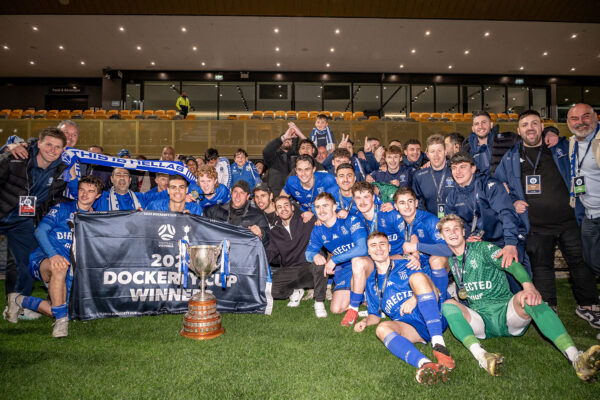

Heidelberg United’s Olympic Park to receive a further $7.5 million in funding

The State Labor Government is contributing $4.5 million to stages 3 and 4 of redevelopment at Olympic Park, alongside $3 million from Banyule City Council.

Olympic Park, home of National Premier League club Heidelberg United, will receive a combined $7.5 million in funding from local and state governments to continue improvements and development of facilities. 

Minister for Multicultural Affairs, Community Sport and Youth, Ros Spence, announced during a press conference at Olympic Park on Friday that the State Labor Government would contribute $4.5 million to stages 3 and 4 of redevelopment at the ground, alongside a $3 million contribution from Banyule City Council.

“These important projects will deliver local jobs in the short term and top-notch facilities for passionate sportspeople for decades to come,” Spence said.

“It’s vital that clubs can provide modern facilities for existing and prospective members – whether they are players, coaches, administrators, or supporters.”

These plans include the expansion of current infrastructure and car park, development of the pavilion, and the building of futsal/basketball courts. The funding is a part of the Daniel Andrews state government’s Community Sports Infrastructure Program.

The ground received a $7 million upgrade during stages 1 and 2 of the redevelopment, which included a new main pitch, as well as a junior and full sized synthetic pitch, of which the state government provided $3.5 million. Today’s conference marked the completion of the upgrade as Spence announced further funding from the state government and Banyule City Council for stages 3 and 4.

Member of Ivanhoe Anthony Carbines attended the announcement and spoke to the crowd of Heidelberg United fans, local government officials, and media. 

“Olympic Park is a place where the community comes together. It’s fantastic that people in Heidelberg and surrounding suburbs will be able to enjoy sports facilities and a meeting place of such a high standard,” he said.

Heidelberg United president Steve Tsalikidis praised the announcement and the work that had been put into securing the funding for the ground.

“A key feature of Heidelberg United’s success on and off the pitch has been the game-changing upgrades here at Olympic Park, and we thank the Victorian government for their part in making the facilities even better.”

Also in attendance at the announcement was Banyule City Mayor Rick Garotti and Football Victoria CEO Kimon Taliadoros.

So far the Community Sports infrastructure Stimulus Package has funded 70 projects worth $335 million in Victoria.

Olympic Park was built in 1956 to accommodate and provide a training base for athletes competing in the 1956 Melbourne Olympics.
Previous ArticleNext Article

Winter Futsal League Returns with New Cup Competition

Football NSW Futsal’s Winter Futsal League (WFL) is back for its seventh season, with 12 men’s clubs and six women’s clubs set to compete across the winter off-season.

The Men’s Division kicks off on Sunday 15 March at Valentine Sports Park and affiliate venue The Centre Dural, welcoming back familiar sides including Dural Warriors, Sydney Allstars and Phoenix Futsal alongside new and returning entrants Eastern Suburbs Hakoah, Mascot Vipers and Sydney Futsal. The Women’s Division follows on 11 April, featuring six clubs including newcomers Dural Warriors and East Coast Bulls. Both competitions will conclude with a finals series in July.

Seven Iranian Footballers granted asylum in Australia after Anthem Protest

Seven members of Iran’s women’s football team have been granted humanitarian visas in Australia, after a dramatic 48-hour operation that saw players slip away from government minders, protesters block team buses, and a late-night diplomatic resolution.

The saga began on March 2, when five players declined to sing the Iranian national anthem before their opening Women’s Asian Cup match against South Korea on the Gold Coast. The moment, seen by millions, prompted furious condemnation on Iranian state television, where conservative commentator Mohammad Reza Shahbazi labelled the players “wartime traitors” and called for them to be “dealt with more harshly.”

“This is no longer some symbolic protest or demonstration,” Shahbazi said on air. “In wartime conditions, going there and refusing to sing the national anthem is the height of shamelessness and betrayal.”

Under Iran’s Islamic Republic penal code, charges of corruption or treason can carry lengthy prison sentences or the death penalty.

A delicate operation

Australian officials had been preparing for what followed for some time. After Iran’s final group match- a 2-0 loss to the Philippines on Sunday night, government representatives were waiting at Robina Stadium on the Gold Coast, signalling to the players that help was available.

A police officer had been stationed inside the team’s hotel, working to create what Home Affairs Minister Tony Burke later described as “the maximum amount of opportunities” for players to make contact. Reports from inside the hotel suggested the women were not permitted to move around unaccompanied and were escorted even to meals.

By Monday morning, it had become clear that five players wanted to stay. The women slipped away from their minders, with Australian Federal Police and Queensland Police there to escort them to a secure location. Shortly after they left, BBC journalists at the hotel witnessed Iranian officials running through the building in an apparent attempt to locate them, but they were unsuccessful.

Burke met the group at approximately 9pm Monday and signed off on their applications for temporary humanitarian visas. By 1:30am Tuesday, the paperwork was complete. In a secure location in Brisbane, the five players, Fatemeh Pasandideh, Zahra Ghanbari, Zahra Sarbali, Atefeh Ramazanzadeh and Mona Hamoudi, broke into a spontaneous chant of “Aussie, Aussie, Aussie.”

Trump calls, the number grows

The story had by then attracted international attention. US President Donald Trump took to his Truth Social platform to demand action, writing that Australia should “give asylum” to the women or “the US will take them.”

Prime Minister Anthony Albanese confirmed he spoke to Trump just before 2am Tuesday. Shortly after, Trump posted again, appearing satisfied: “Five have already been taken care of, and the rest are on their way. Some, however, feel they must go back because they are worried about the safety of their families.”

The number of asylum seekers then continued to rise. As the remaining squad was transferred from the Gold Coast to Sydney Airport ahead of their departure, Burke and Border Force officials pulled each team member aside individually, without Iranian minders present, and offered them a choice. Two more players and a member of the support staff accepted. The total reached seven.

Crowds of Iranian-Australians gathered outside the airport, breaking into cheers as word spread that more players had stayed. A bus carrying the remaining squad had earlier been briefly blocked outside their Gold Coast hotel by protesters lying in the road, some holding signs, others desperately trying to persuade the players visible through the windows to disembark.

“They can’t speak freely because they are threatened,” said Naz Safavi, who had attended all three of Iran’s matches during the tournament. “We are here to show them that we are fully supporting them.”

One changes her mind

The situation shifted again on Wednesday when Burke informed parliament that one of the seven had changed her decision after speaking with departing teammates, who had encouraged her to contact the Iranian embassy.

“As a result of that, it meant the Iranian embassy now knew the location of where everybody was,” Burke said. The remaining asylum seekers were immediately moved to a new secure location.

The six remaining visa holders have been granted temporary humanitarian protection, valid for 12 months and providing a pathway to permanent residency, similar to visas previously issued to Ukrainians, Palestinians and Afghans.

Burke stressed throughout that the process had been entirely voluntary. “We never told anyone it was time to end the meeting,” he said. “If people wanted to stay and keep talking and miss that plane, they had agency to do that as well.”

Iran’s Foreign Ministry urged the players to return home, with spokesperson Esmaeil Baghaei writing on X: “To Iran’s women’s football team: don’t worry- Iran awaits you with open arms.”

The six who stayed have not responded publicly. Burke said they were grateful, and clear about one thing: “They are not political activists. They are athletes who want to be safe.”

Most Popular Topics

Editor Picks

Send this to a friend