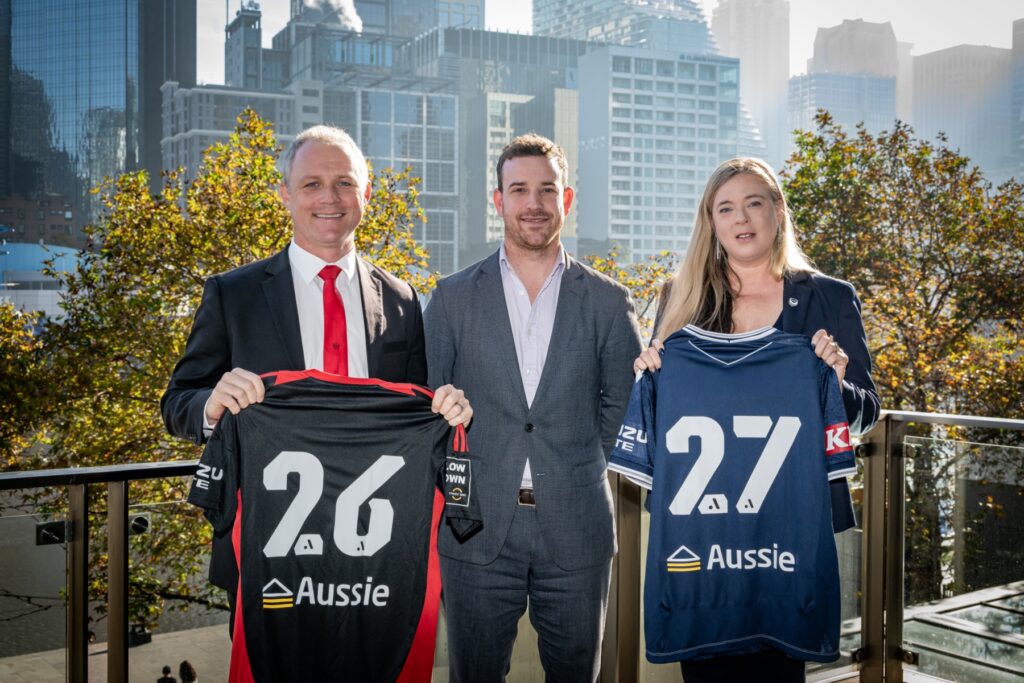




John Didulica’s insight into Australian football is entrenched in a broad and intimate exposure to the game from all areas of the pitch and beyond across many years of playing and working in the game.
His long-standing involvement in football has seen him take on a variety of roles including helping to usher in the Melbourne Heart in their inaugural years as Director of Football Operations, leading Professional Footballers Australia as their Chief Executive Officer and now as Director of Football for a Melbourne Victory side looking to rebuild in the A-League.
His chat with Soccerscene saw a whole range of topics covered, namely his efforts to help push the Victory into a new era, his impactful learnings from his time at the Heart and his recent efforts in helping to produce the ‘Football Belongs’ series with Optus Sport.
Obviously, it’s been a very challenging few years for Melbourne Victory’s A-League side with underwhelming performances on the pitch and difficulties off it, how was it for you coming into a club off the back of some difficult seasons?
John Didulica: I think it’s been an exciting time for me personally to be back involved with football. Melbourne Victory has had such a proud history in its own right, but equally the club has played such a big role in shaping modern Australian football. To be given an opportunity to work here is a great honour and privilege, like anybody who gets to work in football.
The fact that they’ve had a couple of lean years on the pitch doesn’t detract from all the great things they’ve done over the best part of two decades. Coming into the club, with that in mind, it’s not about re-engineering everything or discarding a couple of decades of history. It’s just about trying to more deeply understand what’s worked, what hasn’t worked and where we need to get better to ensure that we’ve got the right standards across not only the team but also all the other areas of the club.
And making sure that we start, day-by-day through our actions, showing that we want to be better. There’s nobody in the world who can come in with a magic wand and say “If you do ‘A, B and C’, you’re going to get a better performance on the park”. The key thing for us is, through our actions, to everyday try and be a little bit better. That’s certainly led by Tony Popovic – that’s the way he approaches his preparation of the team and I think as a staff that’s what we’re adopting.
Hopefully the results on the pitch will in-time reflect that, and restore the confidence of the team, the members and the club which has been tested in recent seasons and we need to show them that we can be trusted with their club.
For you, was it about coming into the club knowing exactly what needed changing or was it about listening and learning?
John Didulica: I think it always has to be about listening and learning. Absolutely that has to be the starting point. I’ve got some models and framework which I like to operate within, but populating that and identifying what needs to be done sequentially is very much about listening and learning.
It’s about seeing where we’re at now, what the acute areas that required immediate attention were, and in our case, it was pretty obvious. We had a brand-new coaching team that we needed to bed down; we had a lot of squad reconstruction that needed to happen; we had to reboot the entire medical department, so, there were a whole of things facing us right from the outset.
Counterintuitively, that’s helped us to build a lot of momentum as it’s forced us to get things done pretty quickly and in a really decisive way. And with a lot of new people on board there’s a lot of really good ideas being shared and I think overtime we’ll start bedding those things down.
But it’s certainly not about disregarding what’s happened over the best part of two decades just because of a couple of lean seasons. I think if anything, the lessons from 3-5 years ago are a lot louder because Victory’s lost its way in the last couple of seasons.
We’re still lucky to have people like Carl Valeri around who has been a great servant at the club for many years and who works in the role of Player Operations Manager. It can just remind us of what we’ve done well in the past and can ensure that we’re continuing to bottle the great things that Victory has done in the past rather than reinvent the wheel.

With the acquisitions of Tony Popovic and numerous proven A-League talents, what are Victory’s objectives for the coming season on the pitch?
John Didulica: Our aspirations are absolutely to challenge for trophies, that’s our expectations internally and I’m sure they’re shared by the members as well. They want to see a team that’s challenging for Honours – that’s certainly Tony’s mindset.
We’re strategically focused on bringing elite Australian talent into the squad and that’s been our absolute priority. Chris Ikonomidis, Josh Brillante, Jason Davidson, Jason Geria, to name a few, are all highly regarded elite proven international level players. So, to have those guys come in it’s a really powerful core and foundation for the club.
And, we might not get everything right in season one because we have so much to do, but I’m really confident that we’ve got a super strong core that will ensure we have a successful season and will only get better in the years to come.
There’s a seduction to going for a couple of big-name players and bringing them in and hoping that they can be a sugar hit, but I just don’t think that’s sustainable and I don’t think that’s what we need at the moment. Because we’re going through so many changes, we need to be able to make as many sure bets as possible. I think with a lot of the players and coaching staff we know exactly what we’re going to get, and we know their history is decorated.
There has been a drive at the club to re-engage the Victory faithful who have ridden through the tough recent history. For Victory fans, what do you believe are the key values off the pitch that need to be reflected on the pitch?
John Didulica: The number one thing I think is for the administration team to match the ambition that the fans have for their club. Our fans at Melbourne Victory are hugely ambitious for what Melbourne Victory can be. Games like we had against Liverpool, that was a magical moment for a lot of people.
Building AAMI Park, something like that doesn’t happen without Melbourne Victory being a success. There’s huge moments and huge steps forward for the sport that are a consequence of Victory doing well. So, the fans see that and are proud to be associated with this club.
Where we need to get back to now is matching the ambition that the fans have for this club. And that’s what we’re committed to doing and I think the board’s demonstrated that by signing Tony Popovic, who’s one of the best Australian coaches and players that are very ambitious, so we know we’re going to get people who are just as ambitious as we want to be.
And I think that sits at the heart of what we’re trying to achieve – matching the fans’ ambition and energy for our club. And if we do that, I know we’re going to be successful. Because we’ve got fans who live and breathe the club and if we reciprocate that then I know we’ll be successful.

You’re now coming into an A-League side that has been around since the beginning of the league’s creation, but taking it back over 10 years ago you spent a few years at the Melbourne Heart from their inauguration. What did you learn from your time at the side in their early years?
John Didulica: One of the things I’ve often learnt on a personal level is to be resourceful and resilient. We didn’t have huge budgets and we ran incredibly lean. We were up against Melbourne Victory who had had such great success as a club.
From my perspective it was great to add to the tapestry of football in Melbourne. The pressure of the Melbourne Derby was, for me, one of the real highlights in A-League history. Those nights have been fantastic regardless of whether you were on the red side of the fence or the dark blue side of the fence, they were great nights.
In terms of that experience [at Melbourne Heart], resourcefulness and resilience were key. What resonated with me during that period was getting a more acute understanding of what the implication taking shortcuts were. When you’re at a club that’s resource-poor, sometimes you have to do that. Sometimes it works and sometimes it doesn’t, but it’s not sustainable.
So, very much coming into Victory it’s key that we’re not going to take shortcuts. We’re going to make sure, to the extent possible, remove as much risk from what we do. That means bringing in high calibre people, servicing them effectively and having the right support around people. Even in those days at Heart we still managed to produce some incredible players; Aziz Behich, Eli Babalj, Curtis Good – these guys were all capped because of the opportunity they were given.
There’s a lot of lessons that I’ve taken with me about the capacity to run youth effectively and hopefully that can be something we can continue to build on here at Victory.

A challenge for Australian football throughout its history has been its search for an identity in the midst of such a diverse sporting landscape. From doing such a deep dive with ‘Football Belongs’, what was confirmed about Australian football for you and what surprised you?
John Didulica: Ultimately, what I was investigating through that series was why is it that we’re not comfortable in our own skin. As football fans we’re always looking for some sort of external validation for who we are. And the more you unwrap football the more you understand the way Australia’s evolved, and therefore the role played by football in shaping modern day Australia and how deeply embedded football is in all of these key themes of Australian life.
And that’s something to be so proud of as a code. We don’t need external validation for what we are as football supporters, I think we should be incredibly proud of what we’ve done. Projecting that forward, I think football has the power to help Australia become a far more progressive nation in the decades ahead.
In the same way football helped Australia navigate the influx of migrants has shown, with the likes of John Moriarty and Charles Perkins, it showed a genuine way of respecting Indigenous footballers. There’s a lot football can do about helping Australia navigate the challenges that we’re going to face as a nation in the generations ahead.
As a sport, we need to take a leadership role in those areas. Anyone who is passionate about football knows it is more than just a sport. Nobody follows football for the ninety minutes on the pitch, as beautiful as that is, we’re all in it because it touches us far deeper. It’s about connecting to your ancestry and the broader community and being able to explore the broader world.
How many football fans would know the capital cities and flags of the world by virtue of their passion for football? Football is an incredible portal to the world and we need to celebrate that more. And it’s about having confidence in celebrating.
A club like Victory is a great segue in regards to ‘Football Belongs’, because Victory’s got a lot of opportunity to lead in a lot of those areas. We’re the biggest football club in the sporting capital of the world in the world’s biggest sport. If you bring those three things together, Victory is uniquely positioned to lead in an incredibly compelling and exciting way.