


La Liga president: OTT streaming platform is key for the future

La Liga president Javier Tebas believes OTT streaming platforms and other technology-based long-term planning is vital to secure the future growth of the Spanish competition.

While the effects of the coronavirus pandemic have forced the football industry into action, Tebas explained it should not come at the expense of exploring different revenue sources.

Speaking at the World Football Summit last week, Tebas outlined La Liga’s long-term plans which will centre on growth in the important digital sphere.

“We’re already working on a 10-year plan,” Tebas revealed.

“There’s already an understanding of what’s coming with regards to audio-visual rights, to technology and to over-the-top (OTT) platforms, which are here to stay. All of this means there’s a need to make plans for a long-term period of transition.”

“I think over these next 10 years, the most important thing for us will be the digital ecosystem,” he continued. “We’ve been working on our digital ecosystem for several years and have invested a lot of money in this, in the likes of OTT and anti-piracy.”

According to Tebas, these investments are needed because the value of audio-visual rights are unlikely to continue to grow at the same rate of the past decade. While the pandemic has contributed to this, the downturn in the market could even be seen before coronavirus affected all of our lives.

Factors like these are the reasons why the president feels it is necessary to turn to alternative revenue streams.

“There are other sources of revenue that we’ve been working on over the years that can be significant and that we think can help us complement the growth [in audio-visual rights income] that might not be two-digit growth,” he continued.

“There’s the digital sphere, there’s OTT and other types of products that you can offer to fans around the world.”

La Liga’s current OTT service, La Liga SportsTV, launched at the beginning of 2019, however primarily offers only lower profile sports in Spain.

As well as creating a platform for these sports, it has also given La Liga a wealth of information in regards to OTT streaming, which will be extremely useful in the years to come.

When asked whether the Spanish competition would ever consider introducing its own version of the NBA League Pass subscription model, Tebas stated: “Certainly. It’s a clever model for a competition’s growth. We’re already working on it and are in an advanced stage of a possible La Liga Pass.”

The president explained that such an offering would not compete with broadcasters, but rather complement existing partnerships.

“La Liga Pass is a product that would be adapted for each territory in the world and that can be offered in collaboration with the audio-visual broadcaster in each territory,” he said.

“It’s a product that could be directed at people who really like La Liga, the super fans, but are living in a territory where the broadcaster only shows a few matches and some highlights. You would be giving these fans more of what they want, which will help the broadcasters to have more value.”

At the centre of any digital growth, there will always be a need for good data capture and analysis, according to Tebas. “If you don’t have a good OTT and good artificial intelligence for all your data, then it won’t help your broadcasters much.”

While Tebas announced his long-term plans for the competition at the summit, in the short term, La Liga has adjusted its economic controls to ensure the game manages the setbacks of COVID-19.

“Reading the accounts from last season, many small and medium-sized clubs are still turning a profit in spite of the coronavirus situation,” he said.

“Next year, there will be profits too because of our economic control. La Liga, in collaboration with the clubs, decides ahead of time how much can be spent, based on income.”

“This had to be a transition year in the sense of signing players,” he concluded. “But these are the responsible measures to take if we are going to meet our collective long-term objectives.”

Previous ArticleNext Article

Decision overturned: FIFA World Cup 2026 to return to Federation Square

Following the announcement earlier this week that Federation Square would not return as a live site for this summer’s FIFA World Cup, Football Victoria announced yesterday that the decision has now been overturned.

Widespread support prevails

The football industry moves swiftly. Whether it’s a deadline-day transfer or cut-throat managerial changes, a lot can happen in a short time span.

And this proved true once again in Melbourne this week.

On Wednesday, Melbourne Arts Precinct announced that it will not proceed as a live site during this year’s tournament.

But following widespread backlash to the decision to not use Federation Square as a live site, the initial verdict will no longer go ahead.

“In the past 24 hours, Victorians demonstrated just how important our national teams are to the fabric of our community,” said Football Victoria CEO, Dan Birrell, via press release.

Furthermore, Birrell highlighted that support for a swift overturn also came from those outside the football landscape.

“The response extended far beyond football participants and supporters, reflecting the wider community’s recognition of the signficance of the tournament and the role these moments play in bringing people together.”


Community comes first

Having Federation Square as a live site during this year’s World Cup ensures that Melburnians wanting to back the Socceroos, can do so as one unit.

But even those who won’t be cheering for Australia, and will instead be adorning another nation’s colours, will still be able to unite and show their pride.

This is what live football is all about.

A variety of communities and nationalities which – despite supporting opposing sides – can come together under a shared love of the game. As Birrell continued to explain, this is a fundamental part of why the decision to overturn bares such importance.

“Football is a game that transcends age, background, language and culture.”

“It brings people together from all walks of life and creates moments of connection that are incredibly powerful, particularly uring global tournaments like the FIFA World Cup.”

The Socceroos will kick off their World Cup campaign against Turkey on June 14.


World Cup 2026 build-up: FA urges Victorian Government to overturn live site decision

Football Australia responded yesterday to the decision by Melbourne Arts Precinct not to host live watch parties during this year’s FIFA World Cup tournament.

FA urges reconsideration

Citing safety concerns, Melbourne Arts Precinct announced that live watch parties would not take place this summer.

As a result, many fans and officials are eager to see the decision overturned as they look forward to rallying behind the Socceroos at their seventh FIFA World Cup tournament.

Football Australia revealed yesterday that they are speaking to both the Victorian Government and the Melbourne Arts Precinct to ensure fans across the city can view live matches together.

“The FIFA World Cup is the biggest sporting event in the world and unites Australia’s multicultural communities, while reinforcing our national identity,” explained Football Australia CEO, Martin Kugeler, via official press release.

“Live sites create iconic moments for Australian sports fans. They bring all Australians together to celebrate and cheer our National Teams competing on the biggest stage.”

“Melbourne is one of Australia’s sporting and multicultural capitals, and this decision goes against this tradition.”


Celebration vs safety

While many will be backing the FA in their call to overturn the decision, the motivations behind it nevertheless stand to reason.

With thousands of fans packed into an outdoor, public space like Federation Square, guaranteeing order and safety becomes increasingly difficult to deliver.

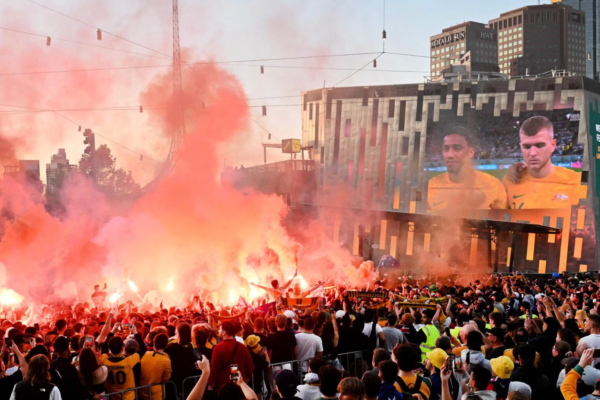
During the 2023 FIFA Women’s World Cup, up to 12,000 fans attended the semi-final screening against England. And although the majority were there to enjoy and support, a small minority took the opportunity to light and throw flares.

Therefore, the response from the FA begs an important question in staging live sporting events:

At what point do celebrations compromise safety?


Final thoughts

Football brings people together, and international tournaments allow fans to display pride for their respective nations.

But safety remains an absolute priority in sports – from the athletes on the pitch to the fans in the stadium or, during major tournaments, at popular live sites.

Hopefully, an agreement can be reached which balances both aspects of the game.

Most Popular Topics

Editor Picks

Send this to a friend