




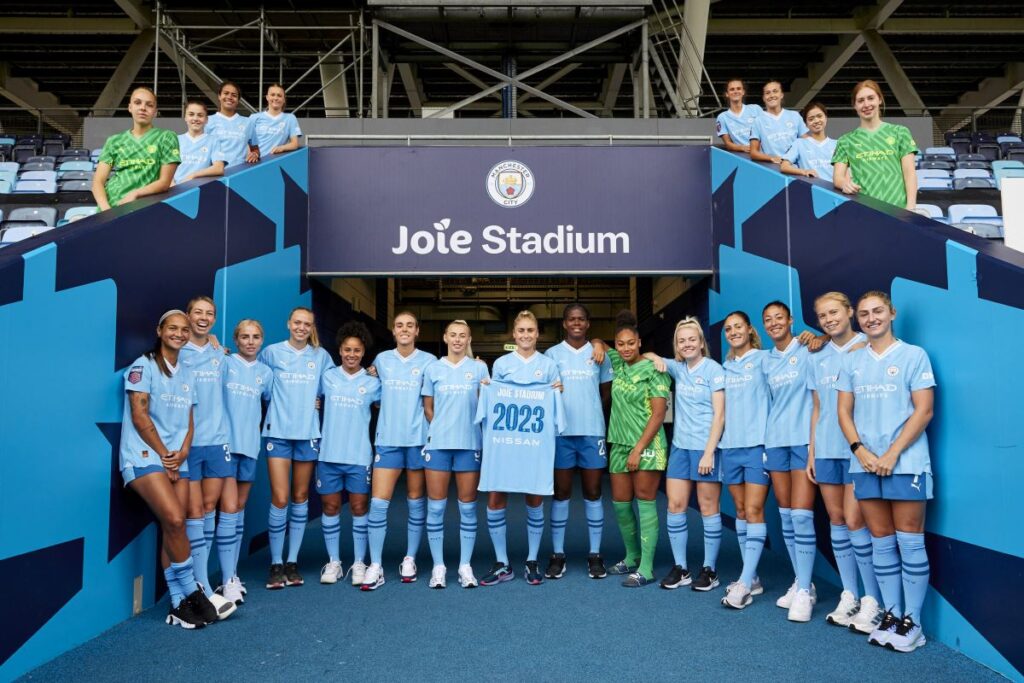
Manchester City Women enter first-ever stadium naming rights deal in WSL history

Manchester City Joie Stadium

Manchester City Women have agreed a stadium naming rights partnership with Joie for their Academy Stadium, the home of their women’s team.

Joie started their partnership with City Women’s team in March earlier this year to become the club’s Official Family Partner and will continue that deal alongside acquiring the stadium naming rights.

Both parties pledge to improve family friendly services at the stadium, as well as offering the best possible matchday experience for fans of all ages across all stadium facilities.

This marks significance as it becomes the first stadium naming rights deal for a Women’s Super League club. The newly renamed Joie Stadium will play host to Manchester City’s second WSL game of the upcoming season against Chelsea on October 8.

The stadium, which opened in 2014, is the only purpose-built stadium in the Women’s Super League and is the home of Manchester City Women. Its current capacity is 7,000 and also hosts many of City’s Elite Development Squad and youth team matches.

Founded in 2011 and originating in the UK, Joie is a family brand that works tirelessly, with families at its heart, to create safety inspired, innovatively designed products that makes parents’ lives that bit easier.

Drawing on decades of industry experience, their devotion to infant products is aimed at doing what is right for parents, children and the environment.

Further internal and external branding featuring the Joie logo will appear across the stadium, with Joie continuing to get involved at every Women’s team fixture.

Gavin Makel, Managing Director of Manchester City Women, explained the importance of this deal for the team in a club press release.

“Today is a really significant moment for Manchester City, as we welcome Joie as Official Stadium Naming Partner,” he said.

“Not only is this a huge moment for Manchester City Women but also for the wider club as the stadium changes name for the first time since its opening in 2014.

“A Women’s team partner since March this year, Joie shares our commitment to family values and high standards, and we’re delighted the brand has chosen to extend its current relationship.

“It is a further reflection of the importance, growth and commercial appeal of Manchester City Women and the wider women’s game, and we are excited to work together with Joie to maximise opportunities for families at our matches.”

David Welsh, Senior Managing Director of Joie, echoed the positive sentiment of the club in regard to this new deal.

“Joie is a family-first brand committed to making childhood and family days out as joyful as possible,” he added via media release.

“We believe that football offers an unforgettable experience for families and by partnering with Manchester City Women and becoming the Official Stadium Naming Partner, we aim to make it truly accessible for all – whether that’s families with babies or parents of older children who will love playing in the Fan Zone.

“We’re incredibly proud of the steps we are making to help provide an all-inclusive experience and are committed to further developing our offer and ensuring that the Joie Stadium is one of the most family-friendly in the Women’s Super League.”

The deal is another step forward for Manchester City women’s team and Women’s football as they gear up for the most anticipated Women’s Super League season in history which kicks off on October 1.


Previous ArticleNext Article

Project ACL: The initiative leading the way on injury research

Launched in 2024, the research project recently welcomed two US-based organisations: the National Women’s Soccer League Players Association (NWSLPA) and National Women’s Soccer League (NWSL).


About Project ACL

Led by FIFPRO, PFA England, Nike and Leeds Beckett University, Project ACL aims to research ACL injuries and understand more about multifactorial risk factors.

After piloting in England’s Women’s Super League (WSL), Project ACL will expand to the NWSL in the US, reflecting the global importance of the project’s research and outcome.

“We are incredibly excited to bring the NWSLPA and NWSL to Project ACL,” said Director of Women’s Football at FIFPRO, Dr. Alex Culvin, via official press release.

“Overall, we believe that player-centricity and collaboration with key stakeholders are central to establishing meaningful change in the soccer ecosystem and that players, competition organisers and stakeholdersaround the world will benefit from Project ACL’s outputs and outcomes.”

Interviews with over 30 players and team surveys across all 12 WSL clubs provided the project’s research team with valuable information about current prevention strategies and available resources.

Furthermore, the project tracks player workload and busy schedule periods during the season through the FIFPRO Player Workload Monitoring tool, therefore gaining insights into the link between scheduling and injury risks.


Looking to the data

Project ACL’s partnerships with the WSL – and now the NWSL – are immensely valuable for the future of player welfare in women’s football.

Although ACL injuries affect both male and female athletes, they are twice as likely to occur in women than men. However, according to the NWSL, as little as 8% of sports science research focuses on female athletes.

In Australia, several CommBank Matildas suffered ACL injuries in recent years: Sam Kerr was sidelined from January 2024 to September 2025, Ellie Carpenter for 8 months after suffering the injury while playing for Olympique Lyonnais, and Holly McNamara came back from three ACL’s aged 15, 18 and 20.

And this is just the tip of the iceberg. The 2025/26 ALW season saw several ACL incidents, including four in just two weeks.


Research, prevent, protect

Injury prevention and research are vital to sport – whether professional or amateur.

But when the numbers are so shocking – and incidents are so common – governing bodies must remember that player welfare comes above all else. Research can inform prevention strategies. Prevention means players can enjoy the game they love.

The work of Project ACL, continuing until 2027, will hopefully protect countless players across women’s football from suffering long-term or recurring injuries.

South Canberra FC Breaks the Mold: Equity-Driven Model Earns ‘Club Changer’ Honour

South Canberra Football Club has been named Club Changer of the Month for April, in a recognition that reflects a broader shift across Australian football toward rewarding clubs that are actively dismantling the structural barriers limiting women’s access to the game.

The AFC Women’s Asian Cup has just delivered record crowds and unprecedented visibility for women’s football in Australia, and the Club Changer program is now asking what comes next. Its decision to name South Canberra Football Club as Club Changer of the Month for April signals a clear shift in how the program defines contribution: away from participation numbers alone, and toward the equity frameworks that determine whether women stay in the game once they arrive.

South Canberra FC built that framework from the ground up. Established in 2021, the club set out to give women and female-identifying players a safe, inclusive environment to play football at any level. It runs entirely on volunteers, operates as a not-for-profit, and is governed by an all-female committee with 13 of its 14 coaches identifying as female.


Building the infrastructure of inclusion

In 2026, the club secured grant funding and put it to work immediately. Two coaches are completing their C Licence qualification, and ten coaches, players and community members have undertaken the Foundations of Football course, which directly tackles the cost and accessibility barriers that exclude women out of coaching pathways.

The club also commissioned a female-specific strength and conditioning program with sports physiotherapists ahead of the 2026 season, targeting injury prevention and explicitly supporting players returning after childbirth.

SCFC’s leadership team draws from LGBTIQ+ individuals, First Nations people and veterans, strengthening the club’s connection to the communities it was built to represent.

The Club Changer program is backing clubs that do this work- clubs that treat equity as infrastructure rather than aspiration. At a moment when Australian football is under pressure to turn its biggest-ever surge of women’s interest into something lasting, SCFC’s model offers a clear answer to the question of how.

Most Popular Topics

Editor Picks

Send this to a friend