

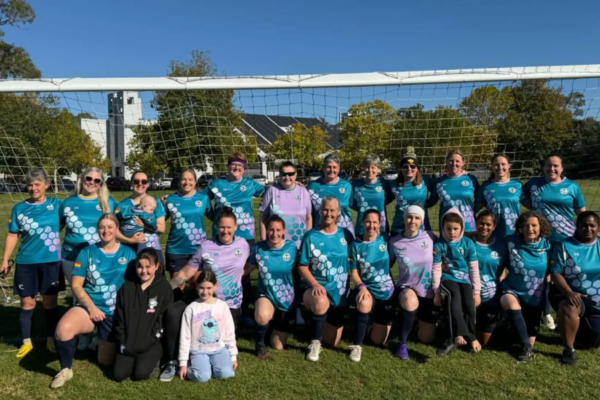

Northern Falcons FC boosted by lighting upgrades from World Game Facilities Fund

Northern Falcons Football Club will receive a substantial lighting upgrade at their home ground in Preston, through a grant received from the Victorian Government’s World Game Facilities Fund.

The World Game Facilities Fund committed $3.8 million to 11 community football facility projects this year, one of them being the lighting upgrades at GH Mott Reserve.

President of the Northern Falcons Football Club, Frank Pizzo, explained the process behind the club’s push to secure the funding.

“We were advised of the grants being available by our local Darebin council,” he told Soccerscene.

“We were discussing with the council (along with Darebin Falcons Women’s Football Club – who we share the facility with) for quite a number of months about how we could get the lighting upgrades. Both clubs were screaming for extra training and facility space for our players.

“There are currently no lights at that facility, so during the winter you can’t train on it. It just doesn’t get the use we could get out of it.

“The council eventually said put in a proposal with the World Game Facilities Fund and see how we go with that, so we started that process with their help and the rest is history.”

The works are set to begin next month according to Pizzo, with a completion date of March of next year.

He believes the upgrades will have a whole range of benefits for not only the club, but also the local community.

“The benefits are going to be amazing,” he said.

“To put it into context, we probably knocked back in excess of 80 kids last year – boys and girls, who we couldn’t accommodate at our main venue.

“There are just no other venues available, so basically the kids weren’t able to play. The massive benefit is that we can get more kids to play the game we love.

“We are also now looking to use the revamped facility as a base for our intellectually disabled team. Currently, that team trains on Tuesday night in a little area on the pitch, which is not really enough.

“We’re now going to be able to give them the facilities they need. A safe facility with recently renovated clubrooms, but now also a pitch with good lighting to train on.

“In terms of the community, they will be able to use the facility as well – it is not just our ground, it is a community facility. There will be a spill over of football activities and other activities at the ground such as cricket. For the community, it’s great for them that they have access to a facility on a 24-hours a day, seven days a week basis.”

The club itself has a strong history and reputation in the local area, something which Pizzo himself has been a huge part of.

“I’ve been involved in the club since its inception in the late 80’s,” he said.

“I was a player at the club, then an administrator, a coach, and I’ve been president for the last 10 years. I’ve got a really strong emotional attachment to the club; my dad was one of the founders of the club. My involvement as president is a fairly consuming, but rewarding role.

“The club has grown in the past five years, from just having seniors and a couple of junior teams, to having 21 junior teams including five women’s teams. It’s grown from being a club with 200 members to a club with 550-600 members, it’s a massive job but I love it.”

The club wants to continue its growth and hopes further pitch redevelopments at its home sites will help with that.

“We would like to have a pitch redevelopment at GH Mott Reserve and we’ve had discussions with council about that already,” he said.

“At our main reserve at Hayes Park, we would love to have some sort of artificial pitch put in there somewhere and we hope we can continue having positive discussions across the board to reach both of these outcomes.”

Previous ArticleNext Article

Football Victoria recognised in Pride in Sport Index 2026

The Silver Status shows Football Victoria‘s commitment to providing Victorians with a safe, inclusive landscape for all to enjoy the beautiful game.

Everyone’s game

Earlier this month, the Australian Pride in Sport Awards recognised several organisations and individuals across the nation who continue to champion inclusive spaces in the world of sport.

Among the nominees was Football Victoria, who received the Silver Status. FV Executive Manager Equity, Programs and Government Relations, Karen Pearce, expressed her pride at the achievement.

“Achieving Silver Status in the Pride in Sport Index is an important reflection of the work being done across Football Victoria to ensure LGBTQ+ people feel safe, welcomed and included in our game,” Pearce said via official press release.

“We remain committed to embedding inclusive practices across all levels of football, and continuing to create environments where everyone can belong, participate and thrive.”


Inclusion matters

While recognition is always a positive reflection of successful work behind the scenes, it is important to remember what the work intends to achieve.

Football – and sport in general – is a unique opportunity to bring diverse communities together, and to compete, spectate and enjoy the game on an equal playing field.

Furthermore, as custodians of ‘the world’s game’, governing bodies, fans and players around the world all share the responsibility to empower marginalised groups to feel included.

Two months ago, The Premier League introduced their own initiative – Premier League With Pride – reflecting their own commitment to ensuring football grounds, schools and academies remain welcoming.


Final thoughts

There is no place for hate or abuse in football, whether on a grassroots field or professional stadium.

Football Victoria will continue its journey and commitment to supporting the LGBTQ+ community – at all levels of the game – for many seasons to come.

Football NSW releases $600,000 towards Grassroots Grants to meet Participation Pressure

The Victorian State Government has announced new grants and funding for 11 new community infrastructure projects for local football clubs, totalling $3.8 million.

Sixty-five football clubs across New South Wales have secured a combined total of nearly $600,000 in funding through the NSW Office of Sport’s Local Sports Grant Program. It follows as a result of Football NSW’s scale of demand for community sport support and the growing pressure on clubs struggling to keep pace with surging participation.

The grants, covering 69 individual projects across the Football NSW footprint, will fund facility upgrades, equipment purchases, participation programs and accessibility improvements: the unglamorous but essential infrastructure that determines whether community clubs can function at the level their members require.

The Local Sports Grant Program made up to $4.65 million available statewide in 2025, with $50,000 allocated to each electoral district and individual grants capped at $20,000. Football’s share of nearly $600,000 reflects the sport’s status as the largest participation code in NSW, and the degree to which that status has not always been matched by corresponding investment in the facilities and resources required to sustain it.

Volunteers carrying an unsustainable load

The announcement arrives against a backdrop of mounting pressure on the volunteer workforce that keeps community football operational. Across NSW, thousands of volunteers dedicate significant unpaid time each week to administration, ground preparation, canteen operation and the logistical demands of running competitive junior and senior programs. As participation numbers climb, driven in part by the sustained visibility of the AFC Women’s Asian Cup and the legacy of the 2023 FIFA Women’s World Cup, those demands have intensified without a corresponding increase in the resources available to meet them.

“As the largest participation sport in NSW it is pleasing to see almost $600,000 will be reinvested back into supporting our players, coaches, referees and volunteers to improve the football experience across our community clubs,” said Helen Armson, Football NSW’s Group Head of Strategic Partnerships and Corporate Affairs.

The equity dimension

The distribution of the grants across 65 clubs and 69 projects also speaks to the geographic breadth of football’s footprint in NSW, and to the uneven distribution of resources that has historically characterised community sport in this country. Clubs in outer metropolitan and regional areas tend to operate with smaller budgets, older facilities and thinner volunteer bases than their inner-city counterparts. Grant programs structured around electoral allocation, rather than club size or existing resource base, provide a degree of equity that market-driven funding cannot.

The kinds of projects funded under this program disproportionately benefit clubs serving communities where the barriers to participation are highest. A club that cannot offer adequate facilities or equipment is a club that turns players away, often without intending to.

Football NSW has used the announcement to call on the NSW Government to maintain and extend its investment in the sport. “We urge the government to continue to invest in football,” Armson said, in the midst for a nation-wide push for a $343 million decade-long infrastructure fund to address the facilities gap across the state.

The nearly $600,000 secured through this round is meaningful. Against the scale of what is needed, it is also a measure of how far the investment still has to go.

Most Popular Topics

Editor Picks

Send this to a friend