Northern NSW Football launches Indigenous Reference Group

Northern NSW Football (NNSWF) has announced the exciting formation of its inaugural Indigenous Reference Group.

The group is made up of seven highly respected members of the football community – including former Matilda Gema Simon, Moree FC’s Darrel Smith and Mick Hugo from South Cardiff FC, as well as Casey Manton (Metford Cobras), Casey King (Italo Stars), Kaliela Thornton (Tamworth FC) and Mat Moncreif.

The group met for the first time virtually on Thursday night (February 3), with the initial meeting a success.

NNSWF Female Participation and Inclusion Officer Annelise Rosnell facilitated the meeting and was thrilled with the positive start for the group.

“It was a really good beginning. We were able to open some initial dialogue on what we want to achieve and how we want to go about it,” she said.

“We have some amazing people who have joined the group and I know given their knowledge and experience we have the ability to make some real progress in this area.

“Our aim is to work together on Indigenous football activities and how NNSWF can better engage Indigenous communities, players, coaches and referees.

“There is plenty of hard work to do but this was certainly an encouraging start.”

NNSWF’s Indigenous Reference Group will meet at least quarterly, but more frequently if needed during the season. Rosnell will report recommendations to NNSWF, which will be factored into the Member Federation’s decision-making process.

NNSWF have been taking positive steps towards connecting with the region’s Aboriginal and Torres Strait Islander heritage.

The Member Federation launched its inaugural RTC Group Indigenous Round across its Premier Competitions last season, in conjunction with National Reconciliation Week.

NNSWF also introduced its first RTC Group NNSWF Talented Indigenous Scholarships to provide assistance to eight Aboriginal and Torres Strait Islander recipients from the Hunter Region and regional northern NSW across playing, coaching and officiating.

The scholarships will again be available in 2022, with details on how to apply made available soon.

Previous ArticleNext Article

Northern NSW Football Launches Female Referee Mentor Program to Strengthen Officiating Pathway

Northern NSW Football has launched a Female Referee Mentor Program, backed by NSW Office of Sport funding, as the federation moves to address one of the game’s most persistent development gaps: retaining and advancing women in officiating.

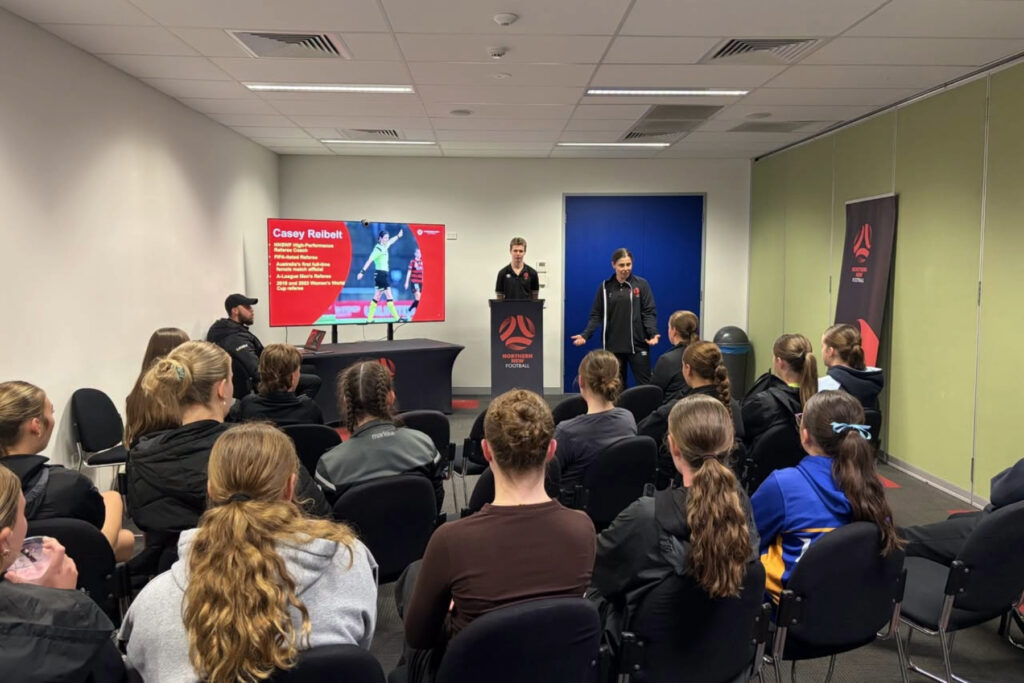
The program pairs emerging referees with experienced female officials and coaches, and has already been introduced in match conditions during the 2026 Northern NSW Women’s State Cup under the oversight of NNSWF high-performance referee coach and FIFA referee Casey Reibelt.

Northern NSW says the initiative is designed to improve progression into representative appointments and leadership roles while building the support networks often cited as critical to referee retention.

Tournament rollout offers first test of model

NNSWF said 25 female referees officiated during the Women’s State Cup as part of the program’s initial phase.

The federation also released a number of key appointments linked to the rollout. Sophie Whale and Jamie Mills-Cove were appointed assistant referees for the Community Plate final. Lilli Skaines and Kaitlyn Digby were appointed to the under-13 and under-15 Premier Youth League Girls Cup finals, with Indi Charlesworth named assistant referee for both fixtures.

Reibelt said the initiative was intended to support younger and less-experienced referees in a practical environment and to reduce the sense of isolation that can come with early officiating experience. NNSWF general manager participation and women’s football Allana Neeve said the federation viewed refereeing as a critical part of women’s football and described the funded program as a pathway investment aimed at long-term sustainability.

From participation goal to workforce strategy

Over the past years, women’s player participation has boomed, but officiating pathways have not always expanded at the same pace, particularly in regional systems where access to experienced coaching and consistent appointments can be uneven.

That has consequences beyond referee numbers. Match officials are a core workforce input for competition quality, scheduling and player development. If attrition is high in early officiating years, federations are forced into constant replacement cycles rather than building depth.

In that context, mentor programs are increasingly treated as operational infrastructure, not supplementary participation projects. What matters is not only recruitment, but conversion: whether referees remain in the system long enough to progress into advanced appointments and eventually into coaching and leadership roles.

Northern NSW’s decision to embed mentoring in live competition rather than classroom-only delivery is a practical strength. Development feedback linked to real matches is generally more actionable for emerging referees than abstract technical sessions.

The next phase, however, will determine whether the program produces structural change. Initiatives launched around major events often generate strong short-term engagement but weaken across regular-season demands, especially where travel, study and work pressures are high.

Over time, the federation will need to show progress in second- and third-season retention, advancement into higher-grade appointments, and sustained mentor participation beyond flagship tournaments. Consistency across metropolitan and regional cohorts will also be central to any claim of pathway equity.

Public funding raises reporting expectations

Office of Sport support gives the program early stability, but it also raises the bar on transparency. Publicly supported pathway programs are typically expected to report outcomes, not just participation stories.

For this initiative, that means publishing practical indicators: cohort continuity, appointment progression and evidence that mentoring remains active throughout the season cycle. Without that reporting architecture, it is difficult to distinguish between a successful event and a durable reform.

For now, Northern NSW has delivered a credible first step: a defined mentor structure, named participants and immediate implementation inside a representative competition. The next challenge is to convert that start into a repeatable officiating pipeline.

Northern NSW Football’s Leadership Program Reaches 98 Graduates as Sport Moves Toward 2027 Gender Parity Targets

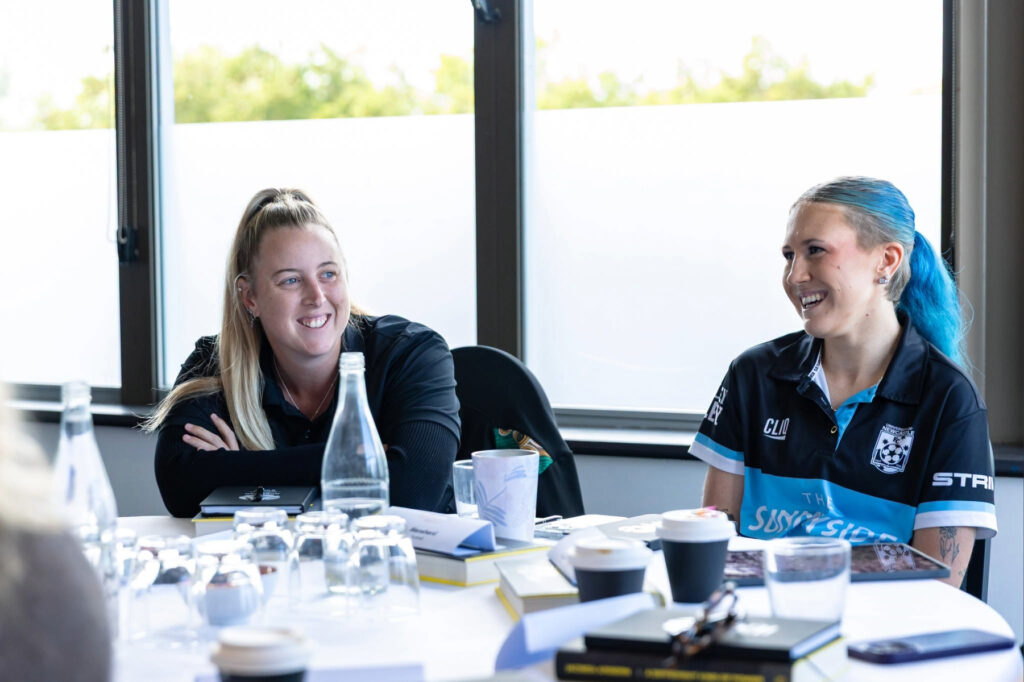
Northern NSW Football has concluded its 2026 Women’s Leadership Program, with 13 participants taking the total number of graduates to 98 women across the region since the program launched in 2023. The five-week program combined online modules with a two-day conference at Rydges Resort in the Hunter Valley, bringing together club volunteers, committee members, administrators and NNSWF staff from Newcastle, Macquarie, Northern Inland and Football Mid North Coast zones.

The program’s growth has been uneven year to year. It launched with two intakes in 2023, drew 25 scholarship recipients in 2024,then settled to 12 in 2025, which brought the cumulative total to 85 before this year’s cohort of 13.

The program was facilitated by Ann Odong, who founded The Women’s Game, Australia’s first dedicated women’s football website, in 2008,and later spent six years as Football Australia’s Media and PR Manager steering the Matildas’ program through multiple World Cups and Olympic Games,before moving into independent consulting work.

A pipeline built against a 2027 deadline

The program fits within a wider set of national targets football and the broader sport sector have committed to reaching within the next twelve months. Football Australia’s Our Game initiative, launched in 2021, set a goal of 50:50 gender parity across players, coaches, administrators and referees by 2027.Separately, the federally backed National Gender Equity in Sport Governance Policy requires all funded national and state sporting bodies to reach 50 per cent women or gender-diverse board directors by 1 July 2027, with funding to be withheld from organisations that fall short.As of the most recent Australian Sports Commission data, 22 per cent of chief executives and 25 per cent of board chairs across 65 federally funded national sporting organisations were women.

Programs built around confidence, networking and committee-level skills, the model NNSWF has run since 2023, are the mechanism most sporting bodies are relying on to close that gap, since board and executive vacancies typically draw from an organisation’s existing pool of committee members, volunteers and administrators rather than external recruitment.

This year’s cohort

University of Newcastle FC’s Charlotte Carey, one of this year’s participants, said the program had given her the confidence to pursue a career in football while developing skills applicable across other areas of her life. Fellow participants included representatives from Cooks Hill United, Westlakes Wildcats, Newcastle Olympic, Lake Macquarie City FC, Western Wolves, Gunnedah and District Soccer Association, Wauchope FC and Stockton Sharks, alongside three NNSWF staff members.

NNSWF Participation and Women’s Football Officer Jamie Bressan said the program had continued to provide women across the game with an opportunity to connect and build leadership skills, with topics covering effective communication, personality styles and team dynamics. Bressan pointed to the network the program builds among participants, drawn from clubs and committees across the region, as one of its central functions rather than the training content alone.

The 2026 cohort’s spread across four zones, Newcastle, Macquarie, Northern Inland and Football Mid North Coast, continues a pattern of the program drawing participants from outside the Hunter region’s largest population centres, consistent with its original design to make the conference and online components accessible to women in regional and remote parts of northern NSW through funded travel and accommodation.

Most Popular Topics

Editor Picks

Send this to a friend