


PolarCool: Increasing performance and recovery in football

PolarCool

PolarCool is a company that provides advanced cooling solutions to treat concussion for a wide range of industries – first established in 2010 and based in Lund, Sweden

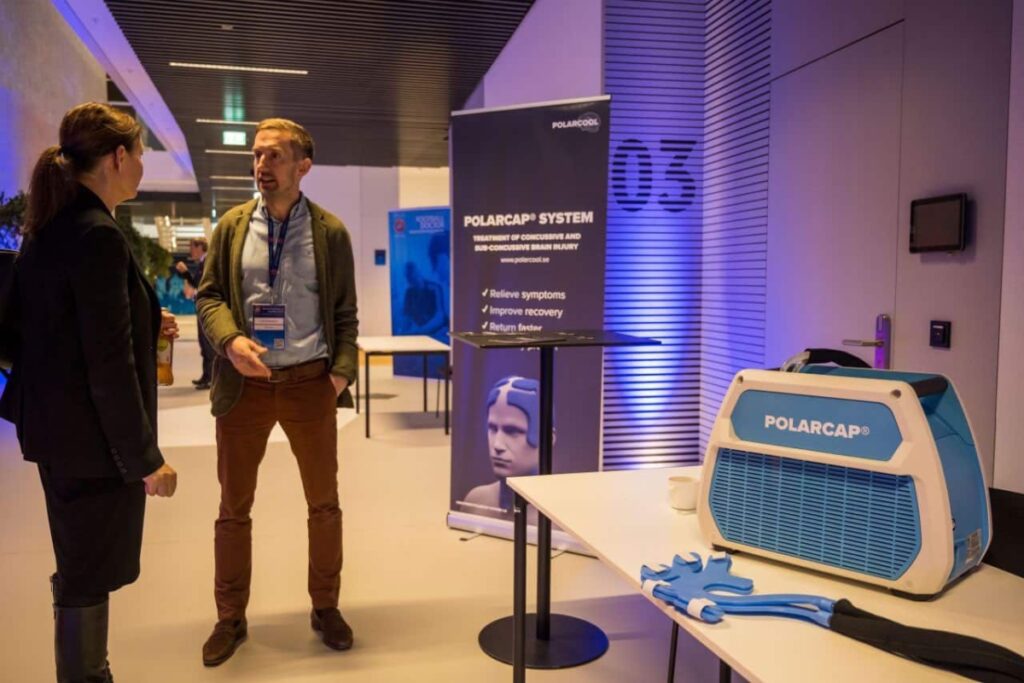
The PolarCap is PolarCool’s flagship product, a personal cooling system that uses evaporative cooling technology to provide instant relief from heat stress. The PolarCap is a headband that can be worn in a variety of environments, including sporting events, outdoor activities, workplaces, and construction sites.

PolarCool, in addition to the PolarCap, offers a variety of other cooling products such as cooling vests, cooling towels, and cooling fans. These products make use of cutting-edge cooling technologies to keep people cool and comfortable in hot environments.

Football is a sport that is known for its physicality and intensity – players are at a high risk of injury, including concussions. Concussions are a form of brain trauma that can have serious long-term effects if not treated properly. In recent years, there has been growing concern about the impact of concussions on athletes, and many organisations have been working to develop new strategies and technologies to help athletes recover from these injuries more quickly and effectively.

The PolarCap has been specifically designed for use in sports, and it is especially effective for football players. Football is a sport that requires a high level of physical endurance, and players are at risk of heat exhaustion and other forms of heat stress. In addition to its benefits for brain trauma recovery, the PolarCap also has a number of other potential applications in sports. For example, it can be used to prevent heat exhaustion and other forms of heat stress in athletes.

There is a growing body of research that supports the use of cooling therapy for the treatment of concussions. One study published in the Journal of Neurotrauma found that cooling therapy can reduce inflammation and improve neurological outcomes in rats with traumatic brain injury. Another study published in the Journal of Athletic Training found that cooling therapy can reduce the risk of second-impact syndrome, a rare but potentially deadly condition that can occur when an athlete returns to play too soon after a concussion.

Due to the positive results shown in the study, the Swedish Ice Hockey League (SHL) has formed a partnership with PolarCool, which ensures that a PolarCap is available at every arena in order to treat concussions.

PolarCool has most recently made waves in football by forming a partnership with the Football Association of Wales (FAW) along with various rugby clubs which include Racing 92, Stade Francais, London Irish, and Scarlets Rugby.

But the benefits of the PolarCap go beyond just preventing heat exhaustion. For athletes who have experienced brain trauma, the PolarCap can be an incredibly valuable tool in the recovery process. By reducing inflammation and promoting healing in the brain, the PolarCap can help athletes recover more quickly and effectively from concussions and other forms of brain trauma.

During one of Wales’ World Cup group matches, a Welsh player suffered a concussion after a speculative shot was blocked with the top of their head.

The player was subsequently treated using PolarCap thanks to the ongoing partnership between the FAW and PolarCool.

After Wales ran on-pitch tests, adhering to FIFA’s guidelines, the player was initially passed to play on before being subbed off 12 minutes later.

The player was then treated with PolarCap for the recommended time of 45 minutes to help reduce his elevated brain temperature and therefore relieve symptoms and potential long-term effects.

This partnership for PolarCool is another progressive step towards improved treatment of concussion incidents in football, an area of the game that has been under heavy scrutiny in recent years.

Aside from the health benefits of using PolarCap for players recovering from a concussion, professional clubs, and organisations can benefit financially from adopting PolarCap.

PolarCool conducted additional research based on the Lund University study’s 5-year clinical results to demonstrate the cost of concussion for sports teams and the financial benefits of using PolarCap.

According to the research, investing in PolarCap is cost-effective because it drastically reduces the injury sunk cost for teams and organisations. The annual injury cost savings for an SHL team were around $51,000.  The average savings for an English Premier League club were calculated to be approximately $257,000

Previous ArticleNext Article

The Spreadsheet Is Dead: Majestri’s Fix for How Clubs Actually Assess Players

If you’ve ever sat through a club’s end-of-season review, you’ll know the drill. A coach pulls out a folder of notes, someone half-remembers what a player was like back in Round 3 and a parent quietly wonders what they actually got for their rego fees beyond a team photo. Football club platform Majestri says it has a fix for that, and it’s built directly into its Player Assessment module.

Why clubs bother assessing players in the first place

According to Majestri, clubs run player assessments for one of three reasons – usually more than one at once. Some are chasing genuine development, using the data to lift the level across their high-performance squads. Others are after a fairer way to pick teams, putting every player on the same measurable scale so selection is based on evidence rather than a coach’s gut feel about who “looks the part.” And for clubs operating under a Football Australia or state federation licence, assessments at set intervals often aren’t optional – they’re a compliance requirement, with the paperwork to prove it when asked.

Whatever the motivation, Majestri’s pitch is the same: don’t let that assessment data die in a spreadsheet on someone’s laptop.

Build your own assessment, your way

There’s no one-size-fits-all template here. The Assessment Designer lets technical directors set their own criteria, sort them into whatever categories their coaching staff already use – think core skills, possession, defending, attacking – and decide what each point on the rating scale actually means. Crucially, every criterion also gets a comment field, because a bare number rarely tells the full story of a player’s development.

The Assessment Module Builder for an NPL Juniors assessment
The Assessment Module Builder, showing an NPL Juniors assessment with a 1-10 rating scale banded from under performing through to excelling and role-specific criteria grouped into core skills, possession, defending and attacking. Source: Majestri.

Build it once and it’s reusable every time that assessment cycle comes around, so every player and every coach – is working off the same yardstick.

Something for the parents to actually take home

One of the more relatable pain points Majestri is targeting: most families never see much tangible return from a season of fees beyond a team photo. Player Assessment addresses that with report cards – colour-coded against the same scale coaches used, grouped by category with averages calculated automatically, and delivered as a PDF or an interactive web page a parent can read without needing a coaching badge themselves.

A player report card for an under-15 player
A report card for an under-15 player, colour-coded from under performing to excelling, with a score for every criterion and a group average across core skills, possession, defending and attacking. Source: Majestri.


Turning the numbers into something useful

The real value, though, sits in what Majestri calls the Player Analysis Lab. This is where clubs can plot a player against their team-mates or an entire age group across two categories at once, spotting clusters and outliers at a glance. Every score gets read against the group average – so a “7” actually means something in context – and clubs can report at the broad category level or drill into individual fields underneath. The results can be filtered down and exported for selection meetings or grading purposes.

The Player Analysis Lab comparing players in an under-15 and under-16 squad
The Player Analysis Lab comparing seven players across under-15 and under-16 squads, with a scatter plot, a sortable table of scores against the player average, and controls for choosing which categories and fields to report on. Source: Majestri.

The admin side nobody enjoys, made easier

Beyond the flashy analytics, there’s a practical layer built for the volunteers actually running the process:

  • Sweep monitoring – a quick view of which assessments are done and which are still outstanding, organised into defined assessment periods so progress can be tracked against peers.
  • Individual development plans – every player gets a personalised plan, and clubs can group common improvement areas to run cross-team training sessions that lift the whole club rather than just one squad.
  • Access control – coaches and technical staff can only see assessments for the teams they’re responsible for, and completed assessments are only visible to people linked to that player’s registration.
“Hard numbers to draw on when you review coaching staff and curriculum – and something tangible for the players and parents who pay the fees.” – Majestri


The bigger picture

Majestri frames all of this as sitting on top of the club’s own data – assessment results live on each player’s profile inside the platform rather than in a spreadsheet that walks out the door when a technical director moves on. For committees, it also means hard numbers to lean on when reviewing coaching staff or curriculum, rather than relying on anecdote.

It’s a fairly clear read on where club administration software is heading: less about digitising paperwork for its own sake, and more about making the data clubs already collect actually work for player development, team selection and compliance  without adding to the workload of the volunteers who run the show.

For more information on Majestri’s Player Assessment module, visit majestri.com.au/player-assessment.

AI-powered camera system makes Supercup debut in live football production

AI-powered camera technology has moved another step closer to mainstream sports broadcasting. This comes after it was deployed for the international tactical feed of the Franz Beckenbauer Supercup between Borussia Dortmund and Bayern Munich.

The system, supplied by Broadcast Solutions, combined Studio Automated’s AI camera automation platform with an Egripment HotHead 3 remote head during the fixture at Signal Iduna Park on 22 August. The Bundesliga and host broadcaster Sportcast have regularly used the season-opening match as a testing ground for new technologies.

Rather than simply tracking the ball or individual players, Studio Automated’s technology analyses the wider match scene and uses broadcast production principles to determine framing and camera movements.

The system was used to operate a camera positioned on the stadium’s main camera gantry. As a result, the footage was available as part of the international tactical production.

The deployment is significant because it demonstrates how AI camera operation can move from trade-show demonstrations into live professional broadcast environments. The companies first showcased the integrated technology at SportsInnovation earlier this year.

The system operates on standard on-premises hardware and does not require cloud connectivity or a calibration process. Its low-latency operation also allows the remote head to respond in a way designed to replicate the movement of a conventional manually operated camera.

Importantly, the technology does not replace the wider production team. The automated camera operates as another source within a multi-camera environment. In this setup, the production team retains control over which images make it to air. This positions AI as a tool for expanding production capabilities rather than removing the role of existing broadcast teams.

For broadcasters and production companies, the potential extends beyond major Bundesliga fixtures. Automated camera positions could help reduce the operational requirements associated with remote and lower-cost productions. At the same time, they can maintain a higher standard of coverage.

Broadcast Solutions will continue showcasing the technology with Studio Automated and Egripment at IBC 2026 in Amsterdam. At this event, the companies will demonstrate integrated workflows for sports production.

Most Popular Topics

Editor Picks

Send this to a friend