
Professional Footballers Australia publishes Socceroos 2022 FIFA World Cup report

PFA Socceroos 2022 Report

Professional Footballers Australia (the PFA) has released a report which analyses the Socceroos’ 2022 FIFA World Cup campaign.

The report here provides the PFA and the broader Australian football community with insights from the experiences of Australia’s elite players at the pinnacle tournament of men’s football and a benchmark against which to measure the Socceroos’ future participation in international competition.

The report comprises player feedback on the Socceroos’ priorities during the next World Cup ‘cycle’, and insights into the production of the next generation of national team stars, from a player perspective. It also includes an overview of the economic impact World Cup qualification delivers for Australian football.

The release of the PFA’s research arrives at a time where the Socceroos continue preparations for the 2023 AFC Asian Cup (to be held in January/February 2024), Australia’s junior national teams compete in international tournaments in Europe and Asia and the Matildas prepare for the 2023 FIFA Women’s World Cup. Key findings of the report include:

A world class environment delivers World Cup success

The report reveals a ‘blueprint’ for the ongoing international success for Australia’s National Teams, including insights into the world-class environment provided to the
Socceroos. The same environment will be afforded to the Matildas at the 2023 FIFA Women’s World Cup kicking off next month through the world-leading Collective
Bargaining Agreement (CBA) signed between the players and Football Australia in 2019.

A new generation emerges

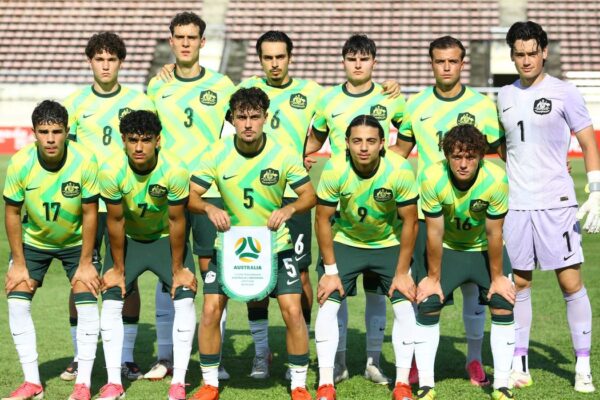
The squad selected at the 2022 FIFA World Cup was the Socceroos’ second youngest by average age. Coupled with emerging talent from the A-Leagues and junior National Teams, the face of the Socceroos is set to evolve further during the next World Cup cycle.

The A-League provides a clear pathway to the National Team

Eight players in the 26-man FIFA World Cup squad were playing in the A-League Men when selected, a record high. A further 12 players had played in the A-League previously, with only six players not having played domestically. These selections and recent developments surrounding youth development provide a promising signal that the A-League is capable of providing a pathway into the national team under current settings.

Players’ feedback on the future

Looking ahead to the Asian Cup, the 2026 FIFA World Cup and beyond, the players said they were focused on building on their progress in 2022 with a preference for more matches against the right opponents to maximise their performance. Nearly half the players (47%) believed that prioritising matches in Australia should be a focus. The players also said that issues impacting young children, such as the cost to play, marketing to attract more children to the sport, and more community facilities for kids, as the highest priorities to help facilitate the production of the next generation of Socceroos and Matildas.

Commenting on the report, PFA Co-Chief Executive Beau Busch said:

“This report is unprecedented in its scope and scale. It is designed to help the Australian football community and all our interconnected stakeholders to deeply understand the conditions that deliver success for our National Teams, to support our collective ambition of sustained international success.

“It is also an important benchmarking tool to help contexualise the achievements of the Socceroos over time and provide an evidence-based, objective analysis of our players and team. There’s a ‘boom and bust’ narrative that often clouds the performance of our National Teams and the performance of our sport, so long-term, data-driven evidence provides a better basis for our game to take calculated strategic decisions towards improvement.

“The report reflects the vital role that collective bargaining has played in delivering a world class environment, which is a clear pre-condition for international success. Equally to the credit of Head Coach Graham Arnold and his staff, the players’ assessments of aspects such as the environment, team culture, and tactical preparation, were also very positive.

“Our hope is that this report provides a foundation for dialogue around the key areas of collective focus and responsibility for our players, Football Australia, the A-Leagues and our National Teams as we pursue a competitive edge on the global stage.”

Click here to download the report.

Previous ArticleNext Article

Football South Australia renews partnership with Datacord as Community Football Commitment Deepens

Football South Australia has announced the renewal of its partnership with Datacord, continuing a relationship that has grown steadily since the South Australian print and document solutions provider first entered the football community as naming rights sponsor of the Collegiate Soccer League Division 1.

That initial agreement, which saw Datacord align with one of Adelaide’s most historic amateur competitions, marked the beginning of what has since developed into a broader commitment to South Australian football at every level. The renewed partnership extends Datacord’s involvement beyond the CSL and into the wider Football SA ecosystem, with clubs across the state now able to access exclusive offers and preferred pricing on photocopying, managed print services and tailored business solutions.

The practical value of that access should not be understated. Community football clubs operate on tight margins, relying heavily on volunteer administrators managing everything from registration paperwork to grant applications. Cost-effective print and document solutions reduce the operational burden on those volunteers, a small but meaningful contribution to the sustainability of clubs that form the backbone of the game in South Australia.

“George is a great supporter of sport in South Australia and we are delighted to have Datacord as a supporter of football,” said Football SA CEO Michael Carter. “Service is second to none and we highly recommend their services to the business community within the Football Family.”

For Datacord Managing Director George Koutsoubis, the renewal reflects a genuine investment in the community rather than a transactional commercial arrangement. “It is important to support the local community, and Football South Australia is the perfect place to start spreading the word about Datacord and what we do for the South Australian community,” he said. “We are locally owned and operated, and I think it is a great partnership to be part of.”

Football NSW releases $600,000 towards Grassroots Grants to meet Participation Pressure

The Victorian State Government has announced new grants and funding for 11 new community infrastructure projects for local football clubs, totalling $3.8 million.

Sixty-five football clubs across New South Wales have secured a combined total of nearly $600,000 in funding through the NSW Office of Sport’s Local Sports Grant Program. It follows as a result of Football NSW’s scale of demand for community sport support and the growing pressure on clubs struggling to keep pace with surging participation.

The grants, covering 69 individual projects across the Football NSW footprint, will fund facility upgrades, equipment purchases, participation programs and accessibility improvements: the unglamorous but essential infrastructure that determines whether community clubs can function at the level their members require.

The Local Sports Grant Program made up to $4.65 million available statewide in 2025, with $50,000 allocated to each electoral district and individual grants capped at $20,000. Football’s share of nearly $600,000 reflects the sport’s status as the largest participation code in NSW, and the degree to which that status has not always been matched by corresponding investment in the facilities and resources required to sustain it.

Volunteers carrying an unsustainable load

The announcement arrives against a backdrop of mounting pressure on the volunteer workforce that keeps community football operational. Across NSW, thousands of volunteers dedicate significant unpaid time each week to administration, ground preparation, canteen operation and the logistical demands of running competitive junior and senior programs. As participation numbers climb, driven in part by the sustained visibility of the AFC Women’s Asian Cup and the legacy of the 2023 FIFA Women’s World Cup, those demands have intensified without a corresponding increase in the resources available to meet them.

“As the largest participation sport in NSW it is pleasing to see almost $600,000 will be reinvested back into supporting our players, coaches, referees and volunteers to improve the football experience across our community clubs,” said Helen Armson, Football NSW’s Group Head of Strategic Partnerships and Corporate Affairs.

The equity dimension

The distribution of the grants across 65 clubs and 69 projects also speaks to the geographic breadth of football’s footprint in NSW, and to the uneven distribution of resources that has historically characterised community sport in this country. Clubs in outer metropolitan and regional areas tend to operate with smaller budgets, older facilities and thinner volunteer bases than their inner-city counterparts. Grant programs structured around electoral allocation, rather than club size or existing resource base, provide a degree of equity that market-driven funding cannot.

The kinds of projects funded under this program disproportionately benefit clubs serving communities where the barriers to participation are highest. A club that cannot offer adequate facilities or equipment is a club that turns players away, often without intending to.

Football NSW has used the announcement to call on the NSW Government to maintain and extend its investment in the sport. “We urge the government to continue to invest in football,” Armson said, in the midst for a nation-wide push for a $343 million decade-long infrastructure fund to address the facilities gap across the state.

The nearly $600,000 secured through this round is meaningful. Against the scale of what is needed, it is also a measure of how far the investment still has to go.

Most Popular Topics

Editor Picks

Send this to a friend