


Professional Footballers Australia unveil 2021/22 A-League Men’s Report

PFA

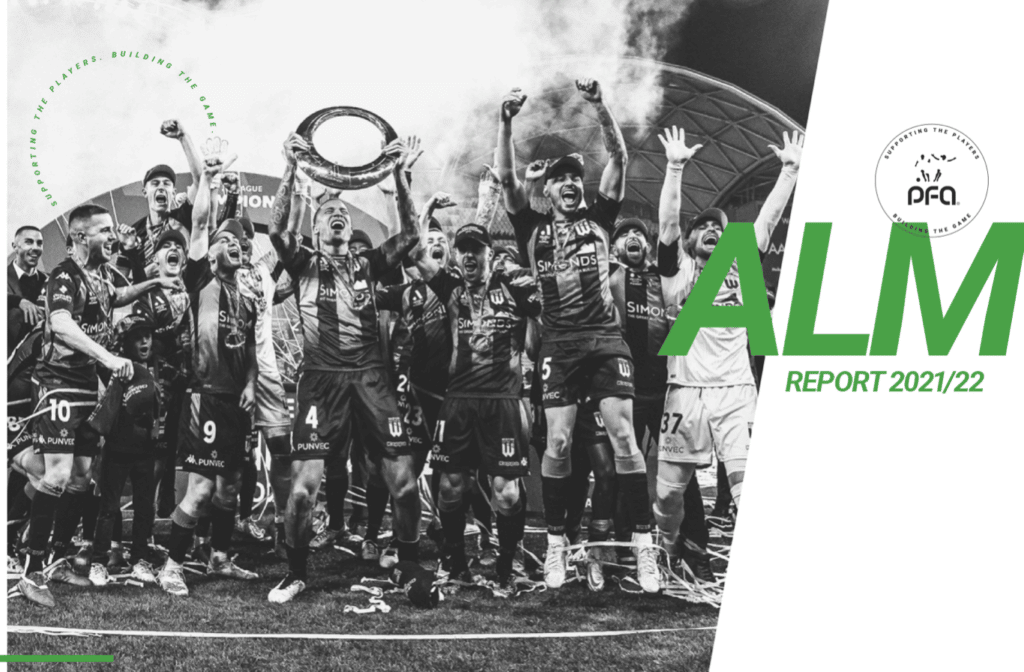
Professional Footballers Australia (PFA), the body that represents professional male, female and elite junior soccer players, has officially released its annual A-League Men Report for the 2021/22 season.

The report revealed that the A-Leagues men’s competition has rebounded from the financial impact of COVID-19 due to an increase in investment from clubs, improved player contract stability and a sustained focus on youth development.

These are among the key findings in the PFA’s annual A-League Men Report, which provides an overview of the 2021/22 campaign and assesses the employment framework and workplace conditions for Australia’s professional footballers.

With the 2022/23 season beginning next week, the Report indicates that the A-League Men competition has solid foundations to build and capitalise upon.

The report identifies that the A-League Men leads all rival Asian Football Confederation (AFC) domestic competitions for fielding players aged 21 or under and sits eighth on a list of 60 leagues from around the world. The League’s average age has been the lowest in competition history during the past three seasons, dropping from an average of 27 to 25. Across the season, 42% of match minutes available were occupied by players under 25.

In addition, the A-League Men is the most competitively balanced league in the Asian Football Confederation. The A-League Men has the closest level of quality among its 12 teams and the tightest points spread recorded in the past decade, delivering more competitive tension within matches and across the season than any other top Asian league.

Clubs invested $52m in A-League Men player payments in the 2021/22 season, demonstrating a rebound in investment following the financial impact of COVID-19 on clubs, up from $38.1m (2020/21).

Moreover, the percentage of players coming off contract at the start of the 2021/22 season was the lowest recorded in eight seasons, decreasing from 68% last season to 48%. The current contract length of Australian players in the A-League Men is among the highest in comparator leagues from Africa, South America, North America and Asia, and the highest in the AFC region.

PFA Co-Chief Executive Beau Busch explained the report underlined the positive impact of the five-year CBA and underlined the resilience of a competition that was severely impacted by COVID-19.

“The objective of agreeing to a five-year CBA was to provide both a genuine partnership between the players and the clubs and crucially to provide the professional game with a stable platform to rebuild the industry,” Busch said in a statement.

“Encouragingly, we continue to see a range of positive trends in relation to increased investment in players, the emergence of a host of talented players and improved contractual stability.

“Whilst these are welcomed signs, there remains much to do to establish the professional game in this country and this report provides the evidential basis to assess our progress as a football nation and benchmark ourselves against our international rivals.”

Click here to download and view the Report.
Previous ArticleNext Article

Football NSW releases $600,000 towards Grassroots Grants to meet Participation Pressure

The Victorian State Government has announced new grants and funding for 11 new community infrastructure projects for local football clubs, totalling $3.8 million.

Sixty-five football clubs across New South Wales have secured a combined total of nearly $600,000 in funding through the NSW Office of Sport’s Local Sports Grant Program. It follows as a result of Football NSW’s scale of demand for community sport support and the growing pressure on clubs struggling to keep pace with surging participation.

The grants, covering 69 individual projects across the Football NSW footprint, will fund facility upgrades, equipment purchases, participation programs and accessibility improvements: the unglamorous but essential infrastructure that determines whether community clubs can function at the level their members require.

The Local Sports Grant Program made up to $4.65 million available statewide in 2025, with $50,000 allocated to each electoral district and individual grants capped at $20,000. Football’s share of nearly $600,000 reflects the sport’s status as the largest participation code in NSW, and the degree to which that status has not always been matched by corresponding investment in the facilities and resources required to sustain it.

Volunteers carrying an unsustainable load

The announcement arrives against a backdrop of mounting pressure on the volunteer workforce that keeps community football operational. Across NSW, thousands of volunteers dedicate significant unpaid time each week to administration, ground preparation, canteen operation and the logistical demands of running competitive junior and senior programs. As participation numbers climb, driven in part by the sustained visibility of the AFC Women’s Asian Cup and the legacy of the 2023 FIFA Women’s World Cup, those demands have intensified without a corresponding increase in the resources available to meet them.

“As the largest participation sport in NSW it is pleasing to see almost $600,000 will be reinvested back into supporting our players, coaches, referees and volunteers to improve the football experience across our community clubs,” said Helen Armson, Football NSW’s Group Head of Strategic Partnerships and Corporate Affairs.

The equity dimension

The distribution of the grants across 65 clubs and 69 projects also speaks to the geographic breadth of football’s footprint in NSW, and to the uneven distribution of resources that has historically characterised community sport in this country. Clubs in outer metropolitan and regional areas tend to operate with smaller budgets, older facilities and thinner volunteer bases than their inner-city counterparts. Grant programs structured around electoral allocation, rather than club size or existing resource base, provide a degree of equity that market-driven funding cannot.

The kinds of projects funded under this program disproportionately benefit clubs serving communities where the barriers to participation are highest. A club that cannot offer adequate facilities or equipment is a club that turns players away, often without intending to.

Football NSW has used the announcement to call on the NSW Government to maintain and extend its investment in the sport. “We urge the government to continue to invest in football,” Armson said, in the midst for a nation-wide push for a $343 million decade-long infrastructure fund to address the facilities gap across the state.

The nearly $600,000 secured through this round is meaningful. Against the scale of what is needed, it is also a measure of how far the investment still has to go.

Victory unites with Roasting Warehouse in culture-led partnership

The Melbourne-based anf family-owned business will join the Victory family, uniting two institutions which represent the city’s culture and identity.

A partnership with local roots

As the newest partner of Melbourne Victory, Roasting Warehouse joins forces with a vital part of the city’s sporting landscape.

The club’s Managing Director, Caroline Carnegie, outlined why the partnership bears so much value to both parties.

“We are excited to collaborate with Roasting Warehouse, a community-oriented destination for high-quality coffee, proud of its foundations in Melbourne,” said Carnegie via official media release.

“Football and coffee sit at the epicentre of Melbourne’s culture. The two go hand-in-hand, consistently at the centre of the conversation that stirs Melburnians, which is no different to the conversation sport and Melbourne Victory stir in the State.”

Indeed, this is a partnership which combines the identity, passions and culture of an entire city, therefore giving it the foundations required for long-term, mutual success.

Representing the best of Melbourne

Both Victory and Roasting Warehouse are hugely successful in their respective industries. They are institutions with community-oriented philosphies, who pride themselves on craft and quality.

“We’re incredibly proud to partner with Melbourne Victory, a club that represents the heart, passion, and ambition of Melbourne,” revealed Roasting Warehouse Head of Brand, Alexander Paraskevopoulos.

“As a Melbourne-founded, family-run business, supporting a team that means so much to the local community feels very natural for us.”

Furthermore, through their high-quality blends, Roasting Warehouse will look to prepare Victory’s players and staff for high performances on the pitch as the seasons nears completion.

But this is about far more than just fueling athletes.

This is a partnership which embodies and unites two of Melbourne’s greatest strengths and cultural markers – a connection forged from the city’s very own DNA.


For more information about Roasting Warehouse, click here.

Most Popular Topics

Editor Picks

Send this to a friend