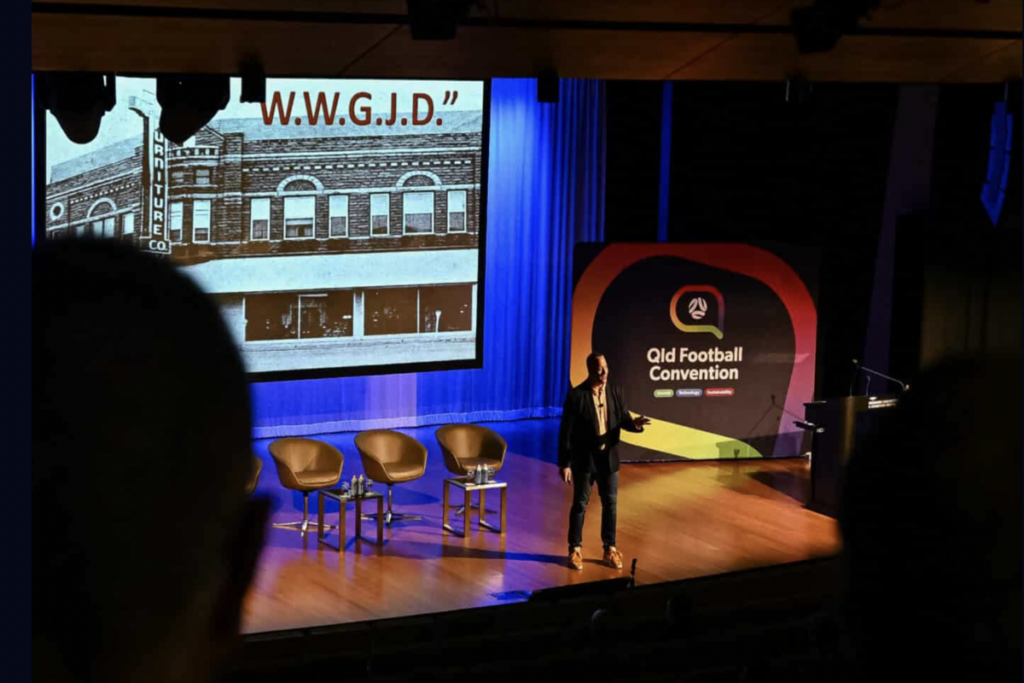

Robert Cavallucci: “We are no longer going to accept playing second fiddle to other sports”

With the COVID-19 restrictions easing in Queensland, CEO of Football Queensland Robert Cavallucci is travelling the state to conduct club summits as part of the Future of Football 2020+ consultation process.

The strategy aims to provide a voice for people involved within the football industry. Administrators, coaches, players, and other stakeholders are being encouraged to constructively participate in high-level discussions and provide recommendations.

After conducting several summits and scheduling many more, Cavallucci spoke exclusively with Soccerscene to share his insights into the current state of investment, infrastructure, and regional football in Queensland and also to discuss some of the challenges ahead.

“We are conducting an extensive state-wide consultation process and the main purpose of it is to listen. It is about asking football stakeholders their vision of the game and ultimately, we will bring it all together in a report where we will outline opportunities across four key areas of focus. Governance, administration, competition reform, and affordability,” Cavallucci says.

One of the major goals for Football Queensland moving forward will be to amplify the level of investment that the State and Federal governments provide. With participation rates steadily increasing, Cavallucci fears the current level of infrastructure will struggle to meet the growing demand caused by more players and more staff.

“The level of infrastructure and financial support is mixed. Some areas have fantastic facilities and others have suffered from years of underinvestment,” he says.

“Underinvestment has been a systemic problem for Australian football. In the past our sport has failed to work with governments in a meaningful way. In Australia and in Queensland, we have failed to demonstrate our value and our contribution to the community. We have failed to stand up for ourselves and we have failed to make the case as to why our sport deserves significantly better investments from the government.”

“We now can demonstrate with data that we are clearly the biggest game, particularly for girls and women. We have the Women’s World Cup on the way and it is absolutely our responsibility to make the case as to why they need to support our game. There is an imbalance of investment and our infrastructure can simply not accommodate the growth, let alone the nature of the game which is changing and becoming far more inclusive and accessible than ever before.”

Although there is a need for more financial backing, recent years have seen a positive trend in the amount of wages Football Queensland have been able to allocate to staff working within the industry.

Data provided by Cavallucci reveals that for men’s football, the annual budget allotted to coaches and other staff in the state was $178,000 in 2017. This rose to $316,000 in 2018 and to more than $551,000 in 2019.

For the women’s side of the game there has also been a substantial increase of funding to meet the demand driven by participation rates. In 2018 $65,000 was being invested into staff wages, a figure which rose to more than $200,000 in 2019 and is set to increase further.

Football has long overtaken the traditional powers of Rugby League and Rugby Union as the most popular organised sport in Queensland and the successful Women’s World Cup bid will certainly add to the world game’s momentum. Football Queensland is optimistic of seizing the opportunities that are presenting themselves by implementing a level of planning and professionalism that has not previously existed.

“For the first time we have created a state-wide infrastructure plan which clearly outlines our motives for the next four years, how we plan to deliver these motives, and how we will work with the government to achieve them. It’s the first time all these types of things are being done and documented,” Cavallucci says.

“Football is the biggest and greatest sport; we are no longer going to accept playing second fiddle to other sports.”

While Football Queensland is working towards high-level reform, the current summits are also focusing heavily on regional and grass-roots football.

One of the major challenges top level administrators currently face in Queensland is the sheer vastness of the state. Townships and regions are often separated by hours of travel so providing equality in terms of competition, infrastructure and development pathways has always been difficult.

“We’re absolutely keen to develop regional football further, but Queensland is a very big state. The tyranny of distance presents immense challenges to ensure we have the opportunity for all participants to have access to the same services, pathways, facilities, opportunities for coaches, and referees. It presents enormous challenges,” Cavallucci says.

“That being said, regional football in Queensland is in a fantastic place. We have great local competitions and there has been some major growth in participation figures for across both genders.”

Cavallucci adds that a theme of the feedback, particularly from those in northern Queensland has been around restructuring the competitive zones. The state is currently split into 10 geographical zones which although designed with the best intentions may be holding clubs back.

“From our perspective, there needs to be a willingness to be open to new ideas. Many of the clubs want broader regions because they feel constrained within their geographical boundaries. The feedback around that has been really strong as the boundaries may limit what some of the more aspirational clubs are wanting to do,” he says.

The Future of Football 2020+ consultation process is expected to include more than 186,000 participants, 317 clubs, and 12 stakeholder groups. For more information or to register for a focus group, visit footballqueensland.com.au/future-of-football.

Previous ArticleNext Article

PFA Reveals Findings from 2024-25 A-League Men Report

Professional Footballers Australia (PFA) has released the 2024-25 A-League Men Report featuring insights into the developments and challenges experienced across the men’s game throughout last season.  

Recently published, the report collected data through PFA end of season surveys, post-match surveys and fan focus groups to gain a comprehensive understanding of player and fan experiences. The report’s findings will hopefully serve not only to highlight existing issues within the men’s game, but to provide a direction for future decisions by the Australian Premier League going into the 2025-26 season. 

Key findings

Inconsistent Attendances

Aided by the introduction of Auckland FC, the average ALM attendance rose by 9% from last season. As the report shows, the club reached a league-high average crowd of 18,101, cementing Auckland as a dominating force both on the pitch and in the stands. Seven other clubs also increased their game attendances, most notably led by Newcastle Jets with a 14% improvement. 

Despite this, five clubs saw attendances fall drastically. Melbourne City witnessed a concerning decline of 27% compared to the 2023-24 season, representing the highest drop-off in the league despite achieving on-pitch success and topping the PFA’s Club Index scorecard. Poor attendance is a common theme across the ALM and ALW, with the latter seeing all but two clubs (Adelaide United and Brisbane Roar) increase their attendance since the 2023-24 season.

Falling attendances are also emphasised by excessive stadium capacities. Only three clubs, Auckland, Adelaide and Western United, managed to fill over half of their stadium capacity, illustrating the need to address stadium infrastructure across the league in future seasons.

Player Dissatisfaction 

Similar to the findings in the 2024-25 ALW Report, ALM players continue to prefer an independent commission to the current APL board. According to the 2024-25 end of season survey, 52% of players were dissatisfied with the APL’s management of the A-League, and 60% affirmed that the ALM board should be formed by individuals with no formal connections to clubs. 

With the current board featuring five club representatives, decisions are increasingly likely to be impacted by conflicts of interest. To resolve such concerns, following the models of leagues like the AFL and NRL may offer a more effective form of governance, in which commissioners selected by the clubs satisfy the prerequisite balance of skills and experience.  

Youth Representation 

A record number of match minutes were given to players under the age of 21 in the ALM last season. According to the report’s findings, Under 21s made up 18% of match minutes, with players under 25 accounting for 56% of minutes played. 

High levels of youth representation isn’t necessarily a cause for concern, as it implies that club academies are maturing and producing high-quality talents worthy of professional minutes. As future generations look to the professional game for inspiration, seeing young players be given the chance to prove themselves is an encouraging sign. 

However, the increasing reliance on young players may also be influenced by clubs turning towards a transfer-focussed revenue and a desire to cut player costs while traditional revenue (such as from broadcasting) falls. 

What Should the Focus be Moving Forward?

As the APL and competing clubs are currently competing in the 2025-26 season, addressing the issues revealed in the ALM Report will help professional football in Australia to flourish. 

Improving Infrastructure 

Increasing attendances and filling stadium capacity will help to elevate matchday atmospheres and thus create an incentive for consistent attendance throughout the season. To this end, following the model practised by MLS clubs in America could be crucial.

According to the report, 22 out of the 29 MLS clubs with stadium capacities of 18,000 to 30,000 all achieved utilisation rates of 79%. Stadia with lower capacity can drive an improved matchday atmosphere and ultimately encourage fans to regularly attend ALM games. 

Inspire Collaboration 

Earlier this week, the PFA and FSAA (Football Supporters Association Australia) announced a new partnership aimed at establishing connections between players and fans and giving them a voice in future decision-making.

This marks a step in the right direction for the men’s game and points to an optimistic future in which all parties can voice their opinion before changes are implemented. Increased collaboration will ensure decisions are collectively agreed upon and reduce conflicts among stakeholders and participants in the APL.

Pounce on International Opportunities  

As the 2026 FIFA World Cup™ approaches, clubs in Australia should see the tournament as a unique opportunity for economic and cultural growth within the men’s game. As part of the altered Men’s World Cup Club Benefits Program, clubs who released players for qualifiers and for the final tournament will now receive a share of the pot totalling just under AUD 535 million. Although it remains unclear how much of this will go to ALM clubs, it remains an added incentive for clubs to propel their players into contention for the tournament in North America next year.

With more domestic players performing alongside the most successful footballing nations on the world stage, it proves to clubs, players and fans that football in Australia deserves high-quality governance, infrastructure and working conditions.

Nerang Real Estate Joins Gold Coast International 2026 as Official Partner

Gold Coast property experts Nerang Real Estate are proud to announce their role as an official partner of the Gold Coast International 2026, bringing their passion for homes and the local community to one of the region’s premier events. Known for turning property dreams into reality, the agency combines local expertise with a commitment to supporting initiatives that unite people across the Gold Coast.

Located in the heart of Nerang, Nerang Real Estate offers comprehensive services for buying, selling, and renting properties. Their experienced team ensures every client enjoys a seamless experience, handling everything from marketing and negotiations to legal documentation for sellers.

For renters, the agency provides a wide selection of properties throughout Nerang and the greater Gold Coast, catering to diverse needs and budgets. Their personalised approach ensures tenants find homes that suit their lifestyle while enjoying a stress-free rental experience.

Buyers and investors benefit from Nerang Real Estate’s in-depth local knowledge and dedication, whether finding a first home, upgrading, or making a strategic investment, the agency has built a reputation as a trusted partner for residents and investors alike.

Partnering with the Gold Coast International 2026 reflects Nerang Real Estate’s commitment to the community and its ongoing support of events that bring people together. Residents, visitors, and fans can look forward to seeing the agency actively involved throughout this major event.

For more information or to discuss buying, selling, or renting, contact Nerang Real Estate at (07) 55 784 000 or visit https://nerangrealestate.com.au/.

Most Popular Topics

Editor Picks

Send this to a friend