


Serie A Gets in on ESports with FIFA

A brand new ESports tournament is set to hit Europe after the Serie A, in combination with marketing partner Infront Media, launched a brand new tournament for the FIFA game series.

The FIFA series is widely regarded as one of the most popular sports titles of all time. Their latest game, FIFA 20, reached 10 million worldwide players in October of last year.

Over the years, FIFA has been a staple of many football fans gaming collection. Only recently has the game delved into the world of ESports.

FIFA and Electronic Arts (EA) first introduced competitive online play in 2009 with their first iteration of the online game mode, ‘Ultimate Team’. Gamers could select any players to play in their sides against another gamer in an online match, with the best players earning promotion to higher divisions.

In FIFA 17, EA began looking to ESports and a more serious approach for online gaming with the introduction of ‘Weekend League’. Here, players would build squads as per usual, except it wasn’t just promotion on the line. Gamers could obtain better players as a result of performing better than everyone else.

Very quickly, EA and FIFA saw the market’s need for a competition to separate the best from the very best and ESports’ collaboration with FIFA began.

The Premier League, MLS and our own A-League have since jumped on board and teams from all of those competitions have registered players to represent their respective clubs in ESports leagues and competitions.

Now, the Serie A has also seen the potential in ESports and a tournament has been launched.

Qualification for the sport is limited to participants who are aged 16 and over, are willing to represent a Serie A top flight club such as Juventus, Inter Milan and AS Roma and they must play on the PlayStation 4 console.

Luigi De Siervo, Serie A Chief Executive has this to say regarding the announcement of the tournament.

“ESports are a phenomenon in continuous growth and expansion and represent one of the key sectors of business in sport.”

“We have the great opportunity to involve an increasingly broad and cross-sectional target, thus bringing us closer to the new generations. All fans will now be able to follow a new championship and the best will be able to represent their favourite team by challenging themselves with their gamepads.”

The ESports competitions, particularly those based around FIFA, have generated copious amounts of attention on popular video sharing platform YouTube and online streaming service Twitch.

FIFA has become a very niche area for people with large areas of reach on the aforementioned websites. Many ‘YouTubers’ have begun playing professionally and have attracted large amounts of fans as a result of their online exploits.

Many of these fans attempt to follow in the footsteps of these professional gamers and as a result, the attention generated for ESports and especially FIFA has spiked ever since ‘Weekend League’ was born.

Online play in the tournament will begin on Monday and Tuesday, with a Grand Final set for May later this year.

 

Previous ArticleNext Article

Netflix’s Women’s World Cup deal puts IMG’s technology in the spotlight

Netflix’s first exclusive football deal will see the next year’s FIFA Women’s World Cup at the centre of it’s live-sport strategy. The US-streaming service company has appointed IMG as its production partner for all 64 matches in Brazil, as well as more than 100 hours of live studio programming. The deal includes English and Spanish coverage for viewers within the US, and English and French-language coverage for those in Canada. IMG will also support Netflix’s coverage of the tournament’s draw in December.

The 2027 Women’s World Cup runs from June 24 to July 25 across eight host cities, and will be the first edition to feature 32 teams. The scale of the tournament makes it an ambitious first foray into sports broadcasting for Netflix – which means IMG’s involvement will be of great significance.

IMG’s production engine

IMG has built its reputation on producing and distributing live sport at scale. It’s Stockley Park, London facility includes broadcast studios, production galleries, edit suites and facilities for radio, podcasting, dubbing and visual effects. The company has worked across major properties including the Premier League, Major League Soccer and other international sporting events.

For a World Cup, this infrastructure provides more than a place to make television; it creates a central point where production teams can manage feeds, graphics, replays, commentary, editing and distribution while events are taking place thousands of kilometres away.

Remote production is the key

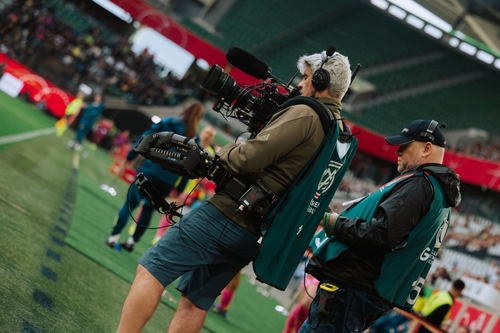
The most important technology for a tournament spread across eight Brazilian cities is connectivity. IMG has invested in remote-production workflows that allow production teams to work across locations, rather than putting every specialist inside each stadium. Its wider production operation has used fibre, satellite, cloud and IP-based connectivity to move live signals between venues and production centres.

That model can reduce the amount of equipment and specialist staff required at every venue while allowing senior producers, directors, replay operators and graphics teams to work from centralised facilities. IMG has also demonstrated long-distance IP production, including a 20,000-kilometre link between Tokyo and London that carried uncompressed, low-latency video. For Netflix, those capabilities are particularly relevant. The platform is building a single viewing experience for audiences in two markets, but the raw ingredients will come from stadiums spread across Brazil. A resilient network becomes just as important as the cameras themselves.

From stadium to stream

The technology chain does not end when the pictures leave the venue. A modern sports production operation has to manage ingest, replay, media asset management, graphics, audio, quality control, archiving and transmission. IMG’s facilities have been built around those workflows, with master control and transmission capabilities alongside post-production and archive operations.

That infrastructure also gives IMG the ability to turn the live tournament into a wider stream of content. A goal can become a replay, a highlight, a social clip or part of a studio package without waiting for the match to finish. For Netflix, that fits a platform built around on-demand discovery as much as live viewing.

A new test for Netflix

Netflix has already made a significant investment in football through documentaries and other programming. The 2027 Women’s World Cup takes it up a level. FIFA describes the agreement as the first competition Netflix has acquired in full, making the tournament a major test of its live sports operation. IMG therefore has a job that goes beyond producing 64 matches; it must help Netflix build the technical backbone for a month-long, multi-venue broadcast, while maintaining consistent production standards across languages and locations.

The viewer may simply press play and see a World Cup match appear instantly. Behind that button will be a complex network of cameras, connectivity, control rooms, production systems, people and data. That is the real significance of Netflix’s IMG deal: the streamer is bringing the tournament to its platform, but IMG is providing much of the machinery that can make a global football event feel seamless.

The ball is no longer just being improved it is being connected

The humble football is becoming one of the more technologically advanced objects on a football pitch.

Across the A-Leagues, Mitre’s new Ultimax Pro is focused on improving what happens when the ball is kicked, while LaLiga has taken the next step by turning the ball into a source of live match data.

The contrast shows how football technology is moving in two directions at once, improving the physical performance of equipment while increasingly connecting it to the digital systems surrounding the game.

Refining the Physical Object: Mitre’s Ultimax Pro

The Ultimax Pro, which will be used across the 2026/27 A-League Men and Ninja A-League Women seasons, incorporates Mitre’s HyperFlow, HyperFoam, HyperSeal and Delta Skin technologies.

Its debossed grooves are designed to reduce drag and improve stability in flight, while the cushioning, bonding and surface technologies are aimed at producing consistent rebound, durability and control. The ball carries FIFA Quality Pro certification, reflecting the testing standards required for professional match balls.

The technology is largely invisible to supporters. Its purpose is to make the ball behave more predictably for players, rather than fundamentally changing the football itself.

Connecting the Ball to the Digital Ecosystem: LaLiga’s Sensor-Driven Approach

LaLiga’s approach is different.

The Spanish competition has introduced a radio-frequency sensor developed by KINEXON into its PUMA match ball, with the technology being used across every LaLiga EA Sports fixture this season.

The sensor continuously transmits information about the ball’s position and the precise moment of contact. Around 12 antennas installed in each stadium capture the data and feed it into LaLiga’s wider technology infrastructure.

That gives the ball a role beyond simply being the object of play.

Knowing exactly when the ball is touched can help officials in a variety of situations. Offside, handballs, deflections and other decisions where a difference of milliseconds can affect the outcome could all benefit.

But the more interesting development may sit outside officiating.

LaLiga is using the connected ball to create xBALL, an official data layer that can feed broadcasts, digital products and future second-screen experiences. Data such as shot speed, ball spin and trajectory could all be incorporated into its media and digital products.

The ball is no longer just something that manufacturers compete to make faster, more durable or more responsive. It can also become a source of proprietary data that leagues can use to improve broadcasts, develop digital products and create new ways for supporters to understand the game.

The Ball as Part of Football’s Intelligence Layer

Mitre is refining the physical object. LaLiga is connecting that object to the digital ecosystem of the match.

Together, however, they point to the same direction of travel.

Football equipment is becoming increasingly intelligent.

The evolution is not necessarily about adding technology for its own sake. In the A-Leagues, the objective is consistency: predictable flight, touch and rebound. In LaLiga, the objective is precision and information: knowing exactly where the ball is and when it was touched.

The commercial opportunity comes from what can be built around those capabilities.

As stadiums become more connected, broadcasts become more data-rich and clubs and leagues collect increasingly detailed information about matches, the football itself can become another input into that infrastructure.

It also changes the relationship between equipment manufacturers and competitions.

A match ball used to be primarily a physical product supplied to a league. Connected technology creates the possibility of the ball becoming part of a broader technology stack involving officiating systems, broadcast platforms, analytics and fan-facing digital products.

The A-Leagues are starting with the physical performance of the ball. LaLiga is showing what can happen when that physical object becomes connected.

The next generation of football technology may not be something players wear or referees use.

It may be the ball itself.

Most Popular Topics

Editor Picks

Send this to a friend