


Sport Psychology Senior Lecturer Dr. Christopher Mesagno: The necessity of mental fortitude in professional sport

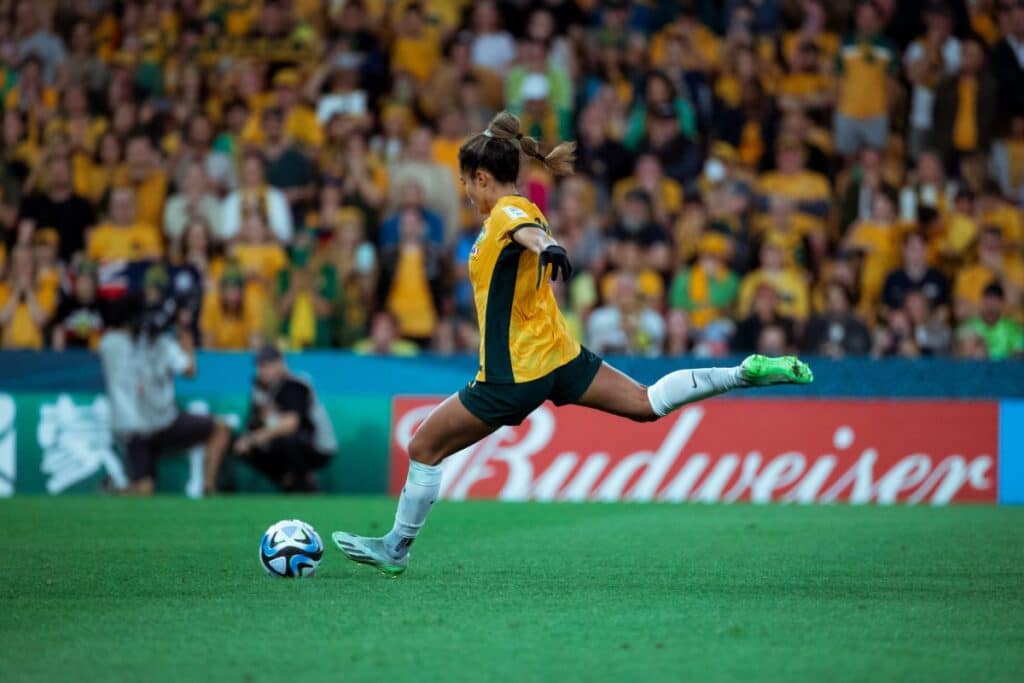
Mary Fowler - Women's World Cup 2023

Psychology and sport are mixing more than they ever have before. With the advent of the internet and the increased pressure that has caused for athletes, sporting clubs and teams are now having to utilise sports psychology to get the best out of their players.

Dr Christopher Mesagno is a Senior Lecturer in Sport and Exercise Psychology at Victoria University. He has over 20 years of expertise in the field and has dedicated much of his research to exploring the effects of stress and anxiety in sport. His predominant focus has been in the phenomenon of ‘choking under pressure’.

Following the Matildas’ record-breaking FIFA Women’s World Cup run, Dr Mesagno provided Soccerscene with some key insights into what mentally might have been happening for our girls as they progressed through the tournament.

What might the Matildas have been thinking and feeling during the tournament?

Christopher Mesagno: Generally, they would be feeling excited and nervous all at the same time. It is very individual for different players as some players become very excited, while some people become very nervous and don’t like the anxiety of the experience.

If they do go to a sports psychologist or if their coaching staff knows a bit about sports psychology, they would have tried to train for that amount of pressure as much as possible, which is very difficult to emulate in a practice situation. They would at least have run though that situation and the possible experience they might have. They’ve also probably played enough to be able to deal with that situation.

As the highest viewed sport in Australian TV history, how might this pressure have affected the players?

Christopher Mesagno: With some of their finals being the most watched sporting events ever, some of them would have been dealing with it and loving it while others might have been freaking out and feeling a bit anxious. But people are individual and its very much about the individual player.

When confronted with big losses, how should athletes best prepare for their next match?

Christopher Mesagno: I would suggest as a sports psychologist that they step away from social media. In sports there’s going to be mistakes and it’s not like they want to do them, but it happens.

Stay away from the social media hype and negativity. You don’t want to carry negative thoughts and feelings into the next match. Importantly, come back to your teammates and coaches as they support and trust you. Stick with the core group that already trusts you and block out the “keyboard warriors”.

What general tips can be recommended for players facing a stressful match?

Christopher Mesagno: Athletes sometimes tend to be worried prior. Music is a way to improve mood and calm down players. Stick with regular routines, whether it be something unique in the warm up or eating the same type of food. Then during a match, get accustomed to the environment and the game setting by getting warm and loose.

After the fact during post-game – be it a win or a loss – try and learn from your mistakes and get back to normal as soon as possible and relax. Especially with the hype of winning huge games you need to go off and reset. You’ve really got to come off even the highs and try and get back to normal and relax a bit.

What is a penalty shootout like from a psychologist’s perspective?

Christopher Mesagno: Research suggests that penalty shootouts are a bit like a lottery as they are so stressful that you may not even know what you’re doing. Those who can mentally regulate themselves and bring back calmness are best placed to succeed in that environment.

When you look at the shootout, there are distinct things that players do that show if they are going to score or not. Most players only miss by a small margin but with choking you see very large misses.

The lead up to the shot-making process is the point where some researchers suggest it is more likely for choking to occur, as players in that moment may be more pre-occupied with getting out of the situation than actually lining up and executing the shot.

One thing you to detect if the players are anxious is that they speed up their penalty kick prior to taking it. The idea of relaxing and taking a deep breath can really go a long way.

Final thoughts

These insights are a great tool for players at all levels as stress can affect anyone. For a player, knowing how to control their emotions is a crucial step in high performance and it was great to have an expert lay out some clear and tangible steps for any players to use.

Once again, we applaud the Matildas for their efforts both on and off the field during this memorable and historic tournament.

Speaking directly about the Matildas, Dr Mesagno offered his personal insight:

“It was amazing to see how the girls lifted and with Australia as well, the further they got into the tournament,” he said.

“I thought the national expectations lifted them a little bit which was nice to see.”

Previous ArticleNext Article

Canada Soccer to begin new National Training Centre project

Backed by the Government of Canada with an investment worth nearly AUD 10 million ($9,826,000), the project aims to establish a world-class facility for athletes, coaches and communities.

Building the sport and community

The investment comes as part of the Build Communities Strong Fund (BCSF), an ambitious program of the Government of Canada which will provide AUD 51 billion ($51 billion) to infrastructure projects over 10 years.

However, the Canada Soccer Training Centre is one key project which will benefit from such substantial investment. But the project isn’t just for future players – it will help boost economic activity and create a facility built for excellence and growth.

“It is about creating a world-class sport facility where athletes can train and represent Canada at their best,” explained Secretary of State (Sport), Honourable Adam van Koeverden, via press release.

“From the playground to the podium, it is projects like this that provide athletes, coaches, local families and communities with vibrant, accessible spaces to fuel participation, connection, and a growing passion for sport.”

President of Canada Soccer, Peter Auguros, further expressed his gratitude for the investment and what it could bring future generations.

“This support reflects a shared belief in the power of sport to strengthen communities and develop the next generation of Canadian talent. We are proud to partner in building infrastructure that will benefit our athletes and help shape the future of the sport in Canada.”


Growth gains momentum

With the FIFA World Cup 2026 set to kick off in a few short weeks, Canada Soccer’s plan for a National Training Centre Project is symbolic of long-term vision.

The tournament is not a final flourish, but a stepping stone to accelerated growth.

And this is not a short-term setup.

As President of Concacaf and Vice-Preisdent of FIFA, Victori Montagliani explained, this is a project designed to survive for generations.

“The development of a National Training Centre in Canada represents an important legacy project for the country and it is always a positive sign when our members invest in infrastructure across the region.”


Final thoughts

The project, therefore, perfectly aligns a growing buzz for football across the region with intentional investment and ambition.

And although the action must eventually stop on the pitch, Canada Soccer are ensuring that growth continues long after the tournament’s final whistle.

Decision overturned: FIFA World Cup 2026 to return to Federation Square

Following the announcement earlier this week that Federation Square would not return as a live site for this summer’s FIFA World Cup, Football Victoria announced yesterday that the decision has now been overturned.

Widespread support prevails

The football industry moves swiftly. Whether it’s a deadline-day transfer or cut-throat managerial changes, a lot can happen in a short time span.

And this proved true once again in Melbourne this week.

On Wednesday, Melbourne Arts Precinct announced that it will not proceed as a live site during this year’s tournament.

But following widespread backlash to the decision to not use Federation Square as a live site, the initial verdict will no longer go ahead.

“In the past 24 hours, Victorians demonstrated just how important our national teams are to the fabric of our community,” said Football Victoria CEO, Dan Birrell, via press release.

Furthermore, Birrell highlighted that support for a swift overturn also came from those outside the football landscape.

“The response extended far beyond football participants and supporters, reflecting the wider community’s recognition of the signficance of the tournament and the role these moments play in bringing people together.”


Community comes first

Having Federation Square as a live site during this year’s World Cup ensures that Melburnians wanting to back the Socceroos, can do so as one unit.

But even those who won’t be cheering for Australia, and will instead be adorning another nation’s colours, will still be able to unite and show their pride.

This is what live football is all about.

A variety of communities and nationalities which – despite supporting opposing sides – can come together under a shared love of the game. As Birrell continued to explain, this is a fundamental part of why the decision to overturn bares such importance.

“Football is a game that transcends age, background, language and culture.”

“It brings people together from all walks of life and creates moments of connection that are incredibly powerful, particularly uring global tournaments like the FIFA World Cup.”

The Socceroos will kick off their World Cup campaign against Turkey on June 14.


Most Popular Topics

Editor Picks

Send this to a friend