



StairMedia: Illuminating stadiums and driving commercial growth in football

It’s likely that football’s TV audiences never actively notice the stairwells of a stadium whilst watching a match. Yet, one company is working to change this by providing football organisations with the opportunity to illuminate its stairwells whilst stimulating economic growth.

StairMedia is a company originating from Spain that installs LED technology for stadium stairwells. Each step is installed with horizontal hardware that, once connected together, delivers an unmissable vertical display.

We currently see leagues and clubs offer televisual space for its sponsors via advertising hoardings, playing shirts and pitch markings. However, StairMedia offers sporting organisations the opportunity to increase its commercial income by maximising the space occupied by banal stadium stairwells.

It is the latest collaboration between technology, marketing and sport sectors, further illustrating the desire of sports organisations to unlock its marketing potential. It also helps to deliver a greater experience for sponsors, who reap the benefits of a highly engaging advertisement that captivates TV audiences.

The company began its sporting journey in basketball, permanently installing its product in the home arena of Spanish basketball club, Saski Baskonia. Since then, it has established high-profile partnerships with some of football’s most recognisable stadiums and organisations.

Most recognisable is Wembley Stadium, where its TV facing stairwells display the logo of the England football team’s official mobile network partner, EE, during their games. The English FA has also utilised StairMedia for its FA Cup semi-finals and finals, helping the competition’s sponsors capture the attention of viewers nationally and internationally.

Later, English powerhouse Manchester City capitalised on StairMedia’s prominence by permanently installing its technology on the stairwells of the Etihad Stadium. This deal has been replicated by Liga MX clubs Chivas de Guadalajara and Santos Laguna.

At the centre of StairMedia’s product is the use of LED technology to illuminate each step on a stadium stairwell. The use of LED in football is not new, with elite stadiums and local grounds turning towards the option for powering floodlights, scoreboards, big screens and advertising hoardings. Therefore, using the technology delivered by StairMedia ticks an important environmental sustainability box for football organisations.

Another plus is the high levels of energy efficiency and durability that comes with LED products, making them a more financially viable option. This ultimately contributes to the return on investment football organisations hope to achieve when installing StairMedia technology.

Behind this is a software system that seamlessly integrates with existing stadium technology, making installation easy for stadium staff and contributes to a highly engaging image for television audiences.

The NRL pioneered StairMedia’s innovative product for its finals series, evidencing its potential in the Australian sports stadia market. This represents a massive opportunity for Football Australia, and the Australian Professional Leagues (APL), to entice current and future sponsors through StairMedia’s game-changing product.

At a time where Australian football is coordinating a major expansion effort, engaging with innovative companies like StairMedia would help unlock new marketing potential. This would play a major role in helping the aforementioned organisations reach its key targets and achieve greater financial stability.

Depending on the timeframe and costing structure, Football Australia or the APL could seek to implement the technology incrementally – as done in the United Kingdom – showcasing it at major events such as the A Leagues Grand Finals, Australia Cup Finals, and World Cup qualifying matches.

Capturing every inch of televisual space for sponsorship and marketing is not an easy task, but through technology companies like StairMedia, football organisations can improve their commercial standing in an environmentally sustainable manner.

We expect to see the stairwells of football stadiums continue to come to life, as StairMedia expands its operation across the globe.
Previous ArticleNext Article

Bentleigh Greens and Metricon Bring Local Business Community Together Through Networking Initiative

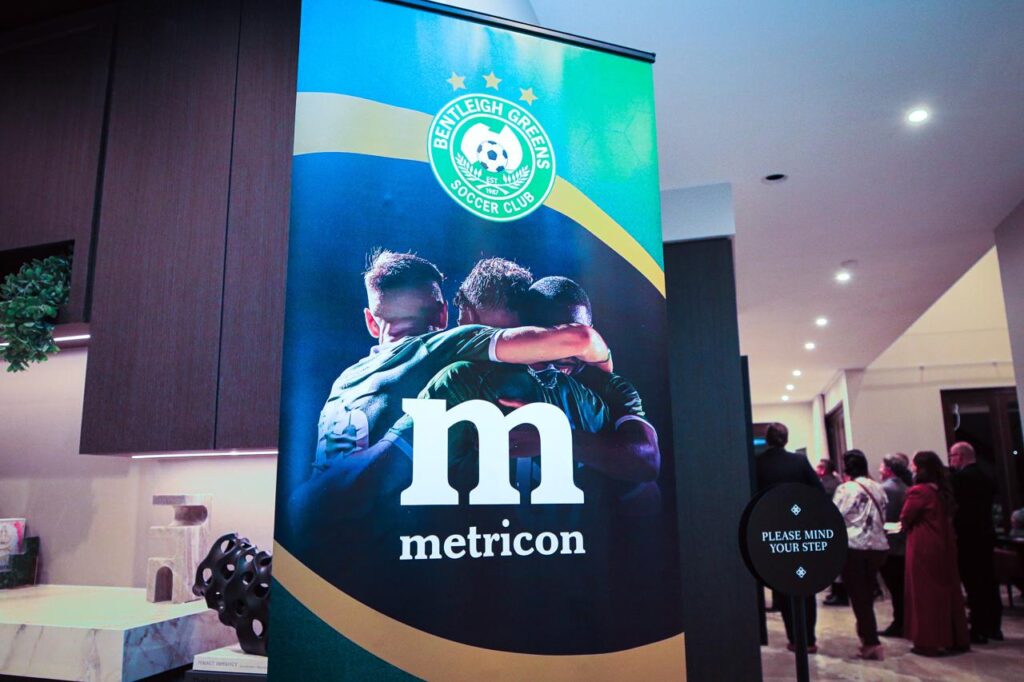
Bentleigh Greens FC has reinforced its commitment to supporting its community beyond football, partnering with Metricon Homes to host a business networking evening designed to strengthen relationships between local businesses, sponsors and club stakeholders.


A unique setting for meaningful connections

Held inside one of Metricon’s display homes, the Bentleigh Greens Business Networking Night welcomed around 60 local business owners, club partners and community leaders for an evening focused on connection, collaboration and knowledge sharing.

Rather than a traditional function space, Metricon opened the doors of one of its display homes, creating a unique networking environment that highlighted how the space could be transformed into a premium venue while providing guests with a relaxed setting to build professional relationships.

The event reflects a growing trend across community football, where clubs are increasingly positioning themselves as platforms for business engagement and local economic development, alongside their role in delivering participation opportunities on the pitch.

Guests also heard from strategic futurist Marcus Barber, who delivered a presentation examining the growing influence of artificial intelligence on modern business. His insights encouraged attendees to consider how emerging technologies are reshaping industries and the importance of preparing for future change.


Creating value beyond sponsorship

While commercial outcomes were never the primary objective, the evening was designed to create long-term value by fostering meaningful relationships between businesses connected to the Bentleigh Greens community.

Early feedback has been overwhelmingly positive, with several attendees already establishing new contacts and beginning discussions around potential collaborations.

The initiative also highlights Metricon’s broader commitment to supporting local communities beyond residential construction. By partnering with Bentleigh Greens and providing the venue, the company helped facilitate an event that encouraged learning, networking and stronger community connections.


Football clubs as community business hubs

For community football clubs, initiatives such as these demonstrate how partnerships can extend beyond traditional sponsorship models. By creating opportunities for local businesses to engage with one another, clubs can strengthen their commercial networks while delivering tangible value to sponsors and the wider community.

As football clubs continue to explore new ways of engaging stakeholders off the field, events like the Bentleigh Greens Business Networking Night illustrate how sport can serve as a catalyst for meaningful business relationships and long-term community growth.

What Football Queensland’s link with Green Room Futures Means as Pathway Strategy Broadens

Football Queensland has signed a multi-year extension and expansion of its partnership with Green Room Futures, formalising the private provider as the state body’s “Official US College & Tour Partner” and adding an annual United States tour for Football Queensland Academy players to the existing college-placement program.

From advisory model to integrated pathway

The agreement marks a substantive evolution in the governing body’s pathway architecture rather than a standalone sponsorship announcement. The two organisations have worked together since at least 2024, when Football Queensland first appointed Green Room Futures as its preferred US college partner and began rolling out athlete information sessions across metropolitan and regional centres. The new arrangement embeds that relationship more deeply into the academy ecosystem by linking advisory services with an international touring product.

In its announcement, Football Queensland said the expanded partnership would offer academy players exposure to US college environments, international competition and broader education-and-sport decision-making support. Chief executive Robert Cavallucci said the relationship had already assisted Queensland athletes to pursue opportunities overseas and that the introduction of an annual tour would strengthen development outcomes for players across the state’s regional footprint. Green Room Futures director Matt Wade said the expansion reflected strong demand for structured US pathways and would provide athletes with more direct insight into student-athlete systems.

A constrained domestic market

For Football Queensland, the strategic rationale means a collegiate model is now an established part of the global football labour market, particularly for players seeking a dual track in education and high-performance sport. In an Australian landscape where professional opportunities remain selective and uneven, college pathways provide a parallel route with different risk settings for families. That logic has been gaining institutional acceptance across the country, and Football Queensland’s move suggests it sees formal international exposure as a competitive differentiator within domestic talent development.

The policy and governance questions are equally clear. The public announcement outlines ambition, but provides limited operational detail on affordability, cohort selection and support settings for regional participants. In practical terms, these details will determine whether the program functions as a broad-based development mechanism or as a premium pathway accessed primarily by households able to absorb compounding costs.

International youth tours involve direct and indirect expenses that typically include flights, insurance, accommodation, tournament costs, travel preparation and time-off-work burdens for families, with regional players often carrying additional domestic travel requirements before departure. Green Room Futures’ publicly available materials also indicate paid service structures within broader college-placement support. None of that is unusual in this market segment; it is, however, central to any serious assessment of access and equity outcomes.

The expanded partnership therefore sits at the intersection of football development strategy and distributional policy. If the tour becomes an informal gatekeeper to college-facing visibility, then financial design features move from administrative detail to core pathway governance. Without those mechanisms, even merit-led programs can produce systematically narrow outcomes because the input conditions are unequal.

For Football Queensland, the outcomes are likely to turn on implementation transparency over the next one to two intake cycles. A cohort profile that is geographically concentrated or socioeconomically narrow would invite predictable criticism, particularly given repeated statewide positioning in Football Queensland’s academy communications. Conversely, early publication of eligibility frameworks, financial assistance settings and regional participation targets would strengthen claims that the program is designed as a genuine statewide pipeline rather than a metropolitan premium add-on.

There is also a broader sector trend at play. Australian sporting bodies increasingly rely on specialist private partners to deliver pathway components once managed internally or left to informal networks. The model can improve expertise and execution speed, but it also shifts part of the development interface into commercial structures. In that context, governing bodies carry a heightened obligation to disclose how partner-delivered opportunities align with public-facing participation commitments, especially where youth athletes and family finances are involved.

What comes next

Well-structured US pathway programs can materially improve athlete decision quality, reduce information asymmetry, and create legitimate post-school options in a constrained professional market. Exposure to college environments can help families evaluate trade-offs around education, migration and sporting progression with greater clarity. For some players, that can be decisive.

The question for Football Queensland is whether the benefits are distributed in a way consistent with its statewide mandate. The announcement establishes intent and strategic direction; the next phase requires publication-grade detail. For a program framed around opportunity, credibility will depend less on partnership language and more on measurable participation design: who is selected, who is supported, and who is priced out.

Most Popular Topics

Editor Picks

Send this to a friend