


Sydney FC introduce first Community Powerchair Football Program

Sydney FC

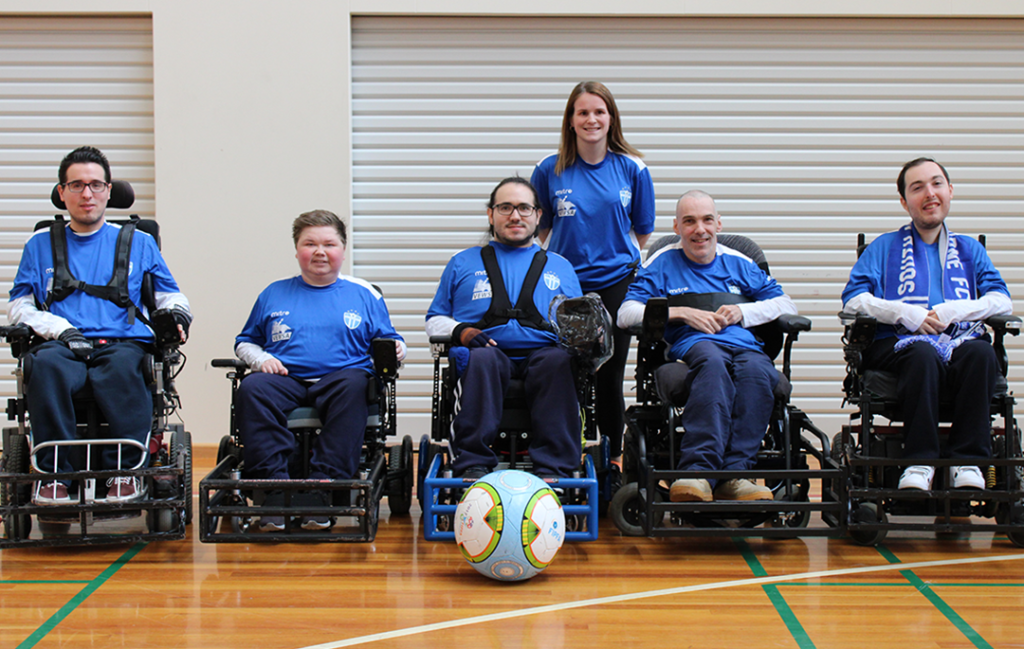
Sydney FC’s Foundation has officially debuted a first-of-its-kind Community Powerchair Football Program.

The initiative saw nine young children and adults with disabilities given the opportunity to experience the world of Powerchair Football for the very first time and were joined by Sydney FC A-Leagues stars Rhyan Grant, Elvis Kamsoba and Charlotte McLean for the two-day clinic at Valentine Sports Park, with Sydney FC’s Powerchair team attending on Day 2.

The Program has been funded by the generosity of the donors and sponsors of The Sydney FC Foundation Dinner and is expected to be carried forward each year.

Haley and Mitch McLean’s daughter, Ruby, took part in their first Powerchair clinic and were thrilled by the experience.

“The Sydney FC Foundation Powerchair Clinic did not disappoint,” Haley said via Sydney FC.

“I’ve got so many thoughts and emotions that are impossible to articulate adequately, she had an absolute ball.

“The whole thing was so well done from the location, the staff, the team, the session, and equipment but most importantly the people.”

Sydney FC Powerchair Head Coach Jason Ryan conducted the sessions which consisted of shooting, dribbling and game-play and was impressed with the players and the initiative.

“I had such a great time delivering this development program,” he said via Sydney FC.

“The excitement that the young people brought to the court was infectious and stayed with us until the very end.

“Watching everyone engage with the football and each other was so rewarding.

“I look forward to more clinics and the opportunity to introduce more people to the sport.”

The Sydney FC Foundation will continue to organise and host multiple Powerchair Football holiday clinics across 2022 and 2023.

Powerchair Football is a modified version of football (soccer) for wheelchair and powerchair users.

The sport is played on a basketball court between two teams of 4, including the goalkeeper.

More information can be found at the Australian Powerchair Football Association – https://www.apfa.org.au/
 

Previous ArticleNext Article

Football Victoria marks World Autism Understanding Month with Expanded Inclusion Program

Football Victoria has marked World Autism Understanding Month with a series of practical inclusion initiatives delivered in partnership with Aspect, reinforcing the governing body’s commitment to making football accessible for autistic participants across all levels of the game.

The partnership, now in its second year, has moved beyond awareness into structural change. Environmental assessments have been completed across multiple programs and match days, including at Collingwood City FC and the All-Abilities League match day at Northcote City FC. Each assessment identifies accessibility barriers and provides concrete inclusion principles integrated into the physical and operational realities of football environments.

Ahead of the 2025 Football For All Gala Day, Aspect conducted an environmental assessment of The Home of the Matildas, informing the development of a Visual Story designed to help participants with autism understand the venue and event before arriving. The same approach has been applied to FV’s GO Camps program, giving participants and families the information they need to engage with confidence.

Aspect has also delivered multiple education sessions for coaches throughout the partnership, with a dedicated session for referees held on April 20, the first of its kind, extending autism understanding across match officials and into all parts of the game day experience.

Football Victoria has also joined the Hidden Disabilities Sunflower Initiative, with training and education to be rolled out across the organisation in the coming months, strengthening its capacity to recognise and support participants with non-visible disabilities.

The initiatives reflect a recognition that access to sport is not guaranteed by an open registration form. For many participants with autism and their families, the barriers are environmental, informational and social; and removing them requires sustained investment in education, assessment and design.

Attendance and Atmosphere: Maximising the A-League’s potential

While many A-League clubs boast some of the most impressive sporting venues in Australia, maximising their potential and drawing in consistently high attendances has remained challenging. As highlighted in the PFA ALM Report 2024-25, only three clubs – Auckland FC, Adelaide United and Western United – reached over 50% of stadium capacity on an average matchday. 

There is a clear infrastructure problem facing the A-League – so how can we tackle it?

Attendance trends in the ALM

Attendance issues and questions over stadia utilisation were revealed in the PFA ALM Report released in November 2025. The findings showed that, were it not for the introduction of Auckland FC and their impressive crowds throughout the season, average attendance in the A-league would have marginally decreased from the previous season. 

Five A-League clubs also saw their attendances fall last season, including Western Sydney Wanderers, Wellington Phoenix, Central Coast Mariners, Perth Glory and Melbourne City. Of these, Melbourne City saw the largest drop off with a decrease of 27%. 

While Auckland should be commended with their ability to attract league-high crowds in their debut A-league season, it must be acknowledged that such reliance on one club to bring up the numbers is not enough. If the league is to continue growing in the years to come, we should encourage all clubs to make efforts to bring local support from the community into the stadium. 


A ‘less is more’ approach?

Planning how to maximise stadia potential and utilise facilities effectively will be vital in future seasons. Unfortunately, the discussions which began at the turn of the millenium with the PFA’s 2002 blueprint ‘For the Fans’, has largely failed to materialise into concrete plans of action. 

The blueprint called for smaller-sized, soccer-specific stadia able to hold 10,000-15,000 fans. In the past 24 years since the blueprint, not a single stadium of this nature has been built. Instead, as the report explains, stadia capacities across the league have excessively increased and strayed beyond the ‘Goldilocks zone’.

Consequently, many clubs have struggled to follow ambitious stadium upgrades with consistently high matchday attendances. For example, of the A-League venues with a capacity of over 30,000, none of them managed to achieve a utilisation rate of over 50% in the 2024-25 season.

In comparison, 22 of the 27 MLS clubs with a stadium capacity of 18,000 to 30,000 achieved a utilisation rate of 79% in 2024, and over half almost always achieved sell-out crowds. It proves that, if clubs want to attract supporters and create intense matchday atmospheres, constructing high-capacity stadiums isn’t always the answer.

Reducing the ‘gap’ between players and supporters

The benefit to ‘soccer-specific’ stadia is that the distance between players and supporters is both physically and figuratively reduced.

“Compact grounds intensify the atmosphere from a given number of people and, close to their limits, create a scarcity factor that drives sustainable support regardless of results or other conditions,” the report explains.  

By having ‘Goldilocks zone’ capacities in purpose-built stadia, home supporters are brought closer to the action and feel more immersed in the matchday experience. As fan engagement grows and attendances increase, clubs can maximise ticket sales, creating new avenues for merchandising and unique matchday experiences to continue establishing connections with local and loyal supporters. 

Multi-purpose, high-capacity venues can rarely match the intense atmospheres and physical proximity provided by a smaller stadium. In this way, building soccer-specific stadia can help fans feel a true sense of unity between themselves and the players, leading to distinct club identities and a contagious passion for the game as a whole.

And as football fans all know, catching the football-fever bug is nearly impossible to shake off. 


Is there still cause to be optimistic?

The A-Leagues are at a turning point in 2026. As a new era begins under the guidance of recently-appointed CEO, Steve Rosich, it is vital that questions are addressed over stadium utilisation and fan engagement. But while many may look abroad for inspiration, it is also important to remember what football fans in Australia are already capable of.

In the 2016/17 season, the Sydney Derby saw an incredible 61,880 fans packed into Stadium Australia, a feat which still stands as the record attendance for an A-League game. The very same fixture took place last weekend, drawing in over 33,000 fans to the Allianz Stadium, more than double their average attendance last year according to PFA Men’s Report (15,282).

It is evident that, when it comes to finding passionate fans of the beautiful game, Australia certainly isn’t lacking. The key, however, will be to ensure that all A-League clubs have the appropriate infrastructure to engage with these fans and maximise their valuable support. 

A stadium is far more than a commercial venue – it is a place for fans to come together and find a collective identity and voice. Perhaps, however, it should be remembered that a stadium with 10,000 filled seats is far more influential than a stadium with 40,000 empty.


Most Popular Topics

Editor Picks

Send this to a friend