



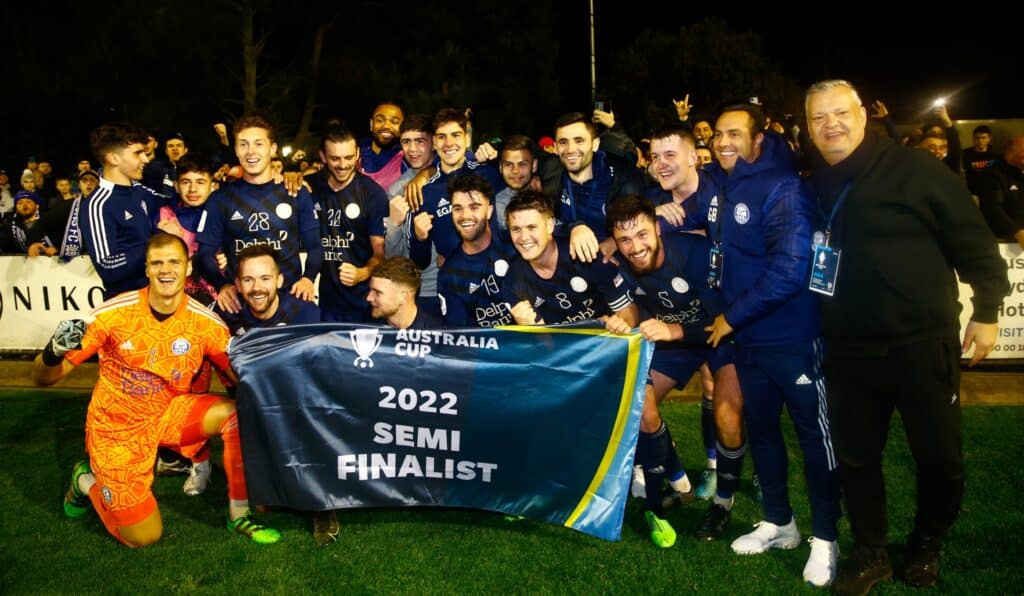
The rise of the ‘Cupset’ – Cannons, Power and City on recent success

Oakleigh

The Australia Cup has officially reclaimed its magic in 2022. Sydney United’s gripping 3-2 win over Brisbane Roar on Sunday saw them become the first state league side to book their place in the competition’s final, while Oakleigh Cannons will become the second if they can defeat Macarthur on September 14.

Interest in the Cup hinges on the romance of the ‘Cupset’, a feat which both Oakleigh and United (twice) have achieved this campaign. That it
is possible for a group of players to beat another despite skewed scales of professionalism and resources, is the charm that makes the competition unique in Australian sport.

What is less revered about the success of state league clubs, but is both more important and difficult than winning, is the work done by the clubs off the field when partaking. Take the Cannons, for example. Their ‘reward’ for beating Brisbane City and moving into the quarter-finals against Sydney FC was a $12,000 bill.

“To host Sydney, immediately we faced issues with our lighting,” Oakleigh president Stan Papayianneris told Soccerscene.

“Lighting needs to be 500 lux for an A-League club (as per Australian Lighting Standards), so straight away there’s $12,000 that you have to add. That’s on top of everything else that you have to provide as a minimum.

“We probably made a little bit more from hosting Brisbane City than Sydney. Operating costs will be the same against Macarthur, so hopefully we get a marginally larger crowd which will make it more beneficial. 

“The weather is supposed to be good, and being a semi-final versus a quarter-final it’s had a bit of media exposure. Hopefully our crowd increases by 25-30%, and it will be worthwhile.”

Adelaide City also experienced the variant challenges that come with hosting A-League opposition as opposed to state league this season. City edged Logan Lighting in a home clash at Marden Sports Complex, before welcoming Adelaide United to the larger SA Football Centre in a night for South Australian football purists.

City president Greg Griffin explained the second clash was profitable due to high ticket sales (host clubs keep 100% of gate takings up to and including the semi-final stage), but that structural challenges within the competition make the experience otherwise tricky.

“There’s a whole range of imposts that make being in this competition very difficult. It’s expensive, so you have to be very careful about what you spend and get your budgeting right. You can lose $10-15,000 in the blink of an eye, which NPL clubs cannot afford,” Griffin told Soccerscene.

“I think Football Australia needs to recalibrate the requirements on NPL clubs. You can’t impose all the costs of broadcast – certain lighting capacity, infrastructure for extra cameras – on the clubs. If we play an A-League team, surely they should pay for that.

“Football Australia needs to take a reality pill and see that the idea is to encourage NPL teams to be involved, not make it an event they’re financially fearful of.”

Peninsula Power have become well versed in putting on an Australia Cup show this season, welcoming all of NWS Spirit, Green Gully and Sydney United to A.J. Kelly Park.

For the Power and their president Craig Feuerriegel, the difference between hosting A-League and state league sides is dramatic; the attention that came with the visits of Melbourne City (2017) and Brisbane Roar (2021) justified the use of nearby Moreton Daily stadium, holding a capacity 11,500.

“We did raise money this year playing at home at A.J. Kelly, but not as much as we would have playing an A-League side at the bigger stadium. We put in quite a significant effort when hosting games there’, Feuerriegel told Soccerscene.

“With a better facility comes the chance to increase revenue if you’re willing to work at it. The more people you can get through the gate the more you can raise, as well as matchday raffles and selling corporate seats.

“There is a downside to that as well with increased cost for the stadium, and when you host an A-League side Football Australia’s rules say you must have certain requirements around medical access, ambulances, and security. So the level does go up in your outgoings as well.”

Like Oakleigh and Adelaide City, the Power’s home ground tenancy agreement with their local council allows them to play extra matches at A.J. Kelly Park on top of their league fixtures if required, so there is no financial punishment in progressing through the Cup in that regard. 

Feuerriegel speaks highly of the Cup experience, where he’s thrilled that players, fans and sponsors can taste a variety of opposition and national attention not possible within the Queensland NPL. He does admit that they’re yet to confront the significant challenge of travel, having never been drawn away in their five matches.

“We certainly weren’t disappointed when the home draws came out, but we have been in it for a number of years now and haven’t drawn an away game. This year I was on board with it. I thought if we do get an away game we’d be happy to support the group to play away and hopefully get a result,” he said.

Papayianneris would like to see Football Australia increase support for travelling sides, which currently includes flights and accommodation for one night as part of a broader travel subsidy. The Cannons were unfazed by their July trip to Bonnyrigg on the park as 5-0 victors, but Papayianneris acknowledges the toll on semi-professional players is significant.

“To negate all the factors that could make you lose a game, you really need to sleep there the night before. If you do that with a group of 25, you’re up for at least $12-15,000.

“If you run with what Football Australia provides, it’s a bit of an impediment to getting the team into the right state to play.

“We rolled with the punches against Bonnyrigg, travelled to New South Wales and played on the same day and won, but it was difficult. It would be good if they could provide two day’s accommodation from next year, as a suggestion.”

Papayianneris states the financial burden of lighting and travel means qualification for the Cup is not a priority for the club, but a bonus on top of their league focus. The current level of prize money is also too low to act as an incentive for the Cannons to strive to qualify, on offer from the Round of 16 onwards.

“I don’t think the prize money comes into it. Even if we were to win, the $50,000 is not an amount you’d steer your efforts towards trying to win. If we’re to lose the semi-final and get a prize of $10-15,000, it would just help us recoup some of our losses,” he said.

‘We’d like to continue playing in the Cup going forward. We’ve had a reasonable amount of exposure which is good for our players, the club, and the local community. But if you happen to draw a couple of away games, it starts to become problematic.

In contrast, Feuerriegel outlined consistent qualification for the Cup is a ‘KPI’ of the Power, while Griffin stated he and City coach Paul Pezos share ‘complete agreement’ that annual Cup participation is essential to the growth of their club.

“As a club we go to the best young talent we can find in South Australia. One of the things we offer is extremely good coaching under Paul and his team, but also that we’ll work very hard to make the Australia Cup to allow them as players to be showcased,” Griffin said.

“A lot of people watched our game against United, and let me tell you a number of our team have received calls from around the country. It’s a very clear target that we have, that we take the Cup very seriously because we want to win it, and to give our talented juniors a chance to shine.”

Despite the financial cost he may be counting, the magic at the Cup’s core is will and truly burning within Papayianneris. While it may still need tweaking there is no doubt it’s roared back to life this season, it’s first unabated post-covid, and the Cannons and United are right in the mix for its flagship success.

“Anything’s possible, everyone has two legs and two arms. If we could get through to the final, we’d play a state league side, there could be a red card to them in the first minute… a lot can happen in a game of football,” Papayianneris said.

“If Greece could win the 2004 Euros, maybe Oakleigh can win the Australia Cup.”

Previous ArticleNext Article

Football South Australia renews partnership with Datacord as Community Football Commitment Deepens

Football South Australia has announced the renewal of its partnership with Datacord, continuing a relationship that has grown steadily since the South Australian print and document solutions provider first entered the football community as naming rights sponsor of the Collegiate Soccer League Division 1.

That initial agreement, which saw Datacord align with one of Adelaide’s most historic amateur competitions, marked the beginning of what has since developed into a broader commitment to South Australian football at every level. The renewed partnership extends Datacord’s involvement beyond the CSL and into the wider Football SA ecosystem, with clubs across the state now able to access exclusive offers and preferred pricing on photocopying, managed print services and tailored business solutions.

The practical value of that access should not be understated. Community football clubs operate on tight margins, relying heavily on volunteer administrators managing everything from registration paperwork to grant applications. Cost-effective print and document solutions reduce the operational burden on those volunteers, a small but meaningful contribution to the sustainability of clubs that form the backbone of the game in South Australia.

“George is a great supporter of sport in South Australia and we are delighted to have Datacord as a supporter of football,” said Football SA CEO Michael Carter. “Service is second to none and we highly recommend their services to the business community within the Football Family.”

For Datacord Managing Director George Koutsoubis, the renewal reflects a genuine investment in the community rather than a transactional commercial arrangement. “It is important to support the local community, and Football South Australia is the perfect place to start spreading the word about Datacord and what we do for the South Australian community,” he said. “We are locally owned and operated, and I think it is a great partnership to be part of.”

Beyond the Pitch: Miyuki Kobayashi on the Real Challenges Facing Japan’s Women’s Game

Last week, Soccerscene spoke to pioneer of women’s football in Japan, Miyuki Kobayashi, about the game’s development in Japan and the intersection between sporting and social change in the country.


Talent, quality and recent silverware

After Japan’s recent AFC Women’s Asian Cup victory in the final against Australia, the women’s national team solidified its standing as the No.1 team in Asia.

Throughout the last 15 years, Japan’s women’s national team has grown into a formidable opponent, boasting a World Cup trophy, an Olympic silver medal, as well as three AFC Women’s Asian Cups.

The talent is undeniable. The quality is unwavering. And the team shows no signs of slowing down.

But these victories and trophies on the world stage wouldn’t be possible without the leaders behind the scenes – none more so than Miyuki Kobayashi, former WE League Board Member and current JEF United Ladies Scout and Academy Chief.


Laying the foundations

Kobayashi has led the charge for women’s football in Japan, promoting not only a sport which values success, but one which empowers female footballers across the nation.

“At university, not many girls were playing and we didn’t have an official team. I went to the US and the environment was so different,” Kobayashi explained.

“That opened my eyes – women can play. That’s how I started the women’s soccer league when I came back: to make an environment for girls to play.”

Thus, accessibility and opportunity became driving factors behind Kobayashi’s work, not only for those on the pitch, but for those in the dugout.

“I got involved at the JFA (Japanese Football Association) to promote women’s football. We wanted to create the opportunity for women to be coaches.”

“They are coached by men all the time, so even when the top players leave the football world, they never think to be involved.”

Furthermore, as a former coach of JEF United Ladies Youth and General Manager, Kobayashi was intent on employing as many female coaches as possible. It was not merely a personel change, but a challenge to widespread social attitudes.

“When I started to employ female coaches, the girls’ parents asked why the coach wasn’t a man. But gradually, we started to make it equal – they didn’t talk about the gender, but about the quality of the coach.”


The mission to empower

In 2011, the same year Japan’s women won the World Cup, the domestic league was yet to become professional. Known as the Nadeshiko League, players would work during the day and train in the evenings.

The transition from an amateur to the current professional league required time, resilience and a change in perspective.

“The sports world in Japan is more traditional – it is dominated by men,” said Kobayashi.

“If you want to make the environment even, or (want) more women to come into the (football) world, you can change the mind of the players.”

Since 2021, the WE League has embodied a sense of growth and positive change for the women’s game. In name and nature, it looks to empower players, coaches and all involved in the industry.

“I was in charge of mission achievement for women’s empowerment. We wanted to educate the players, to inspire girls and women who watch the game.”

However, the drive to empower women in football was not without backlash and challenges.

“Some people don’t like that word: ’empowerment’. It’s too strong for them. Some women really appreciate it, but it’s not easy to change the mind of society through football,” Kobayashi admitted.


Growing and attracting talent

Although WE League clubs are accelerating youth development and expanding pathways across U15, U18 and first team football, Kobayashi acknowledged that the overall product must improve to bring foreign players to Japan and entice homegrown talent to stay.

“Most of the national team players go to Europe or North America. I don’t say it’s a problem, but from a young age, girls who can play in the WE League want to go abroad,” Kobayashi outlined.

Indeed, when looking at the starting XI in last month’s AFC Women’s Asian Cup final, only one player – Hana Takahashi – plays in the WE League.

But the key to attracting domestic and international players to the WE League, is aligning financial investment and industry attitudes.

“The reason why women’s football has developed in European countries is the social thinking – you have to be equal and have the same opportunities as men in football. The Japanese way of thinking, especially in the football world, is not that at all,” Kobayashi continued.

“When I speak to people at Spanish clubs, women’s football is not a charity, but an investment.”

“We have assets. We have good, young players, but we’re exporting them, so we need to import too.”

Indeed, Spain is a perfect example of what can happen when investment becomes intentional, not optional. Back-to-back UEFA Women’s Nations League titles, 90% television viewership increase since 2016, and record-breaking crowd numbers reflect what can happen when the industry aligns in vision and commitment.

Japan has the players to compete against any nation in the world. Purposeful investment, combined with its overall quality of players and style, could transform the WE League into a true, global powerhouse.


The vision for the future

Moving forward, Kobayashi hopes that girls progressing through JEF United’s academies develop confidence and resilience, whether as players or people.

“We want to make the girls – even if they aren’t in JEF United – continue playing football and continue to be leaders,” Kobayashi said.

“Some of them have a dream to be a coach or a leader off the field too, so that’s one of the attributes we want to develop.”

This resilience, reflected by the club’s ‘never give up’ philosophy, is testament to the vision of empowerment championed by Kobayashi across the women’s game.

Even in the face of social obstacles and a lack of financial investment, perseverance and hard work is at the bedrock of women’s football in Japan. It is not just that these values exist, but that they are consistently manifested on and off the pitch, which can show future generations that football is a sport for all – men and women alike.


Final thoughts

There is no limit to what the WE League and the national team can achieve if given the resources it deserves. All the ingredients are there: individual quality, a distinct playing style, football philosophy and ambitions to grow.

By following the example of industry leaders like Kobayashi, women’s football in Japan can hopefully continue to make waves of impact – in the sporting landscape and society as a whole.

Most Popular Topics

Editor Picks

Send this to a friend