Western Australia officially declare support for 2023 Women’s World Cup bid

In recent times, the Victorian and South Australian governments have gotten onside with the 2023 Women’s World Cup hosting bid.

The Matildas are one of, if not our most decorated international sides and to say they deserve to host the largest women’s sporting tournament in the world is a severe understatement.

Ever since the bid was initially proposed, there have been strong suggestions that Perth and the state of WA would be integral to the makeup of the tournament.

On Saturday, WA Premier Mark McGowan and the state government officially declared that the state of Western Australia will indeed be a part of the bid to host a Women’s World Cup.

In theory, a Women’s World Cup would 100% work in Australia, despite clashes with the AFL and NRL seasons. With this in mind, matches at the 100,000 capacity MCG seem to be unlikely.

With that in mind, Perth has become a major talking point when it comes to a host city or where a potential final would be held. Now, with the WA government officially on board with the FFA’s proposed bid, that idea has a base.

The sport of soccer has seen a resurgence to a certain degree in recent times. Perth Glory have re-established themselves as an A-League powerhouse and were unlucky not to be crowned champions last season.

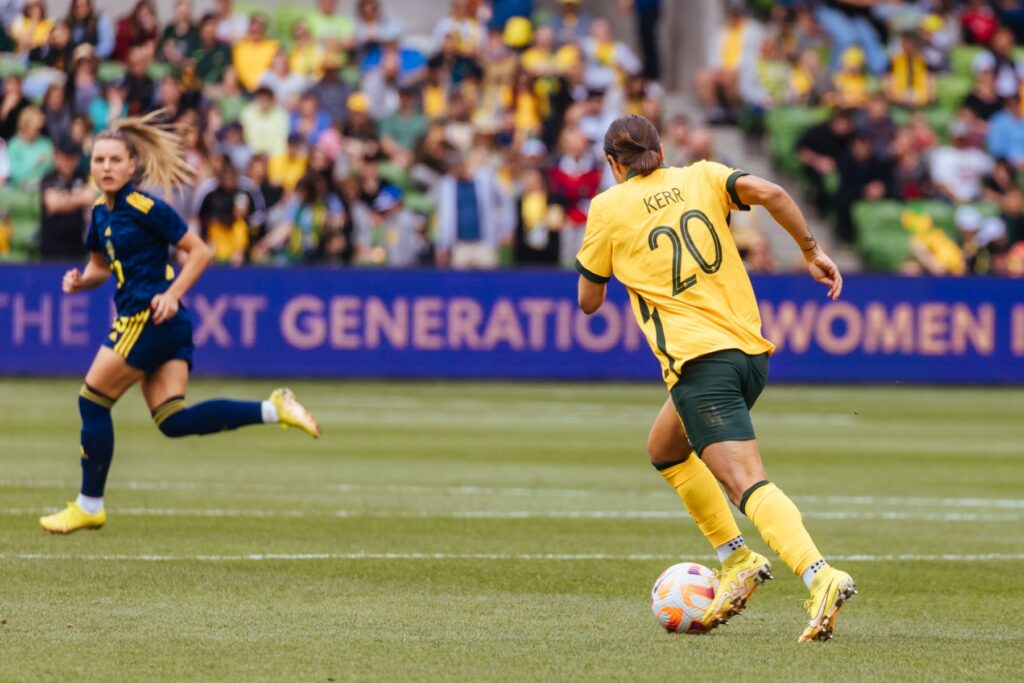
But when it comes to soccer in WA, the main talking point is Sam Kerr.

The Matildas captain is one of the poster girls for women’s soccer all across the globe. She recently made international headlines by signing for Chelsea’s women’s team in England. The Blues currently lead the FA Women’s National League, the Premier League equivalent for women.

She has been and continues to be an inspiration for up and coming soccer players in Australia, especially in her home state of Western Australia.

McGowan subsequently spoke about how it’s a potentially fantastic reward for the Matildas, but how beneficial it could be for his state.

“The WA Government is very excited at the prospect of being part of the FIFA Women’s World Cup™ in 2023,” McGowan said.

“We have also partnered with FFA to secure at least two Socceroos games in Perth, including two guaranteed World Cup qualifiers next year and in 2021.

“The benefits to our State will be significant, in terms of having a major economic impact on and providing a massive increase in exposure to the rest of the world.”

We have previously spoken about the prospect of hosting a Women’s World Cup Down Under in 2023 and how it’s benefits would have no end.

The amount of aspiring female players will skyrocket, with many hoping to emulate the likes of Kerr, Lisa De Vanna, Steph Catley and Chloe Logarzo.

As Premier McGowan outlined, the increase in exposure across the globe would do a world of good. The Matildas are already a highly respected side, currently ranked 8th in the world by FIFA and ahead of international footballing powerhouses like Brazil, Spain and Italy.

The game in Australia would benefit hugely and more fans from around the world would start watching our domestic competitions, both male and female.

Compare this to the way in which Qatar became the number one topic everywhere when it was named the host of the 2022 Men’s World Cup.

When soccer fans think of Qatar, they automatically think to how they are hosting that competition, as well as how they recently stunned the continent of Asia by winning this year’s Asian Cup back in February.

The tournament is still two and a half years away and yet, talk about them and the tournament still continues. Imagine when the tournament actually gets underway.

The bid continues to attract major stakeholders and more and more people are getting #onside with it. It goes to show that women’s sport isn’t just emerging from the shadows, it’s becoming a genuine revolution and now, it’s viewed upon by the majority as just as important as the men’s game.

Let’s hope that the 2023 bid is successful because it would be the sustained interest that soccer in this country needs.

 

Previous ArticleNext Article

APL and PFA remain without agreement as bargaining tensions continue

The Australian Professional Leagues (APL) and Professional Footballers Australia (PFA) remain without a new collective bargaining agreement, with negotiations continuing less than three months before the start of the 2026–27 A-Leagues season.

The APL presented the players’ union with a new one-year interim proposal on August 5, which included an increase to the A-League Women salary cap and a commitment to establish a pathway towards full-time professionalism for the women’s competition within 12 months.

The proposed agreement would provide an interim framework while the two parties continue discussions over a longer-term collective bargaining agreement.

APL chief executive Steve Rosich said the proposal reflected the league’s commitment to reaching a sustainable agreement with players following eight months of negotiations.

However, the PFA criticised the APL for publicly announcing the proposal shortly after presenting it to the union, arguing that the approach had further damaged trust between the two parties.

PFA Chief Executive Beau Busch also said players had overwhelmingly rejected the APL’s previous final offer, citing a lack of trust in the league’s ability to ensure its future.

Full-time professionalism for the A-League Women remains a key priority for the PFA, with players seeking improved conditions and greater investment in the competition.

The A-League Men and A-League Women seasons are both scheduled to begin on 16 October 2026.

With the new season approaching, both parties face pressure to resolve the dispute and establish the framework governing player conditions across the A-Leagues.


Theo Fotopoulos outlines vision for Canberra United’s future

Professional football in the nation’s capital has entered a new era with Australian Sports Group (ASG) officially taking over Canberra United ahead of the 2026/27 season.

Led by Chairman Morris McAllister and CEO Theo Fotopoulos, ASG takes over a club whose future has been uncertain in recent years. Now, the focus has shifted from survival to building a sustainable future for football in Canberra.

Speaking to Soccerscene, Fotopoulos discussed why ASG chose to invest in Canberra United, the importance of preserving the club’s identity, and the roadmap for the chapter ahead for football in the nation’s capital.

Why Canberra?

The investment in Canberra United comes at an important time for the club. The beginning of the 2026/27 A-League Women season is just around the corner, and the prospect of an A-League Men side is drawing closer. Asked why ASG chose to invest in Canberra United and Canberra itself, Fotopoulos’ answer was simple.

“Canberra has stacks of football culture. It is a football city,” Fotopoulos said.

Speaking on the decision to retain the name Canberra United and not undertake a rebrand, Fotopoulos pointed to the club’s history and connection to the community.

“We retained the name, Canberra United, because of the history and the association. We felt there were more positives to retain the name,” Fotopoulos said.

The new ownership also wants supporters to play an active role in shaping the club’s future.

“The fans will be involved in making decisions,” Fotopoulos said.

Fotopoulos revealed that the club is already consulting with fans on the introduction of a nickname and is looking at developing a playing kit that is designed by the fans.

While Canberra offers a unique opportunity for professional football, Fotopoulos acknowledged the club will still compete for supporters’ attention alongside established sporting organisations such as the Canberra Raiders and ACT Brumbies.

Rather than viewing that as a disadvantage, he believes Canberra’s appetite for sport presents an opportunity to grow the club’s presence in the capital.

“It is something that allows us to accelerate the building of the brand in Canberra, Canberrans really love their sports,” Fotopoulos said.


The road ahead

The 2026/27 Ninja A-League season kicks off in October, and the priority for Fotopoulos and ASG at Canberra United is to ensure that Canberra is ready to compete not only next season, but sustainably for the years ahead.

“For us, it’s really stabilisation for the women’s. Build that and build the infrastructure around the women then translate that into an additional structure for the men’s program,” Fotopoulos said.

Infrastructure also forms a key pillar of ASG’s long-term vision. Fotopoulos said securing a long-term home at McKellar Park and improving football facilities across Canberra would play an important role in supporting future growth.

He believes better facilities will benefit not only Canberra United but football throughout the ACT and surrounding region.

Importantly, the takeover of the club included an option to introduce a team into the A-League Men’s competition from the 2028/29 season, which is something that ASG intends to pursue.

When speaking about the future of the proposed senior men’s side, Fotopoulos pointed to the quality within and around the organisation that will ensure its introduction.

“We’re quietly confident, the football department is very positive. There are a lot of quality people, both in Canberra and outside of Canberra, that have indicated interest in being part of the elite pathways academy structures that will be the foundation for a new A-League men’s team,” Fotopoulos said.


More than a football club

For Fotopoulos and ASG, this investment is about more than just owning and running a football club. The focus extends beyond results on the field to developing an integrated football structure and greater cohesion across the game.

In order to support a strong senior men’s and women’s side, Fotopoulos outlined the importance of establishing strong junior pathways for young players growing up in Canberra.

“One of the other big picture objectives is to finally get to establishing a permanent pathway,” Fotopoulos said.

Fotopoulos believes that these pathways will ensure long-term stability for Canberra United and help form the foundation of both senior playing groups for years to come.

However, it wasn’t just an investment in football in Canberra. It was a vote of confidence for women’s football in Canberra in particular.

While excitement is building around a potential expansion into the A-League Men, Fotopoulos believes that the current moment represents an even greater opportunity for the women’s game.

“If I was to look at any other time in history, this is probably the strongest time to invest in women’s football,” Fotopoulos said.


Most Popular Topics

Editor Picks

Send this to a friend