Image Credit: Football NSW
Football NSW has delivered a Club Capability Building Workshop designed to give community club coaches direct exposure to the methodology underpinning the state’s elite Talent Support Program, in an initiative that addresses one of the more persistent structural problems in Australian football development.
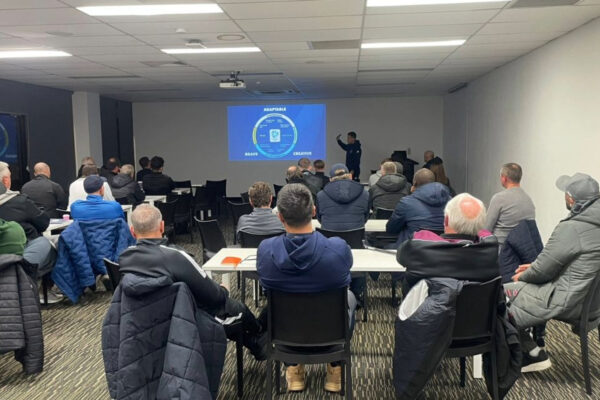
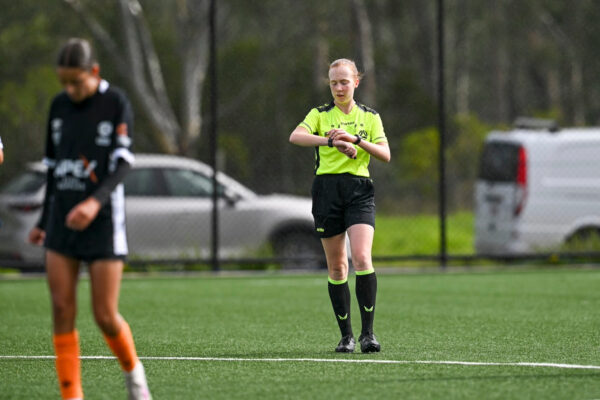
The workshop, led by Player Development Managers Phil Myall and Nadine Sheils, who oversee the technical direction of the Boys and Girls Talent Support Programs, combined classroom presentation with pitch-side observation of live TSP fixtures. Coaches from clubs including Rydalmere FC attended sessions covering talent identification processes, player development models, coaching methodology, Individual Development Plans and player profiling based on technical traits and competencies.
The structure of the day, moving coaches from theory into a live competitive environment, reflects an attempt to close a gap that has long shaped the relationship between community clubs and elite talent pathways in Australian football. Club coaches typically operate with limited visibility into how state-level development programs actually function in practice, relying on secondhand information, accreditation course material or assumptions about what elite environments look like. The workshop replaced that distance with direct access.
Why the gap matters
Talent Support Programs exist to identify and accelerate the state’s most promising young players, but the players who enter those programs come from community clubs first. If the coaching methodology and development philosophy applied within elite pathways is poorly understood at the community level, the two systems risk operating with misaligned expectations of what good development actually looks like.
This means a player developed in a club environment that does not share the technical language or coaching priorities of the elite pathway may find the transition into a Talent Support Program more difficult than it needs to be, not because of any deficiency in the player but because the systems around them were not speaking to each other.
Football NSW’s decision to bring club coaches into direct contact with TSP methodology, including observation of live matches rather than theoretical instruction alone, represents an attempt to narrow that gap at the level where it matters most. Rydalmere FC’s Head of MJDL, Michael Canale, said the experience offered a clear reference point for his own club’s program.
“It was great to see how the FNSW Talent Support Program operates and the level of alignment from the methodology and match environment,” Canale said. “For us at Rydalmere FC, I took away ideas that we can look to build into our own programme. It provided a really clear reference point and an opportunity to reflect on how we can continue to strengthen our environment moving forward.”
A model for industry-wide capability
The workshop also points to a broader question facing football governing bodies as participation continues to climb nationally. As more players enter community football and the demand for genuine development pathways grows, the capability of community coaches becomes a determining factor in whether that growth translates into improved player outcomes or simply more players moving through under-resourced environments.
Football NSW’s approach, embedding observation and direct engagement with technical staff alongside structured presentation, offers a model that other state federations grappling with similar capability gaps may look to replicate. The collaborative element of the day, where coaches from different clubs compared notes and aligned their understanding of TSP application, also suggests an organisation attempting to build a shared development language across its club network rather than treating elite pathway knowledge as something that remains internal to Football NSW staff.
Whether that shared language translates into measurable improvement in player outcomes at community level will depend on how consistently workshops like this one are delivered, and whether the ideas coaches take away are genuinely implemented rather than simply observed. For now, the initiative represents a concrete step toward addressing a gap that has shaped Australian football development for years, the distance between what elite pathways do and what community clubs understand about how and why they do it.