




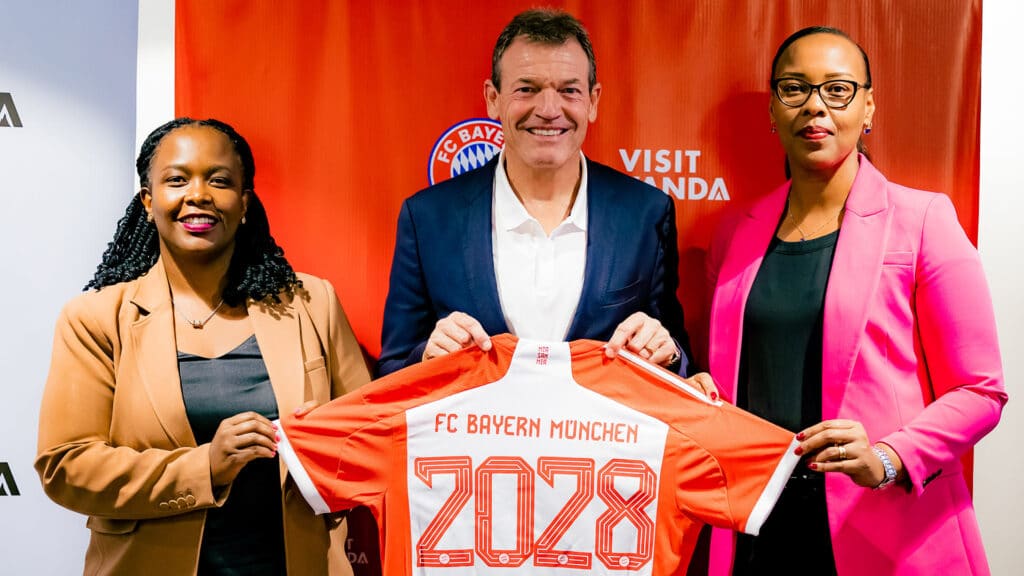
Bayern Munich link up with Visit Rwanda for five years to help promote tourism

FC Bayern and Visit Rwanda

German football giant Bayern Munich announced a five-year partnership with Visit Rwanda to promote tourism and help develop the country’s football sector.

Bayern Munich will do this by working closely with Rwanda’s Ministry of Sports to set up a football academy to strengthen the development of football in the country.

Also through this partnership, Visit Rwanda branding will be displayed on matchday LED boards at Allianz Arena, one of the world’s most modern and advanced stadiums that holds 75,000 fans.

Visit Rwanda is a brand that provides a platform for Rwanda to showcase its tourism attractions, cultural heritage, and investment opportunities to the whole world.

They have recent history in the world of football, signing with Arsenal FC as a sleeve sponsor in 2018 and then followed suit in 2019 when they partnered with PSG as a premium partner and training kit sponsor for the club. These deals are still ongoing with both clubs and Rwanda President Paul Kagame stated that they have very healthy relationships with each club as well as tourism revenue success from their involvement in football.

Andreas Jung, FC Bayern Executive Board Member Marketing, mentioned the goal with football development in Rwanda in a club press release.

“I am looking forward to this new, very exciting collaboration. We will support the Rwandan Ministry of Sports in developing youth football programs, including our FC Bayern Youth Cup. We want to spread ‘Visit Rwanda’ as a tourism destination, and we also welcome the new partner to our business network,” he said.

Jan-Christian Dreesen, FC Bayern Chief Executive Officer, added:

“I am very pleased with this collaboration agreed upon until the summer of 2028. FC Bayern can become active on the African continent and gather important experiences,” he mentioned.

“The new platinum partnership is aligned with long-term goals. We will promote ‘Visit Rwanda’ and help Rwanda grow in sports with projects for youth football. These are challenging and responsible tasks. Africa is a continent of opportunities. For FC Bayern, this is the next important step in internationalisation.”

There is a clear goal from Bayern Munich to expand globally into Africa and cement themselves as a world footballing powerhouse with a strong brand identity.

Aurore Mimosa Munyangaju, Rwanda Minister of Sports, said in a joint media release:

“We’re thrilled to partner with FC Bayern to support the development of youth football for boys and girls in Rwanda,” she said.

“We look forward to setting up the FC Bayern Academy where their expert coaches will share knowledge of the game with local coaches and players. The potential is there for Rwandans to excel in football and this partnership provides a great platform for Rwanda to strive for excellence in sports.”

Clare Akamanzi, CEO of the Rwanda Development Board, discussed the already strong relationship between the two countries.

“The Rwanda Development Board is pleased to welcome yet another strategic partner in FC Bayern Munich. It’s been five outstanding years since the Government of Rwanda announced the Visit Rwanda campaign and adding FC Bayern as another additional partner allows us to reach out to its millions of fans across the globe and tell them to visit Rwanda,” she stated via media release.

“Germany is among Rwanda’s top five tourism source markets and we aim to use this partnership to attract more tourists to Rwanda, showcase investment and business opportunities and encourage all to stay in Rwanda.”

This partnership is a good fit for both parties, allowing Bayern Munich to expand into an untapped African market for German football clubs as well as help Rwanda generate further revenue for tourism and improve their football team which is a key goal for President Paul Kagame.


Previous ArticleNext Article

Marie-Louise Eta makes history as new Union Berlin head coach

In an historic appointment, Eta will take over as head coach of Union Berlin until the end of the season.

History in the making

Previously the first female assistant coach in Bundesliga history with Union Berlin, Eta will now take the reigns of the men’s first team on an interim basis.

Currently, the club sit in 11th place in the Bundesliga table, but with only two wins so far in 2026, relegation appears an all-too-real prospect, and one which the club is desperate to avoid.

“Given the points gap in the lower half of the table, our place in the Bundesliga is not yet secure,” said Eta via official media release.

‘I am delighted that the club has entrusted me with this challenging task. One of Union’s strengths has always been, and remains, the ability to pull together in such situations.”

Eta will begin as Union’s new head coach with immediate effect, and will be in the dugout for the club’s matchup against Wolfsburg this weekend.


A step into an equal future

Eta’s appointment signals a major step towards a more level playing field in the football landscape.

Furthermore, Eta joins other coaches including Sabrinna Wittmann, Hannah Dingley and Corinne Diacre who, in recent years, have blazed a trail for female coaches to step into the men’s game.

Wittmann currently manages FC Ingolstadt in Germany’s third division, and was the first female head coach in Germany’s top three divisions.

In 2023, Dingley became caretaker manager of Forest Green Rovers, and thus the first woman to lead a men’s professional team in England.

Diacre, now head coach of France’s women’s national team, managed Ligue 2’s Clerment Foot between 2014 and 2017.


Final thoughts

The impact therefore, is that Eta’s appointment will show future generations of aspiring female coaches that men’s football is an equally viable and possible pathway as the women’s game.

The time is now to level the playing field.

And while it may be a short-term role, its effect on attitudes towards equality and fair opportunities in the game will hopefully resonate long after the season ends.

Record Pathway Breakthrough: Football NSW Report Highlights Power of Access and Equity

Playing soccer

Football NSW has released its 2025 Player Development Report, documenting a year of significant growth across its Talented Player Pathway programs for girls, boys and regional players, and offering the clearest picture yet of how the state’s talent identification infrastructure is reshaping who gets access to elite football development in Australia.

The report distinguishes between three streams: girls, boys and regional, where each operate under the umbrella of the Talented Player Pathway, which encompasses Football NSW’s Youth Leagues, Talent Support Program and state teams. Across all three, the numbers point to a system that is identifying more players, reaching further into the community, and producing more national team representatives than at any previous point in the program’s history.

A Girls Pathway Coming of Age

The girls program recorded some of its most significant outcomes to date in 2025, headlined by the inaugural Future Sapphires Program, a dedicated development environment for 2009, 2010 and 2011-born players that ran 140 training sessions, 16 high-level matches against boys teams, and identified 20 players for national team involvement across its first year alone.

The Talent Support Program conducted 494 player assessments across 119 club visits, with 117 additional games provided for TSP players throughout the season. At the Emerging Matildas Championships, Football NSW fielded three state teams, with the Under-15s Sky team claiming the championship, the Under-16s finishing as runners-up, and the Under-15s Navy placing third.

The pathway-to-national-team conversion rate was striking. Of the 23-player squad selected to represent the Junior Matildas at the AFC Under-17 Women’s Asian Cup Qualifiers, 13 were from Football NSW, a 56.5 percent representation rate from a single state federation.

“This report does not simply provide data and numbers,” said Girls Player Development Manager Nadine Shiels. “It highlights our progress and validates the standards we set.”

The equity implications of that pipeline are significant. Elite female footballers in Australia, have historically faced a narrower and less resourced development corridor than their male counterparts. Programs like the Future Sapphires and the TSP are structural interventions in that imbalance, reshaping access mechanisms that determine which players get seen and which do not.

Boys Program Deepens its Reach

The boys Talent Support Program underwent deliberate restructuring in 2025, reducing squad sizes from approximately 90 players and five teams to 54 players and three teams per age group, while extending match duration from 50 to 70 minutes. The intent was to raise the standard of the best-versus-best environment rather than simply widen it.

The results support that confidence. To date, 155 players who have participated in the boys TSP have transitioned to A-League academies, with approximately 35 progressing to A-League Men’s competition and a further 30 representing Australia at junior national level across the Under-17, Under-20 and Under-23 squads.

The 2025 season added four Talent Development Scheme matches for players born between 2007 and 2009, delivered in collaboration with Football Australia and targeting potential Junior Socceroos and Young Socceroos selection. The program also hosted the inaugural A-Leagues/TSP Tournament at Valentine Sports Park in December, featuring Melbourne City, Melbourne Victory, Western Sydney Wanderers, Sydney FC, Macarthur Bulls Academy and a TSP Select team.

“Our purpose is clear- not only to identify talent, but to prepare it,” said Boys Player Development Manager Philip Myall.

The Regional Question

Perhaps the most structurally significant section of the report concerns regional development- the stream that most directly addresses the geographic equity gap in Australian football’s talent pipeline.

Talent identification in Australia has historically concentrated in metropolitan areas, where NPL clubs, A-League academies and state federation programs are most densely located. Players in regional and rural NSW face a structural disadvantage that has nothing to do with ability and everything to do with geography. Fewer club visits, reduced access to high-performance environments, and reduced visibility to the coaches and scouts who determine national team selection saliently reflect a systemic barrier.

The 2025 regional TSP involved 241 players across 57 training sessions, 18 hub matches and 58 additional tournament games, with Football NSW coaches present at local association fixtures and regional tournaments including the Bathurst Cup and Country Cup. Regional players were also integrated into Elite Game Days at Valentine Sports Park, directly competing against metropolitan TSP cohorts and A-League academy players.

“The program has continued to enable identified players to progress and be part of the greater football elite player pathway,” said Regional Development Manager Andrew Fearnley, “with opportunity to progress and be identified into national youth teams.”

Most Popular Topics

Editor Picks

Send this to a friend