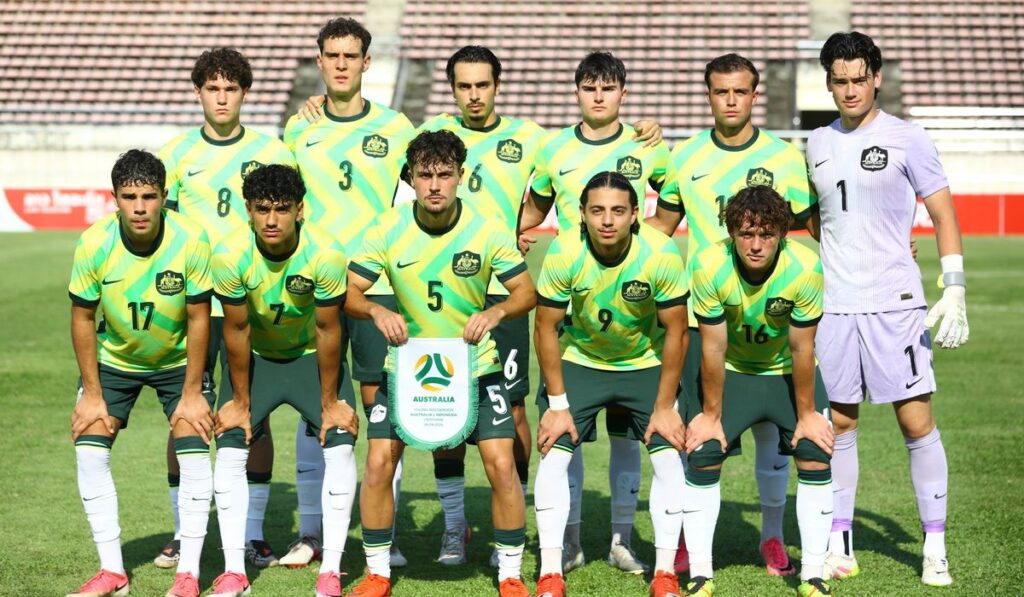
Matildas mark significant milestone

Football Federation Australia (FFA) has honoured the first ever women’s international match by congratulating that team alongside the current Westfield Matildas.

It’s been 40 years since the Matildas took part in their first full international, which was on October 6th 1979 at Seymour Shaw Park in Sydney, playing in a 2-2 draw with New Zealand.

It paved the way for future women players to get involved, with the Matildas still going strong.

Both the past and present have come together at the same venue they started in a special occasion for women’s football.

It’s a time to thank the inaugural members of the Matildas for their contributions that helped encourage other women to get involved and sustain the Matildas side till now.

“These athletes started a movement, not just a team, which has now become one of the most powerful, popular and recognisable in Australia, said FFA chairman Chris Nikou.

“Many of these women worked full time, while playing for the national team and for many years, this continued to be the case.

“There have been 204 Matildas represent our country in ‘A’ internationals over the past 40 years and today we celebrate each of them and thank them for their contribution to our sport.

“Later this month Cheryl Salisbury will become the first female footballer to be inducted into the Sport Australia Hall of Fame, which rightly recognises the sacrifices and efforts of our female footballers over this time.

“Today many of our Westfield Matildas are full time professional footballers, many playing around the world and when they represent their national team today on home soil, it is in front of big crowds.

“We recognise there is still work to do to ensure our female athletes have more opportunities on and off the park from the grassroots up to our national teams, but today we look back and celebrate the immense strides made.”

From humble beginnings, the Matildas have grown into one of the best women’s football sides in the world.

It goes to show the massive inroads that have been made in the last 40 years and which will continue to be made.

Previous ArticleNext Article

Australia’s Sportstech Sector Surges to $7.11 Billion as Technology Reshapes the Future of Sport

Australia’s sports technology sector has reached a record $7.11 billion in annual revenue, highlighting the rapidly growing role of innovation across the country’s sporting landscape.

The latest Sports Innovation Report from the Australian Sports Technologies Network (ASTN) found the sector grew by 16 per cent in FY2026, up from 10 per cent the previous year.

The growth has been accompanied by a significant expansion in employment, with the industry now supporting 20,604 jobs across 924 sportstech companies nationwide.

For a sporting nation increasingly reliant on data, technology and digital innovation, the figures point to an industry that is moving well beyond its emerging phase and becoming an important part of Australia’s broader sporting economy.

A sector entering a new phase

The latest figures represent the fifth edition of ASTN’s annual Sports Innovation Report and show that Australia’s sportstech ecosystem is becoming increasingly mature.

While the number of companies increased by only 1.8 per cent during FY2026, revenue growth accelerated significantly, suggesting that existing businesses are scaling rather than the industry simply expanding through the creation of new startups.

The 115 largest companies now account for 89 per cent of total revenue, generating $6.30 billion, while also representing 74 per cent of total employment.

That concentration highlights the emergence of a group of Australian sportstech companies capable of competing at scale both domestically and internationally.

Companies including Catapult Sports, PMY Group, Bodd, VALD and Champion Data have been identified among the businesses driving the sector’s growth.

For football, the development of this ecosystem is particularly significant.

Technology is now embedded across almost every level of the modern game; from athlete tracking and performance analysis to injury prevention, coaching, broadcasting, stadium operations and fan engagement.

ASTN identifies nine major sportstech categories, including athlete performance and injury prevention, wearable technology, sports analytics and coaching, media and fan engagement, stadium and venue operations, and equipment and surfaces.

Football’s data revolution

The increasing sophistication of sports technology has transformed how football clubs understand performance.

Wearable technology and tracking systems can provide coaches and performance staff with detailed information about player workloads, physical output and movement, while analytics platforms allow teams to examine performance at a level that would have been impossible only a generation ago.

Australian companies have been at the forefront of that development.

Champion Data, for example, has become a major player in sports data and analytics, while companies such as Catapult have developed technology used by elite sporting organisations around the world.

The impact is not restricted to professional football.

As technology becomes more accessible, similar tools are increasingly being introduced into academies, community sport and grassroots environments, potentially allowing clubs at all levels to improve player development, coaching and administration.

The next stage of that evolution could be driven by artificial intelligence.

ASTN has identified AI in sport, esports and international trade as three of the key themes expected to drive future growth in the sector.

AI could increasingly influence everything from opposition analysis and recruitment to automated content creation, personalised fan experiences and coaching support.

Brisbane 2032 could accelerate the next wave

One of the most significant opportunities identified in the report is Australia’s upcoming hosting of the 2032 Olympic and Paralympic Games.

Queensland is already emerging as one of the country’s fastest-growing sportstech markets, with ASTN reporting a 20 per cent increase in established sportstech companies in the state.

The organisation expects Queensland to overtake New South Wales in both business numbers and employment by FY2028 if current trends continue.

The Brisbane 2032 opportunity is particularly relevant for football.

The tournament will bring major investment in sporting infrastructure, technology, venues and digital experiences, while also creating an international showcase for Australian companies looking to export their products and services.

The Queensland Government and ASTN have already established an initiative designed to strengthen the state’s sportstech ecosystem, connect local businesses with international networks and build the capabilities required ahead of Brisbane 2032.

The opportunity extends beyond the Olympic Games themselves.

With Queensland increasingly positioning itself as a major destination for international sporting events, the state’s sportstech ecosystem could benefit from sustained demand for technology across venues, broadcasting, participation, performance and fan engagement.

Melbourne remains Australia’s sportstech capital

Despite Queensland’s rapid growth, Victoria remains Australia’s leading sportstech state.

Victoria accounts for 38 per cent of Australia’s sportstech companies, followed by New South Wales at 26 per cent and Queensland at 23 per cent.

Together with the ACT, the eastern states account for 88 per cent of the country’s sportstech businesses and more than 93 per cent of sector revenue and employment.

Melbourne alone accounts for 39 per cent of total sector revenue.

The city’s existing sporting infrastructure, concentration of professional sporting organisations, universities, technology companies and major events has helped establish it as the country’s central sportstech ecosystem.

That creates opportunities across football, with Victoria home to the Australian Professional Leagues, Football Victoria, numerous professional and semi-professional clubs, academies and one of Australia’s largest grassroots football communities.

Technology moving beyond the elite game

Perhaps the most important development for football is the extent to which sportstech is no longer limited to professional clubs.

More than one in four Australian sportstech businesses now service industries outside sport, including health, defence, events, media and education.

At the same time, new technologies are increasingly being designed with participation and community sport in mind.

Recent developments across Australia’s sportstech ecosystem include AI-powered analytics for grassroots basketball, digital learning platforms for coaches and officials, and technology designed to improve club operations and participation.

For football, this could eventually mean smarter club administration, more accessible performance analysis, improved coach education and greater use of technology to identify and retain participants.

The challenge will be ensuring that innovation does not become something available only to Australia’s wealthiest clubs.

If the benefits of technology can be scaled down to the grassroots level, the potential impact could extend far beyond elite performance.

A global opportunity for Australian innovation

Australia’s sportstech sector is also increasingly looking beyond its domestic market.

The APAC region currently represents around 10 per cent of global sportstech activity, while the United States and Western Europe remain the dominant markets. ASTN has identified international trade and the ability for Australian companies to scale globally as important opportunities for the sector.

That presents an opportunity for Australian sport to become not only a consumer of new technology, but an exporter of it.

Australian companies are already operating internationally across areas including athlete performance, analytics, sports equipment and digital innovation.

The country’s strong sporting culture provides a natural testing ground for new technologies, while major events such as Brisbane 2032 can provide a platform to showcase those innovations to an international audience.

The next decade

The $7.11 billion figure demonstrates that sportstech is no longer a niche part of Australia’s sporting economy.

It is becoming an industry in its own right, employing more than 20,000 people and supporting hundreds of companies across the country.

For football, the implications could be significant.

From the way players train and recover to how coaches analyse matches, clubs recruit talent, supporters consume games and grassroots organisations operate, technology is steadily changing almost every part of the football ecosystem.

With AI, analytics, wearables and digital platforms continuing to develop — and Brisbane 2032 providing a major catalyst for investment — Australia’s position as a global sportstech hub could strengthen considerably over the next decade.

The challenge now is ensuring that the benefits of that growth reach the entire sporting pyramid.

If that happens, Australia’s $7.11 billion sportstech industry could ultimately prove to be about far more than technology.

It could help shape the way Australians play, watch, experience and understand sport.

Theo Fotopoulos outlines vision for Canberra United’s future

Professional football in the nation’s capital has entered a new era with Australian Sports Group (ASG) officially taking over Canberra United ahead of the 2026/27 season.

Led by Chairman Morris McAllister and CEO Theo Fotopoulos, ASG takes over a club whose future has been uncertain in recent years. Now, the focus has shifted from survival to building a sustainable future for football in Canberra.

Speaking to Soccerscene, Fotopoulos discussed why ASG chose to invest in Canberra United, the importance of preserving the club’s identity, and the roadmap for the chapter ahead for football in the nation’s capital.

Why Canberra?

The investment in Canberra United comes at an important time for the club. The beginning of the 2026/27 A-League Women season is just around the corner, and the prospect of an A-League Men side is drawing closer. Asked why ASG chose to invest in Canberra United and Canberra itself, Fotopoulos’ answer was simple.

“Canberra has stacks of football culture. It is a football city,” Fotopoulos said.

Speaking on the decision to retain the name Canberra United and not undertake a rebrand, Fotopoulos pointed to the club’s history and connection to the community.

“We retained the name, Canberra United, because of the history and the association. We felt there were more positives to retain the name,” Fotopoulos said.

The new ownership also wants supporters to play an active role in shaping the club’s future.

“The fans will be involved in making decisions,” Fotopoulos said.

Fotopoulos revealed that the club is already consulting with fans on the introduction of a nickname and is looking at developing a playing kit that is designed by the fans.

While Canberra offers a unique opportunity for professional football, Fotopoulos acknowledged the club will still compete for supporters’ attention alongside established sporting organisations such as the Canberra Raiders and ACT Brumbies.

Rather than viewing that as a disadvantage, he believes Canberra’s appetite for sport presents an opportunity to grow the club’s presence in the capital.

“It is something that allows us to accelerate the building of the brand in Canberra, Canberrans really love their sports,” Fotopoulos said.


The road ahead

The 2026/27 Ninja A-League season kicks off in October, and the priority for Fotopoulos and ASG at Canberra United is to ensure that Canberra is ready to compete not only next season, but sustainably for the years ahead.

“For us, it’s really stabilisation for the women’s. Build that and build the infrastructure around the women then translate that into an additional structure for the men’s program,” Fotopoulos said.

Infrastructure also forms a key pillar of ASG’s long-term vision. Fotopoulos said securing a long-term home at McKellar Park and improving football facilities across Canberra would play an important role in supporting future growth.

He believes better facilities will benefit not only Canberra United but football throughout the ACT and surrounding region.

Importantly, the takeover of the club included an option to introduce a team into the A-League Men’s competition from the 2028/29 season, which is something that ASG intends to pursue.

When speaking about the future of the proposed senior men’s side, Fotopoulos pointed to the quality within and around the organisation that will ensure its introduction.

“We’re quietly confident, the football department is very positive. There are a lot of quality people, both in Canberra and outside of Canberra, that have indicated interest in being part of the elite pathways academy structures that will be the foundation for a new A-League men’s team,” Fotopoulos said.


More than a football club

For Fotopoulos and ASG, this investment is about more than just owning and running a football club. The focus extends beyond results on the field to developing an integrated football structure and greater cohesion across the game.

In order to support a strong senior men’s and women’s side, Fotopoulos outlined the importance of establishing strong junior pathways for young players growing up in Canberra.

“One of the other big picture objectives is to finally get to establishing a permanent pathway,” Fotopoulos said.

Fotopoulos believes that these pathways will ensure long-term stability for Canberra United and help form the foundation of both senior playing groups for years to come.

However, it wasn’t just an investment in football in Canberra. It was a vote of confidence for women’s football in Canberra in particular.

While excitement is building around a potential expansion into the A-League Men, Fotopoulos believes that the current moment represents an even greater opportunity for the women’s game.

“If I was to look at any other time in history, this is probably the strongest time to invest in women’s football,” Fotopoulos said.


Most Popular Topics

Editor Picks

Send this to a friend