

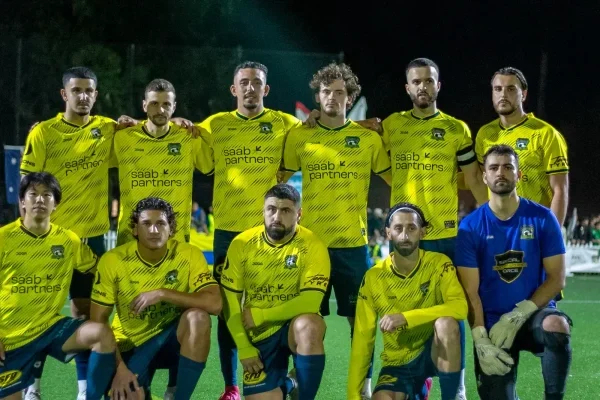


Football NSW supports Female Coaches CPD as Women’s Football Surges

Football NSW has used the platform of the AFC Women’s Asian Cup to deliver a targeted professional development workshop for female coaches, bringing together scholarship recipients for an evening of structured learning and direct engagement with elite women’s football.

Held at ACPE last month, the session was open to female coaches who received C or B Diploma scholarships through Football NSW in 2025. Coaching accreditation carries a financial cost that disproportionately affects women, who are less likely to have their development subsidised by clubs or associations operating in underfunded community football environments. Scholarship access changes that equation at the point where many women exit the pathway.

Facilitated by Football NSW Coach Development Coordinator Bronwyn Kiceec, the workshop focused on goal scoring trends from the tournament’s group stage, with coaches analysing attacking patterns and exploring how those insights could translate into their own environments. The group then attended the quarter-final between South Korea and Uzbekistan at Stadium Australia.

The structure of the evening mattered as much as its content. Female coaches in community football rarely have access to elite competition environments as a professional resource. The gap between the level at which most women coach and the level at which the game is analysed and discussed tends to reinforce itself. Placing scholarship recipients inside a major tournament, as participants rather than spectators, closes that gap in a way that a classroom session cannot.

Female coaches remain significantly underrepresented across all levels of the game in Australia. The pipeline that will change that depends not only on accreditation access but on the professional networks, peer relationships and exposure to elite environments that male coaches have historically taken for granted.

The workshop forms part of Football NSW’s ongoing commitment to developing female coaches through scholarships and structured learning opportunities.


Previous ArticleNext Article

A Structural Fix or Stoppage? Will FQ’s New Referee Pipeline Solve its Shortage?

Football Queensland‘s newly launched club referee framework is being presented as a game-changing solution to one of the most persistent operational problems in grassroots football: the chronic shortage of match officials. Will democratising and lowering the bar for entry saturate the gap, or exacerbate a skills shortage?

What the framework actually does

The core of the announcement is a free, 30-minute online module that certifies players or club members as club referees, creating a new category of match official below the formal FQ referee pathway. The stated goal is a 1 referee per team ratio within clubs, with these club-level officials intended to fill the gap at the grassroots end while the formal pathway continues operating above them.

Referee shortages at community level are not primarily caused by a lack of interest in officiating at the elite end. They are caused by the structural reality that organising and staffing fixtures for hundreds of junior and community matches each weekend requires a volume of officials that a centralised recruitment and accreditation model simply cannot generate fast enough. A club-embedded approach that lowers the barrier to entry addresses that supply problem at the point where it actually exists.

The framework’s strongest element is its acknowledgment that referee development is not a single pipeline but a layered ecosystem. By creating a supported entry point within clubs, the program recognises that people are more likely to begin something when the initial ask is modest and the environment is familiar.

The 30-minute online module removes cost and time as barriers, which are consistently among the most cited reasons people do not take up officiating. The integration with FQ’s broader resources and the explicit framing of club officiating as a stepping stone into the formal pathway is also structurally intelligent. A club referee who develops confidence and competence at the grassroots level is a more likely candidate for formal accreditation than someone approached cold by a recruiting drive.

Where the questions remain

The framework’s weaknesses are largely the weaknesses of any supply-side solution to what is partly a demand-side problem. Referee shortages exist not only because there are not enough officials but because the experience of refereeing is sufficiently unpleasant that retention rates are poor. Verbal abuse, sideline behaviour from parents and coaches, and the lack of adequate support structures mean that many referees who enter the system do not stay in it.

A 30-minute module and a club-based support structure does not directly address those conditions. If a newly certified club referee’s first experiences on the pitch involve the same patterns of behaviour that drive experienced officials out of the game, the framework risks building a pipeline that feeds into an environment that consumes referees rather than retaining them. Football Queensland’s existing Protect Our Game initiative and Three Strike Policy are relevant here, but the announcement makes no explicit connection between the new referee framework and the behavioural standards clubs will be expected to maintain around their own officials.

There is also a question of quality consistency. A 30-minute online certification, by design, provides a basic level of preparation. At the youngest junior levels, where match outcomes are secondary to development, that may be entirely adequate. But the framework’s success will depend on clubs implementing the structured learning and support it promises in practice, not just in principle. Clubs vary enormously in their administrative capacity, volunteer bandwidth and culture. A framework that works well in a well-resourced metropolitan club may deliver inconsistent results in a smaller regional association operating with a single administrator.

The broader structural implication

Perhaps the most significant question the framework raises is whether it represents a genuine investment in the referee pathway or a pressure valve designed to relieve immediate operational strain without addressing underlying conditions.

If the club referee model is understood as the entry ramp to a properly resourced and well-supported development pathway, it is genuinely valuable. Football Queensland’s 10-point referee plan, of which this forms one element, suggests the intent is systemic rather than cosmetic. The investment in Alex King as Head of Advanced Match Officials, the all-female referee courses and the appointment of Casey Reibelt as Australia’s first full-time female referee all point to an organisation that is thinking seriously about the full arc of official development.

But frameworks announced with language like “game-changing” and “record investment” carry an expectation of accountability that should be tracked. The meaningful measure of this initiative is not how many club referees are certified in its first season but how many are still officiating two and three seasons from now, and how many progress into the formal FQ pathway.

A referee pipeline is only as useful as its retention rate. That number will tell the real story.

What does the Football Victoria’s Annual Report mean for Victorian Football?

Football Victoria has released its 2025 Annual Report and held its Annual General Meeting at the Home of the Matildas at La Trobe University, presenting a picture of a governing body managing rapid growth while laying the administrative foundations it says will be required to sustain it.

Total participation across all formats reached 96,095 in 2025, a 14 percent overall increase, with women and girls players across outdoor, futsal and social formats reaching 30,928. MiniRoos participation climbed to 39,827, volunteer numbers grew 7.4 percent and female volunteer participation increased 40 percent. Across community competitions, 47,481 fixtures were delivered across 5,016 team entries.

The numbers reflect the sustained momentum of women’s football in particular, a growth curve that has accelerated sharply since the 2023 FIFA Women’s World Cup and continued through the AFC Women’s Asian Cup held in Australia earlier this year. Football Victoria’s report documents that trajectory in participation data but also in the decisions being made about governance, infrastructure and who is shaping the sport’s direction.

Who is shaping the game

The AGM saw the re-election of Elenna Niteros to the Football Victoria board, having first been elected at the 2024 AGM. Niteros, a long-time player and volunteer, is described by the organisation as dedicated to ensuring diversity, equity and inclusion and the growth of women’s football are central to board decisions. The election also returned Peter Filopoulos, an experienced football executive with more than two decades across club, state, national and international organisations. Steve Forbes was subsequently appointed as a director to continue overseeing the organisation’s digital and systems priorities.

The composition of the board matters in ways that extend beyond individual appointments. Football Victoria operates under a 40:40:20 constitutional requirement for gender balance, and the report documents that 94 percent of clubs met that criterion in 2025. That figure, alongside the 100 percent of clubs meeting diversity and inclusion criteria, represents the most structurally significant governance data in the report. The decisions that shape who gets to play, where facilities are built, how budgets are allocated and which programs receive investment are made by the people in those rooms.

Chair Dr Angela Williams, in her first full year in the role, acknowledged the broader environment in which the sport is operating, noting that 2025 had not been easy for everyone and naming violence motivated by race, religion, gender and politics as unacceptable. Her statement that football would play its role in providing peace, belonging and kindness was framed not as aspiration but as responsibility.

Life membership and legacy

The evening included the formal welcome of Life Members from regional associations transitioning into Football Victoria’s statewide structure, alongside the announcement of two new Life Members: Eugene Brazzale, a legendary referee and mentor, and Maggie Koumi, recognised as a trailblazing female administrator.

The In Memoriam section of the annual report carries its own weight. Betty Hoar and Maria Berry AM, both described as foundational pioneers of the women’s game, were among five Life Members farewelled in 2025. Berry’s four-decade legacy included advocacy that tore down systemic barriers for women in sport. Hoar was an inaugural Hall of Fame inductee. The document also recorded the tragic passing of Heidelberg United NPLW striker Keely Lockhart, described by her club as a legend and an angel, known for her kindness toward younger players and her impact on the women’s game in Victoria.

Infrastructure and the years ahead

CEO Dan Birrell framed the year as one defined by progress, describing growth not as a statistic but as a signal that football matters to more people than ever and that communities believe in what is being built. The language is carefully chosen. Progress implies direction, and Football Victoria’s advocacy for infrastructure investment is the clearest indication of where that direction leads.

The Level the Playing Field campaign and the Parliamentary Friends of Football group both received mention in the CEO’s report as central to the organisation’s relationship with government. The recent Victorian State Budget delivered $750,000 to Avondale FC and Hume City FC for facility upgrades, and Football Victoria has indicated further budget announcements are forthcoming. The connection between booming participation and facility access, as Birrell noted, remains central to the organisation’s work with government and partners.

The practical implications of that work are not abstract. Facilities without adequate lighting cannot host evening training. Grounds without gender-inclusive changerooms communicate, without saying a word, who the sport was built for. The $343 million grassroots infrastructure fund Football Australia and Football NSW have sought from the NSW Government reflects the scale of the problem nationally. Victoria faces the same challenge, and the governing body’s political advocacy exists precisely because participation growth without infrastructure investment produces a sport that is larger but not meaningfully better.

With 96,000 participants and a board mandated to reflect the diversity of the community it serves, Football Victoria is in a stronger position than it has been. Whether the infrastructure and investment follow is the question the next decade will answer.

Most Popular Topics

Editor Picks

Send this to a friend