






Football is growing fast in Australia, but the infrastructure and planning behind it are not. In a Soccerscene-exclusive survey conducted between 19 and 30 January 2026, distributed through our 31,000-strong industry database, grassroots and semi-professional leaders raised consistent concerns that council consultation, long-term facility planning, and funding priorities are failing to match rising participation demand.
The risk is bigger than overcrowded pitches and volunteer burnout. If the foundations of the game cannot keep pace, Australia’s ability to develop talent, retain players, and remain competitive, particularly against structured football nations like Japan and South Korea, becomes harder to sustain.
Football participation in Australia continues to grow at a rapid pace. Local councils frequently emphasise their support for the game and its contribution to community life.
However, feedback from those responsible for administering football at club level suggests this support is not consistently reflected in long-term planning, effective consultation, or infrastructure funding that matches rising demand.
A growing game facing structural pressure
The disconnection can be seen in recent survey findings gathered from across Australia’s football ecosystem, including administrators, coaches, club executives and volunteers working predominantly at grassroots and semi-professionals levels. The results point to a consistent pattern of concern around how local councils are engaging with the game.
When asked how well their local council understands football participation demand, almost two-thirds of respondents (64 per cent) said councils had either a limited understanding or no understanding at all. Only one respondent indicated that their council understood participation demand “very well”.

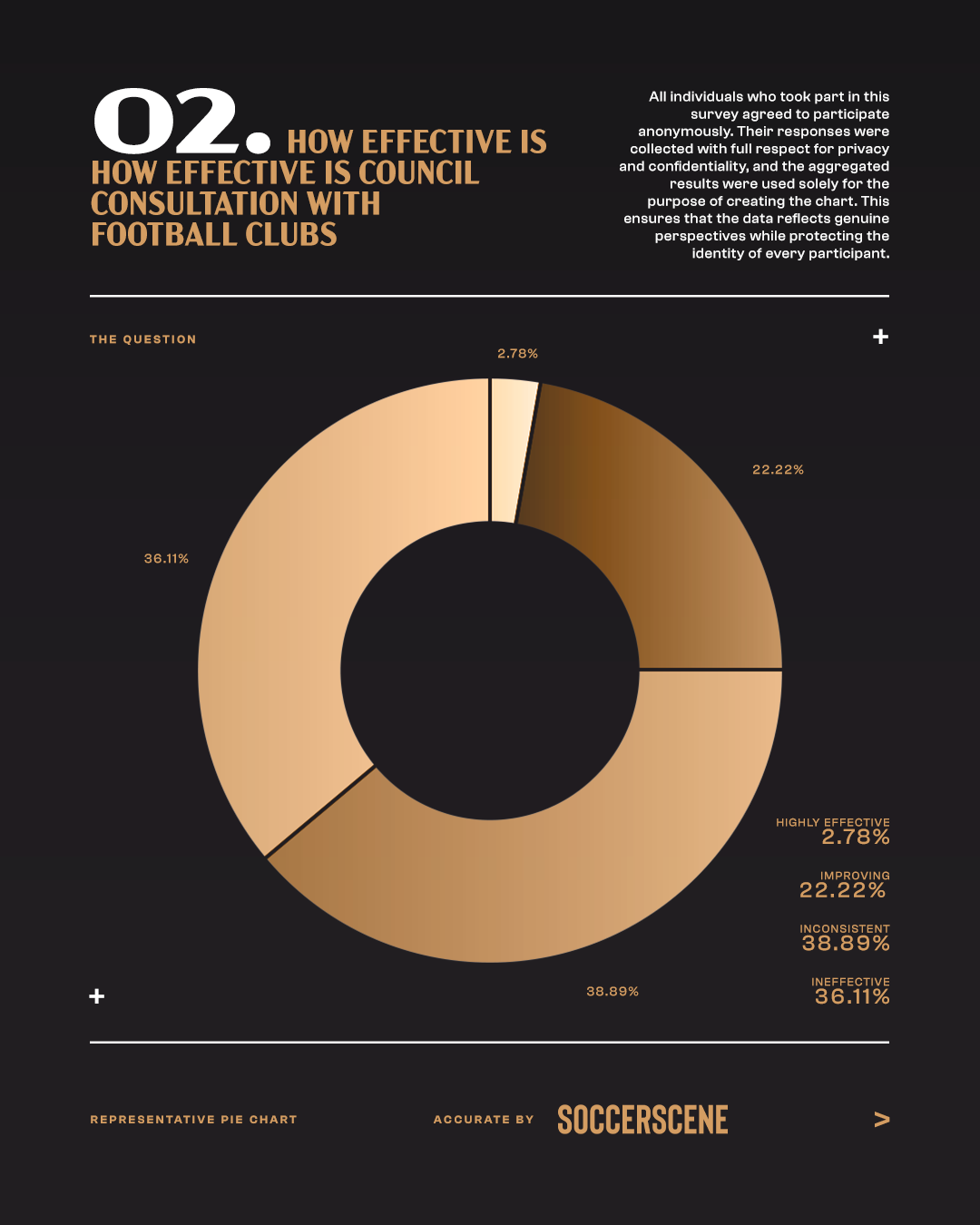
Concerns extend beyond awareness to process. Three-quarters of respondents (75 per cent) described council consultation with football clubs as either inconsistent or ineffective. This suggests that while engagement may occur, it is often fragmented, reactive or lacking meaningful follow-through.
Long-term planning failing to match participation growth
The implications of this are most evident in infrastructure planning. Half of respondents said football facilities are not being planned with long-term growth in mind, with a further 19 per cent indicating planning is short-term only. In other words, nearly seven in ten respondents believe current approaches fail to adequately account for future participation pressures.

Funding priorities continue to challenge football’s expansion
Funding priorities also emerged as a critical issue. Almost half or respondents (47 per cent) identified the lack of prioritised funding as the single biggest council-related challenge facing football, ahead of poor facility design, limited engagement and slow planning processes.

Importantly, these concerns were raised by people deeply embedded in the game. The majority of respondents represented grassroots or semi-professional clubs, many holding governance, leadership or operational roles. Underscoring that these findings reflect lived, on-the-ground experience rather than isolated dissatisfaction.
Taken together, the data suggests the issue is not one of individual councils falling short, but of a broader mismatch between football’s rapid participation growth and the frameworks councils use to plan, consult and invest.
The reality on the ground for clubs and communities
The consequences of this misalignment are already being felt on the ground. Findings in a 2024 audit undertaken by Football Victoria affirm that across many municipalities, football facilities are operating at or beyond capacity, with pitches heavily overused across multiple days and codes, increasing wear, limiting recovery time and compromising playing surfaces.
For clubs, this pressure is most visible in how access is allocated. Women’s teams are increasingly competing for already limited training and match slots, often scheduled later in the evening or displaced altogether, despite participation growth being strongest in the women’s game. Junior teams, meanwhile, are frequently compressed into unsuitable or undersized facilities, with multiple age groups sharing spaces not designed for that level of demand.
In the absence of sufficient council-led planning, clubs are left to absorb the consequences. Volunteer administrators are tasked with managing participation growth councils did not anticipate, juggling scheduling conflicts, maintaining deteriorating facilities, and responding to rising expectations from players and families.
Over time, these pressures risk undermining the very outcomes councils say they value. Participation pathways become constrained, equity of access is compromised, and clubs are forced into reactive decision-making simply to keep programs running. What emerges is not a failure of clubs to manage growth, but a system in which demand has outpaced the infrastructure frameworks designed to support it.
How councils interpret and respond to these challenges ultimately shapes how football infrastructure evolves at a local level.
How councils view the challenge
Longstanding Councillor of Merri-Bek, Oscar Yildiz, acknowledges that funding football infrastructure remains one of the most complex challenges facing local government, largely due to competing demands across multiple sporting codes.
“We get requests from AFL, cricket, bowling and a whole range of other sports,” Yildiz said. “With limited funding, councils are constantly trying to balance those competing priorities and direct investment where it will have the greatest impact.”
Yildiz also suggested that funding decisions are influenced not only by council budgets, but by broader political dynamics between local, state and federal governments.
“If all three levels of government aren’t working together, you’re going to have fractures,” he said. “And when that happens, clubs lose, players lose, and communities lose.”
Consultation, another major concern identified in the survey, is an area Yildiz believes councils must continually improve. While he noted that council officers often maintain strong working relationships with local clubs, he acknowledged that bureaucratic delays and staff turnover can weaken engagement and slow progress.
“The biggest issue with any level of government is time,” Yildiz said. “Clubs want issues resolved quickly, whether it’s facility access, maintenance or funding, but processes can be slow. During that time, clubs can lose members, resources and opportunities.”
In municipalities such as Moreland, where football plays a significant cultural and community role, Yildiz believes councils have an added responsibility to recognise the sport’s social value.
“Football engages thousands of people across culturally diverse communities,” he said. “It’s not just about sport – it’s about connection, wellbeing and participation.”
What happens if councils fail to keep pace?
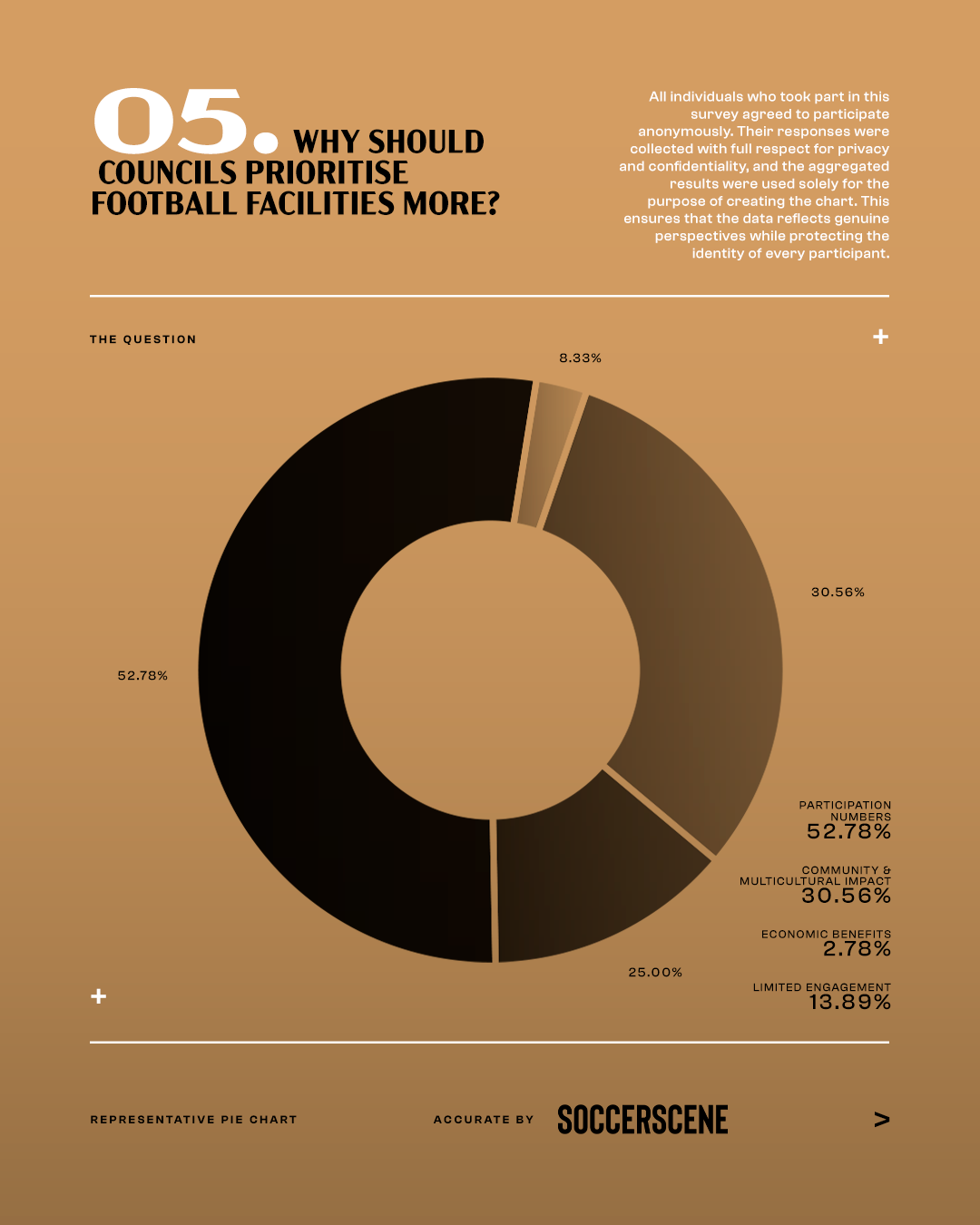
Ultimately, Yildiz argues that the cost of failing to invest in football infrastructure extends far beyond financial considerations.
“It’s about the return on investment for families and communities,” he said. “If clubs aren’t supported to continue operating and growing, the long-term social and health impacts are something we all carry.”
While councils face genuine financial and political constraints, the survey findings highlight a growing expectation across the football industry that infrastructure planning, consultation processes and funding frameworks must evolve alongside participation growth.
The question is no longer whether football is growing. The question is whether council planning is prepared to grow with it.

