


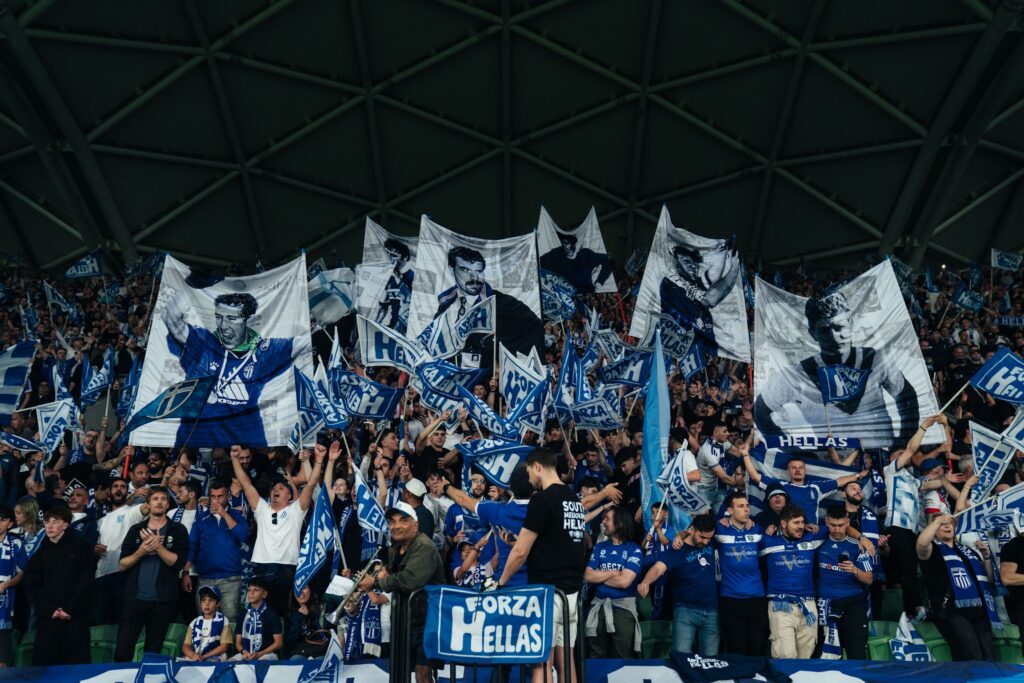
South Melbourne Hellas did more than win the Australia Cup; they reminded Australian football of something it has struggled to fully embrace for more than two decades. The game already possesses extraordinary assets in its clubs, supporters, communities and history. The challenge is no longer deciding who belongs, but building a system that allows the best of Australian football to thrive.
The supporters have delivered their verdict
There are moments in football that transcend the ninety minutes. Moments that challenge conventional thinking and force an industry to confront questions it has avoided for too long.
A fortnight has passed since South Melbourne Hellas defeated Melbourne Victory in the 2026 Australia Cup final. That match was definitely one of those moments.
For some, it was a remarkable ‘Cupset.’ For others, a historic triumph for one of Australia’s most decorated football institutions.
For me, it represented something greater.
It was a symbolic one-finger salute to the establishment from supporters who have spent decades demonstrating their commitment to the game.
Not because they want to tear down the A-League, but because they want their clubs and communities recognised as part of Australian football’s future.
The passion, atmosphere and emotional investment demonstrated something that cannot be manufactured overnight. Authenticity.
These supporters did not suddenly discover football. They have been here all along, volunteering, raising funds, maintaining facilities and passing their allegiance from one generation to the next.
Yet the conversation has too often focused on whether traditional clubs belong within the professional football landscape.
Perhaps we have been asking the wrong question.
The issue was never the clubs. It was whether Australian football had developed the governance, structures and commercial model needed to unlock their potential.
That does not mean the establishment of the A-League was a mistake – quite the opposite.
When the competition launched in 2005, it represented significant progress. It attracted new audiences, investment and commercial opportunities while establishing professional standards and a stronger national presence.
Those achievements deserve recognition.
But a model designed for Australian football in 2005 should not be immune from scrutiny in 2026.
The question is not whether the A-League was the right decision twenty years ago. It is whether our current football structure remains fit for purpose today.
The Crawford Report: Twenty-three years later, are we listening?
In April 2003, the Independent Soccer Review Committee, chaired by David Crawford, delivered its landmark report into Australian football’s governance, structure and management.
It remains one of the most significant documents in the modern history of our game.
The Crawford Report was fundamentally about governance, accountability, financial management and structural reform. It was not an endorsement of any particular club or competition model.
Its assessment was unequivocal:
“The current structure of soccer in Australia is ineffective, does not work and needs changing.”
That was 2003.
The report identified governance weaknesses, financial instability, political divisions and a lack of strategic direction. It also recognised the game’s enormous strengths, including “passionate latent public support”.
One observation remains particularly relevant:
“The role of the administrators of soccer is to advance and benefit soccer in totality.”
That statement should sit at the centre of every discussion about Australian football’s future.
Administrators are responsible for advancing the game as a whole, not simply protecting individual competitions, institutions or interests.
The Crawford reforms helped establish the foundations for a new professional era. They contributed to changes that delivered genuine progress.
But reform cannot be a one-off exercise.
What concerns me is that, in conversations across the football industry, I have encountered administrators who are not even familiar with the Crawford Report, let alone its findings.
How can we properly assess where Australian football needs to go if we do not understand the decisions that shaped where we are today?
This is not about returning to the past. It is about learning from it and determining what the next stage of reform should look like.
The clubs keep demonstrating what is possible
The Australia Cup has become one of the most important competitions in Australian football because it allows clubs from different levels of the game to compete on the same stage.
Community clubs from outside the A-League continue to demonstrate what is possible.
In 2015, Heidelberg United hosted Melbourne City in an FFA Cup quarter-final at Olympic Village.
The appearance of former Greek international and European champion Kostas Katsouranis helped attract more than 11,000 spectators.
Melbourne City won 5-0, but the occasion demonstrated the ability of an established community club to generate significant interest, commercial exposure and national attention.
In 2024, Heidelberg eliminated Central Coast Mariners from the Australia Cup. A year later, the club reached the final against Newcastle Jets, having overcome several A-League opponents along the way.
Now, you can add the story of South Melbourne Hellas.
Australian Championship winners in 2025, participants in the inaugural OFC Pro League in 2026, and now Australia Cup champions.
These achievements demonstrate ambition, resilience and the strength of established football communities.
But we must also recognise something important.
One major cup final, regardless of its significance, does not automatically establish a sustainable professional football business model.
The real opportunity is what happens next.
Can that excitement translate into repeat attendances, memberships, commercial partnerships and stronger investment?
Can clubs develop the infrastructure, administration and financial capacity required to compete sustainably at a higher level?
South Melbourne’s triumph should not simply be celebrated as a victory over an A-League club. It should be viewed as an opportunity for the entire Australian football ecosystem.
The potential is there. Now it must be converted into long-term value.
Three voices. One challenge for Australian football.
During their respective appearances on Soccerscene’s Unfiltered podcast, Bill Papastergiadis, Peter Filopoulos and Geoff Lord offered different perspectives on Australian football’s future.
But there was a common thread.
We already possess extraordinary football assets. The challenge is developing the leadership, structures and commercial strategy to maximise their potential.
South Melbourne co-President, Papastergiadis challenged the notion that professional competitions or their administrators should be regarded as the sole custodians of Australian football.
His argument was that custodianship belongs to the people and the wider football ecosystem.
Football is not simply a competition, broadcast agreement or commercial licence. It is a network of clubs, families, volunteers, supporters and businesses built around generations of shared history.
Papastergiadis recalled meeting an elderly South Melbourne supporter who had travelled from Ringwood by public transport to attend a match, carrying photographs and memories accumulated over decades.
That loyalty is an extraordinary asset.
But emotional connection alone is not enough. It must be supported by professional administration, financial discipline and commercial sustainability.
A long-time Australian sports administrator across codes, Filopoulos raised another important point: rather than continually identifying new geographical markets where supporter bases might develop, Australian football should also recognise established clubs with existing audiences and deep cultural roots.
Clubs such as South Melbourne, Heidelberg United, APIA Leichhardt, Marconi Stallions, Melbourne Knights and Preston Lions have spent decades building their identities and communities.
Those assets carry genuine commercial potential.
However, this should not become another argument between traditional clubs and A-League franchises.
Australian football has spent enough time divided along those lines.
The future must bring the best of both worlds together.
The A-League has contributed professional infrastructure, national exposure, commercial experience and new generations of supporters.
Traditional clubs bring established communities, history, local connections and cultural identity.
Neither should be dismissed. Why not develop a system that maximises both?
Then there is Lord, Melbourne Victory’s founding chairman, who was particularly direct about the industry’s leadership.
“The game desperately needs leaders, whether they’re putting money in or not. And it desperately needs vision.”
Lord helped establish Melbourne Victory from the ground up and witnessed what leadership, commercial discipline and a compelling football product could achieve.
He also raised concerns about the competition’s commercial performance, media strategy, financial sustainability and lack of structural progression.
His assessment, too, was blunt:
“The game needs big thinkers. If they don’t have big thinkers and leaders, then it ain’t going anywhere.”
Three different perspectives, but a common challenge.
Australian football must recognise its existing assets, strengthen its leadership and develop a sustainable structure that connects the entire game.
The missing link: An integrated football pyramid
Australian football has made genuine progress in creating national competitions.
We have the Australia Cup.
We have the Australian Championship.
And we have the A-Leagues.
Each serves an important purpose.
But the critical missing piece is a clearly articulated pathway connecting these competitions into a genuinely integrated football ecosystem.
The Australia Cup allows clubs from different divisions to compete against each other. The Australian Championship creates another national platform for ambitious clubs. The A-Leagues represent the professional level of the domestic game.
Yet we still lack a fully connected structure that allows clubs to progress through a transparent, merit-based pathway.
What Australian football needs is not simply another competition. It needs a coherent football pyramid.
A system built around sporting merit, ambition, opportunity and professional standards.
That does not mean every club should automatically be entitled to participate in the A-League.
Nor does it mean promotion and relegation can be introduced without addressing the financial and operational realities involved.
It means designing a credible pathway that clubs can understand, prepare for and work towards.
Without that connection, we risk developing separate competitions that generate excitement but fail to deliver the broader structural benefits Australian football requires – a situation which is already well underway.
Professional football must be earned, not purchased
If Australian football is serious about creating a more open and connected system, club licensing and professional standards must be central to the discussion.
Entry into the professional game cannot simply be determined by a club’s history, geographical location or ability to pay a licence fee.
It must be earned.
And it must be supported by transparent criteria.
Those criteria should include sporting performance, financial sustainability, governance, infrastructure, commercial capacity and the ability to meet professional operating standards.
Clubs should understand exactly what is required of them, where they stand and what they must improve.
Equally, administrators must provide clarity about the opportunities available to clubs that meet those standards.
There is little incentive to invest millions of dollars in facilities, administration and football operations if the pathway forward remains uncertain.
A credible licensing framework must reward ambition while protecting the financial integrity of the competition.
It should encourage clubs to improve rather than simply exclude them.
That is how a genuine football pyramid can be built responsibly.
Stop talking about the vision. Develop an investable business model.
This is where Australian football’s leadership must demonstrate its value.
The industry needs a bold, properly costed and commercially credible vision for the future of the domestic game.
Not another collection of aspirational statements.
Not another strategy that disappears into a boardroom.
And certainly not another structural proposal without a viable financial model.
We need an investable proposition.
One that addresses the fundamental economics of the competition.
How will media rights be developed and distributed?
What is the long-term broadcast and digital distribution strategy?
How will clubs generate sustainable revenue?
What are the operating costs of an integrated national competition?
How much capital is required, where will it come from and what returns can investors reasonably expect?
How will commercial opportunities be shared across the football ecosystem?
These are not secondary questions. They are fundamental to the success of any proposed reform.
The Crawford Report established the importance of sound governance.
Filopoulos highlighted the value of established markets.
Papastergiadis demonstrated the strength of community connection and supporter loyalty.
Lord reinforced the importance of leadership and commercial discipline.
The challenge now is bringing those elements together into a commercially sustainable model that investors, clubs and supporters can believe in.
But there is another uncomfortable question.
Who actually owns responsibility for developing and delivering Australian football’s long-term domestic vision?
Football Australia, the Australian Professional Leagues, state federations and clubs all have responsibilities.
Yet fragmentation across those organisations remains a fundamental challenge.
Who is responsible for bringing the stakeholders together, establishing the commercial model and delivering measurable outcomes?
Without clear ownership, even the strongest vision risks becoming another document that never translates into action.
Leadership must come with responsibility. And responsibility must come with accountability.
Develop the business case.
Establish the governance framework.
Define the pathway.
Determine the capital requirements.
Then take that proposition to market.
Engage investors, broadcasters, commercial partners, governments and the wider football business community.
Raise the capital.
And deliver it.
Everyone has a decision-maker somewhere in their phone contacts.
It is time to start making those calls.
The writing is on the wall. The opportunity belongs to everyone.
South Melbourne Hellas’ Australia Cup triumph was an extraordinary moment.
But its greatest contribution may not be the trophy itself.
It may be the conversation it forces Australian football to have.
Not about whether traditional clubs are better than A-League clubs.
Not about returning to the National Soccer League.
And not about reopening divisions that have held the game back for too long.
The opportunity is much bigger than that.
It is about taking everything Australian football has learned over the past twenty years, recognising the extraordinary assets already within the game and building a more connected, competitive and commercially sustainable future.
The Crawford Report helped establish the foundations for change.
The A-League delivered an important professional era.
The Australia Cup demonstrated the power of connecting different levels of the game.
And the Australian Championship created another opportunity for ambitious clubs to demonstrate their potential.
Now we must connect the pieces.
Establish the pathway.
Set the professional standards.
Develop the commercial model.
Identify who is responsible for delivering it.
And hold the industry’s leadership accountable for the outcomes.
The clubs were never the problem. The challenge has always been creating a system that allows the best of Australian football to thrive.
Give clubs the platform, policies and resources to succeed.
Demand professional standards, accountability and financial discipline in return.
Then allow sporting merit, ambition and commercial capability to determine how far they can progress.
The supporters have demonstrated their commitment.
The clubs have demonstrated their ambition.
And the professional game has demonstrated what can be achieved when the right leadership and investment come together.
The writing is on the wall.
The question is no longer who belongs in Australian football’s future.
The question is who has the vision, courage and accountability to build it.