


Victorian Labor commits $500,000 to Thornbury Football Facility as State Election Advocacy Intensifies

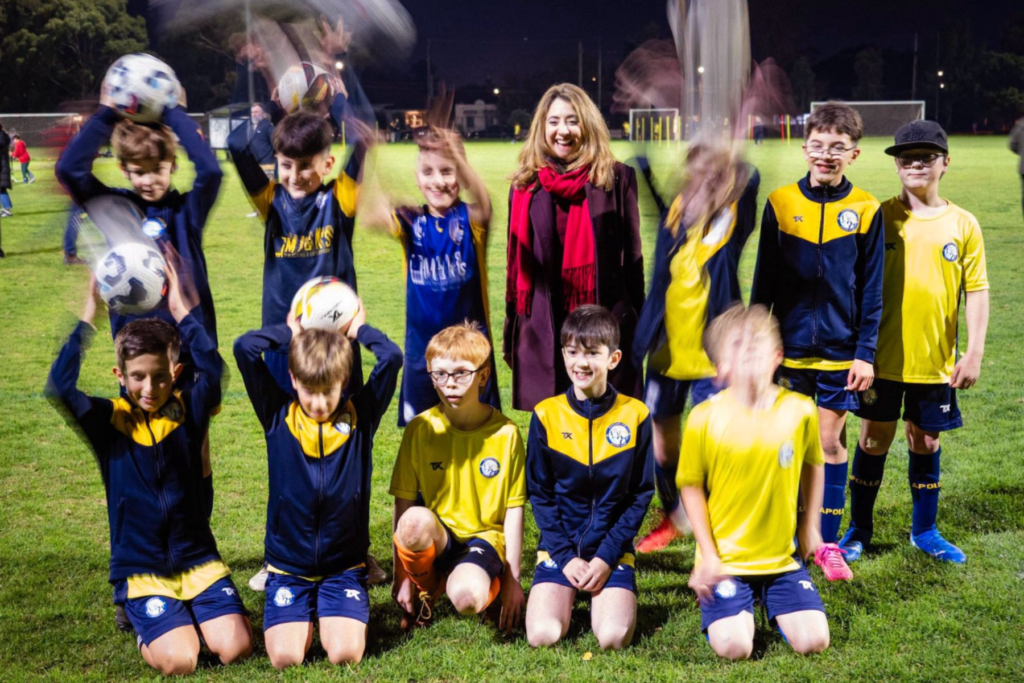
The Victorian Labor Party has confirmed $500,000 in 2026-27 State Budget funding to upgrade facilities at Mayer Park in Thornbury, with Northcote MP Kat Theophanous joining Darebin United juniors for a training session earlier this month to mark the commitment. The funding follows a public campaign by Football Victoria highlighting the ground’s deteriorating conditions, and lands within an escalating advocacy effort by the sport ahead of the next Victorian election.

The money will go toward upgrading the playing surface and planning a new pavilion at a ground that has received no infrastructure investment in over a decade, according to Football Victoria, despite participation at Darebin United more than quadrupling in that time. The club fielded five teams in 2021. It now fields more than 20, with over 300 players including more than 130 children under 12 and over 70 female players.

That growth has collided directly with the limits of the ground itself. Mayer Park has no drainage and no synthetic surface, and Football Victoria reported that Darebin United lost 23 training sessions in 2024 alone due to unsafe, waterlogged conditions. Club President Michael Slaughter described a pitch that was uneven and at times dangerous, particularly for junior and female players.

“I have been there for six years, and the club is at a stage now that we need something new,” Slaughter said in comments to Football Victoria earlier this year. “There’s only so many training sessions you can cancel, and then there’s the cost of finding alternative grounds indoors or outdoors, which isn’t ideal.”

A campaign that found its target

Football Victoria published a dedicated article in March calling on Darebin City Council to urgently prioritise redevelopment of Mayer Park, explicitly linking the club’s case to its broader Level the Playing Field campaign. Three months later, the funding arrived, not from council, but from the state government, attached to the local member’s name and delivered with a photo opportunity on the training pitch.

A club’s need becomes visible through governing body advocacy, a local member adopts the cause, and the funding is announced as a direct response to community need rather than as a line item in a broader budget process. Theophanous’s own account of the announcement makes the local framing explicit, describing the investment alongside free public transport, school upgrades and registration discounts as part of what she has billed as “easier, safer and more affordable” support for Northcote.

“Community sporting clubs bring Northcote locals together,” Theophanous said in her budget statement. “Through our Get Active Kids voucher program, we’re making sure the cost of fees and equipment doesn’t keep kids from playing the sport they love. And we’re also investing to make local clubs even stronger.”

Earlier this year, Avondale FC secured $500,000 for lighting at Avenger Park and Hume City FC received $250,000 for upgrades at Nasiol Stadium, both delivered through the same budget cycle and both paired with local member announcements. Mayer Park follows the same pipeline, a state government commitment, a local seat, a community club whose growth has outpaced its facilities, and a governing body using the win as evidence in a larger campaign.

The equity dimension

What distinguishes the Mayer Park case is the explicit role gender and accessibility played in Football Victoria’s advocacy. The governing body noted that unsafe pitch conditions were particularly dangerous for junior and female players, and highlighted that Darebin United maintains 40% female representation on its committee with seven female coaches, alongside its status as one of Darebin’s first 2-Star Club Changer accredited clubs, a Football Victoria program recognising clubs that actively remove barriers to female participation.

A club building one of the more credible female participation pathways in the municipality was, until this announcement, doing so on a ground its own administrators described as unsafe. Infrastructure investment of this kind does not simply improve playing conditions. It determines whether programs explicitly designed to grow women’s and girls’ football can function as intended, or whether they remain constrained by the same ageing facilities that have shaped community football for a decade.

What it means for the campaign ahead

Football Victoria has framed the Mayer Park outcome as one data point within its Level the Playing Field campaign, which continues to call for more equitable government investment in football relative to other codes. The organisation has indicated further football-related announcements are expected from the 2026-27 Victorian State Budget, with the upcoming state election positioned as the decisive moment for the sport’s broader infrastructure future.

For Slaughter, the immediate outcome is more concrete. “The funding is extremely important,” he said. “It allows us to deliver our football program and to grow. This will give them a place to come, to have fun and to enjoy their soccer”.

Whether that template, governing body advocacy, local political adoption, budget announcement, repeats consistently enough to address the scale of Victoria’s grassroots facilities gap remains the open question Football Victoria’s campaign is designed to keep in front of both major parties as the election approaches.

Previous Article

World Cup betting boom presents billion-dollar opportunity, and a growing dilemma, for Australian football

The 2026 FIFA World Cup is expected to become the biggest betting event in sporting history, with more than US$50 billion ($76 billion AUD) expected to be wagered globally across the tournament.

Financial services firm Macquarie estimates around US$500 million will be bet on each match, eclipsing the estimated US$35 billion wagered during the Qatar 2022 World Cup. The jump is driven by the tournament’s expansion from 32 to 48 teams and from 64 to 104 matches, alongside the rapid growth of legal sports betting markets in North America.

While much of the attention has focused on the sheer scale of betting turnover, the figures also underline football’s commercial importance to Australia’s wagering industry.

The World Cup has long been one of the country’s biggest betting events, sitting alongside the Melbourne Cup, AFL Grand Final and State of Origin. With Australia qualifying once again and attracting strong national interest, bookmakers have invested heavily in marketing campaigns designed around football’s month-long global spectacle.

TAB recently launched its nationwide “The Cup at TAB” campaign, positioning venues across Australia as communal destinations to watch World Cup matches, backed by research suggesting 61% of Australians prefer experiencing the tournament with others.

Sportsbet has also rolled out a major World Cup advertising campaign built around football’s global appeal, highlighting just how commercially valuable the tournament has become for Australia’s betting operators.

What about Australian Football?

Unlike Europe’s major leagues, Australian football still relies heavily on sponsorship and broadcast revenue to grow participation, develop professional competitions and improve fan engagement. The increased commercial attention generated during a World Cup inevitably benefits broadcasters, venues, hospitality businesses and wagering companies looking to capitalise on football’s largest audience.

SBS has introduced in-game advertising during FIFA’s mandated hydration breaks for the first time at a World Cup, creating additional commercial inventory during live broadcasts while maintaining uninterrupted match coverage.

Yet football’s commercial success arrives amid mounting political pressure over gambling advertising.

The Albanese Government has proposed significant restrictions on gambling promotions, including banning betting advertisements during most live sport before 8.30pm, prohibiting gambling branding at sporting venues and preventing athletes and celebrities from promoting wagering products. While described as Australia’s biggest gambling advertising reforms to date, critics argue the measures still leave significant loopholes.

What does it mean for football?

As betting companies spend millions attaching themselves to the World Cup, gambling harm advocates argue football’s biggest event also becomes one of the industry’s most effective customer acquisition tools.

Macquarie analysts have warned bookmakers face an additional challenge beyond simply attracting World Cup punters. The industry’s long-term profitability depends on converting casual tournament bettors into year-round customers across football, racing and other sports, as well as higher-margin casino products.

That concern has been repeated by gambling reform organisations, which argue global football tournaments expose younger audiences and first-time bettors to increasingly sophisticated wagering products.

For Australian football administrators, the issue reflects a broader commercial balancing act.

The sport continues to chase greater investment to compete with the AFL and NRL for fans, sponsors and media attention. World Cups generate unprecedented engagement, creating opportunities for broadcasters, pubs, clubs, hospitality operators and betting companies alike.

However, as governments tighten gambling regulations and public scrutiny intensifies, football’s commercial ecosystem may also need to evolve. The 2026 World Cup demonstrates football’s extraordinary economic power beyond ticket sales and broadcasting rights. Billions of dollars will flow through betting markets over the next month, reinforcing football as one of the world’s most commercially valuable sports.

For Australia, the challenge is ensuring that the business generated by football strengthens the game itself, rather than simply enriching industries that surround it.

Football Victoria joins campaign to fight racism in sport

With the launch of the Victorian Government’s Racism Doesn’t Belong in Our Game campaign, Football Victoria joins several sporting organisations in the state to ensure sport remains inclusive and welcoming for all.


About the campaign

Racism Doesn’t Belong in Our Game aims to raise awareness of racism in community sport, uniting organisations and associations like VACSAL, Vicsport, VicHealth and more.

Football Victoria, as the state’s governing body for the beautiful game, will affirm its commitment to ensuring football is a safe and inclusive place for all who play, coach or support by joining the campaign.

It reflects the leadership and guidance of the Centre for Multicultural Youth (CMY) and its CMSport initiative, a service provider with over 30 years of experience in supporting diversity in sports through training, coaching and mentoring, and consulting support.

“It has been fantastic to work with CMSport, CMY and the other sporting codes to bring this campaign to life,” said FV Executive Manager of Equity Growth and Government Relations Karen Pearce via media release.

“The Racism Doesn’t Belong in Our Game campaign started with a pledge from all seven codes to tackle racism, and I really do believe that we can achieve that as a cohesive group pulling toward the same goals.”


Strength in diversity

Australia is an immensely diverse and multicultural nation. According to numbers from the Australian Bureau of Statistics, the population includes 8.8 million people born overseas, representing 32% of the population. 48% have a parent born overseas, while 4% is Indigenous.

It should therefore be expected – and indeed, welcomed – that Australia’s most-participated sport reflects this multiculturalism.

But for many who want to enjoy playing or watching football in their local community, incidents of racism continue to plague their experiences in the game.

“Research tells us over 56% of Victorian community sport have reported experiencing or witnessing racism, a truly alarming number,” Pearce continued.

“We look forward to working together to lower that stat as we try to stamp out racism in sport once and for all.”

Racism Doesn’t Belong in Our Game ultimately embodies not only the goal for all sport going forward, but the best way through which to achieve it.

That is, through unity and championing the diversity which makes Australia a nation to admire.

Most Popular Topics

Editor Picks

Send this to a friend