

Arsenal FC and Cadbury’s relationship grows sweeter

Arsenal & Cadbury partnership

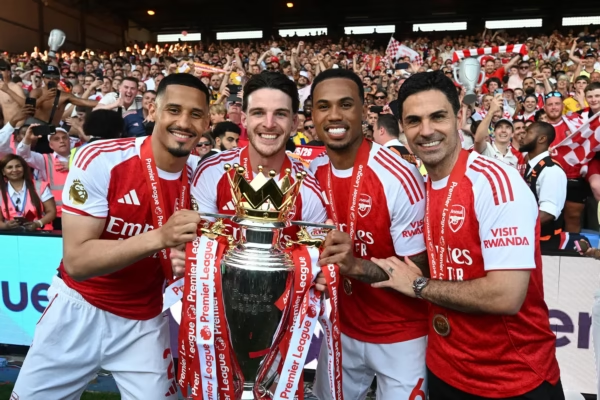
Cadbury has continued their partnership with London juggernauts Arsenal FC, as the official snack partner for the club.

The partnership, now entering its fourth season running, initially began in August 2020 and aims to target a local British audience, with a focus on community.

A partnership between Arsenal and British Sign Language (BSL), has also been integrated into this deal, with BSL aiding and promoting deaf awareness at Arsenal home matches, as well as Cadbury’s ‘Fingers’ snack being tied into BSL initiatives to promote education and inclusion through sign language, with the slogan ‘sign with fingers, big and small’.

Cadbury have also had history with National Deaf Children’s Society, in which a greater understanding of deaf people’s social interaction and football matchday experience was understood. Arsenal & Cadbury are committed to make a change, with matchday programmes at Emirates Stadium to include BSL education, and overall deaf awareness, to ensure greater inclusion for the deaf football community.

Cadbury are also branching into the promotion of women’s football, on the back of the Arsenal women’s successful runs in the Women’s Super League, and the UEFA Champions League. Cadbury and Arsenal plan to enter local communities, to help grow the women’s game at a grassroots level, and give female coaches the opportunity to develop their skills to continue to grow the women’s game in England.

In a video posted to Arsenal’s YouTube channel signifying the extension of this partnership, Arsenal legend Ian Wright shed light on the difficulties and exclusion that deaf fans experience on a matchday, in what Wright describes ‘things we take for granted’. The simple things, such like as conferences, player interviews.

Arsenal have teamed up with lifelong fans, Christopher, and Max, to ensure that the club are doing all that they can to provide a welcoming and inclusive matchday experience for deaf fans, this includes having interpreters on camera when interviews are being done, ensuring that deaf fans can hear from their favourite players in live time.

Arsenal have been at the forefront of inclusion on all fronts and are the first Premier League team to have pitch side interpreters for their deaf audience members, in what Christopher and Max hope, sets a precedent for the rest of the Premier League. In 2018, Arsene Wenger left the club after 22 years of service, but with no interpreters, Arsenal’s deaf audience felt left out of the conversation.

Arsenal and their players look to provide more deaf-inclusive facilities within the Emirates Stadium, with sign language interpreters, and graphics on screens for both dead and non-deaf individuals. Nick Rogers from Mondelez International said via Arsenal’s media release; “Cadbury are dedicated to fostering inclusivity in the game, and we are proud to have incorporated British Sign Language… emphasising the importance of including everyone in the conversation.”

Both Cadbury and Arsenal are giant British brands with a weighted history of inclusion and diversity, with people from differ racial, gender, and disability groups all welcome at the Emirates. This partnership looks to continue to build upon the ongoing community projects that Arsenal & Cadbury share, and now with BSL, to ensure that no one is left out of the conversation.

Previous ArticleNext Article

Google expands football footprint with AI partnerships at five European giants

Google has announced long-term partnerships with five of Europe’s biggest football clubs.

Expanding the role of artificial intelligence in fan engagement through collaborations with Arsenal, Barcelona, Bayern Munich, Liverpool and PSG.

Google Gemini will become each club’s official consumer AI Partner, while Google Pixel will serve as the official smartphone partner.

The partnerships are designed to deliver AI-powered match insights, personalised fan experiences and exclusive behind-the-scenes content across the clubs’ digital platforms.

Supporters will be able to use Gemini to access tactical insights, historical statistics and match analysis while Pixel devices will be used by club media teams to capture content through the company’s “Shot on Pixel” initiative.

A key component of the partnership is the commitment to increasing the visibility of women’s football.

Google confirmed the agreements cover both men’s and women’s teams, with AI tools and Pixel technology set to help produce content and expand the reach of the women’s game through club media channels.

The announcement continues Google’s growing investment in football technology.

Google initially had individual agreements with several of the clubs, including PSG and Liverpool.

By bringing the partnerships together under the Gemini and Pixel brands, Google is positioning artificial intelligence as a core part of the modern football fan experience rather than simply a commercial sponsorship.

For football clubs, the collaboration highlights a broader industry trend towards technology partnerships that extend beyond branding.

AI is increasingly being used to produce personalised content, deliver deeper match analysis and strengthen engagement with large global audiences.

Clubs continue to invest in these growing digital platforms alongside their traditional commercial portfolios.

The partnerships also reinforce the growing intersection between football and technology, with leading clubs increasingly working alongside global technology companies to enhance supporter experiences and explore new ways of connecting with fans on matchday and beyond.


Football Has the Audience. Does It Have the Commercial Strategy?

Soccerscene has launched Survey 4: Commercial Confidence in Football, calling on clubs, sponsors, governing bodies, commercial leaders and football industry professionals to assess whether the game is making the most of its enormous commercial potential.

Football has the audience, participation base and community reach to be one of Australia’s most powerful commercial platforms. But does the industry have the commercial strategy, professionalism and infrastructure required to turn that potential into sustainable growth?

That is the question at the centre of Soccerscene’s latest industry research.

The survey examines how attractive grassroots football is to potential commercial partners, what industry professionals believe is limiting football’s commercial potential, and whether clubs are presenting themselves professionally enough to sponsors.

It also explores what sponsors value most when engaging with football – from community reach and participation scale to brand alignment, values and purpose – as well as whether improved facilities could directly contribute to stronger sponsorship outcomes.

Is football fully capitalising on its commercial opportunity?

Football continues to provide brands with access to highly engaged communities across grassroots, community and elite environments. Yet the commercial landscape remains fragmented, with clubs operating with vastly different levels of resources, capability, governance, media infrastructure and commercial expertise.

Soccerscene’s survey is designed to capture the industry’s perspective on where the opportunities exist – and where football may be leaving commercial value on the table.

The research will look specifically at four key areas:

  • Commercial attractiveness – How attractive is grassroots football as a commercial partnership?
  • Commercial barriers – What is holding football back from reaching its full commercial potential?
  • Club professionalism – Are clubs presenting themselves effectively and professionally to sponsors?
  • Sponsor value – What are sponsors really looking for when they invest in football?

The survey also asks whether better facilities would have a direct impact on sponsorship outcomes, highlighting the potential relationship between infrastructure, commercial presentation and investment.

Have your say

Soccerscene is encouraging football clubs, sponsors, commercial professionals, governing bodies, administrators, media professionals and industry stakeholders to participate.

The findings will contribute to Soccerscene’s ongoing program of industry research, designed to provide a clearer picture of the challenges and opportunities facing football and the organisations operating within it.

Take the Survey: Commercial Confidence in Football

Complete the Commercial Confidence in Football Survey here

The survey will close on 30 August 2026 at midnight, with responses received before the deadline included in the final analysis.

Football has the audience. The question is whether it has the commercial strategy to match.

Most Popular Topics

Editor Picks

Send this to a friend