

Caroline Carnegie: “I don’t think there’s a reason why the game shouldn’t be a success”

Season 2023/24 has been crucial for Melbourne Victory as Managing Director Caroline Carnegie is guiding the Club in the right direction.

There was a tricky period for the organisation, but that has not slowed Victory both on and off the park, as the A-League Men’s and Women’s sides have both performed well in their respective campaigns, with the former bouncing back superbly.

Coupled with significant business partnerships and acquisitions, Victory is establishing a gameplan for long-term growth ahead of its 20th year of existence in 2025.

In this interview with Soccerscene, Carnegie discusses the A-Leagues landscape, the partnership deals Victory have made, tackling the infrastructure problem and maintaining the World Cup legacy.

How are things travelling with Melbourne Victory?

Caroline Carnegie: We’re heading in the right direction with both the men’s and women’s team doing very well.

There’s always going to be noise in different sports – with the Australian Professional League’s situation there’s no doubt we have a lot of work to do and room to grow, both from the league and Club.

Part of it is that despite being a world game, it just hasn’t taken off from a professional perspective in comparison to the participation.

That doesn’t happen in 30 seconds, so there’s a lot of work to get where we want to be as a code, and we all have got to contribute.

That includes every stakeholder that sits around it too and I totally understand that can be difficult to do if there’s no agreement in decisions or directions.

Ultimately, our number one to build our Club and code is to fill stadiums week in, week out and we can’t do that without passionate people who want to be part of it.

You say that the A-Leagues is still in its infancy stage, your thoughts?

Caroline Carnegie: We have a lot of work to do, but there’s so much potential.

I know people have heard that a lot and get tired of the same messaging, but there have been numerous phases from a regulation perspective that we all have to grow, adapt and move with.

Next season is our 20th season and that is super exciting, but the Club is still so young in context with what’s happening in other professional sports so that needs to be factored in.

You’ve acquired numerous partnerships in the past few months including Turkish Airlines, ASICS and Lite n’ Easy, your thoughts on acquiring and retaining them?

Caroline Carnegie: We work incredibly hard to retain our partners and proud of the quality and calibre of them such as Turkish Airlines.

We’ve got wonderful partners that have been with us on the journey such as La Ionica, KFC and Checkpoint that have been around for a very long time, among many others.

When we sat in a room and announced the Turkish Airlines deal, Prof. Ahmet Bolat was talking about flying 90-95 million people around the world next year – all of whom will have exposure to their partnerships, which is a massive win for us. It’s also a win for the football code to get exposure as well.

In addition, having 777 Partners as a strategic shareholder is important to us.

We have General Managers across the business who meet regularly to look at leveraging better opportunities across the network. There’s a good analytical group that really supplements what we can do.

It’s still early days with 777 Partners, but still a positive relationship so far.

Turkish Airlines are one of Victory’s major partners.

Infrastructure is an ongoing challenge for all clubs, how is Victory managing it?

Caroline Carnegie: It’s a big challenge. There are so many people that want to play our sport off the back of the men’s and women’s World Cups, but not enough pitches to play at.

It’s a constant challenge but not necessarily unique to us – we want to try and solve the infrastructure problem but the one good take out of it is the number of people wanting to engage in our sport.

There’s work to do for infrastructure and that comes from us as well – these things don’t happen in 30 seconds either.

You need to find the right place, they need to be funded and it’s hard to find green open spaces to the extent that we would like, but it’s an exciting journey with it being better than people not interested in our sport.

We’ve found that people such as in council are happy to work with us, but as we can imagine the number one priority for us may not be the number one problem that those people have to solve as well.

Whenever we have those discussions, there’s a myriad of stakeholders that each party must deal with.

There is an impetus towards football grounds, more so than 5-10 years ago and that’s really pleasing to see because that is what the community is asking for.

Victoria is multicultural and people come together from all different backgrounds, so all of those people have probably played football from where they’ve come from, not so much from domestic sport.

There’s no shortage of appetite to work with people, it’s just a shortage of time for everybody to have their priorities lined up.

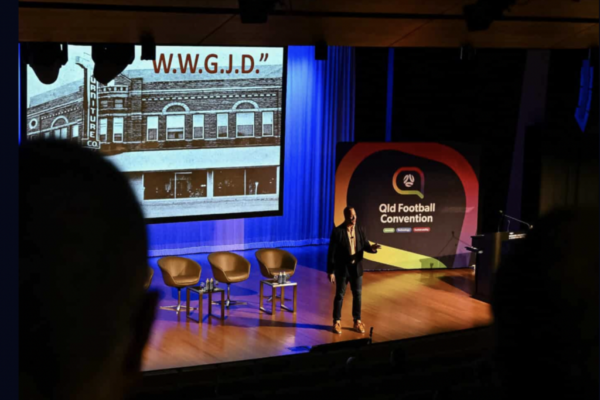
Caroline Carnegie speaking with Craig Foster.


You’ve spoken about preventing a ‘sugar hit’ from the World Cups, how do we sustain the momentum?

Caroline Carnegie: I don’t think there’s a reason why the game shouldn’t be a success.

Because we have a lot of different layers when we all work together, all stakeholders and state/national bodies need to help each other build what we aim to do.

The number one factor is people – when they lose interest, then sponsors and broadcasters would do the same and has a massive flow on effect.

We need to work together to ensure that the product going out there is what people want to see. Watching the Socceroos and Matildas was amazing, but we need people to have their heroes from domestic competitions.

The kids that love the game off the back of the World Cup are not able to see their heroes if they don’t follow the A-League every week.

In an ideal world, they love it when they play for their team, but then for the country loving them plus others that galvanise the national sides.

Victory has set up the Female Development Fund, how has that been incorporated?

Caroline Carnegie: For our A-League Women matches, we have not charged patrons for entry this year.

What we did was create the Female Development Fund and what we ask people to do if inclined is to put their money into that for female programs only and for people to apply for grants to help with program development.

It’s a tricky one because it’s not that we don’t value the girls, but it’s because we didn’t want to have any barriers to people not jumping on the women’s game when we had such a successful World Cup tournament.

In the women’s space, it’s those things to make sure that people have greater access to games and that they can watch their heroes and want to aspire to be like them.

No tickets for games is a different approach, but we have a long-term view to keep people involved and engaged with the game, eliminating those barriers.

Caroline Carnegie congratulates goalkeeper Lydia Williams.

How has the move been to The Home of Matildas?

Caroline Carnegie: It has been really well received.

As with any stadium, it’s more convenient for some compared to others, but it’s the elite nature of the facility from both a training and playing perspective has been welcomed by the girls.

A couple of years ago we had a member forum and we had more double headers coming up – there were people concerned around that.

We were clear at the time that we wanted to do the right thing by our members but also for our players, because the more they play the more you want to watch them.

If you speak to any of the girls, the difference in terms of how elite they feel having the home base with the quality it presents is huge. We are really pleased with how it’s turned out.

It’s a mindset shift as well, as our female players are still semi-professional and need to do other things given the nature of how the league is structured.

In your role, what does the future look like?

Caroline Carnegie: Our partners and shareholders are crucial to what we do.

However, our members and fans are number one. We can’t fill stadiums without them, and the players don’t want empty seats.

We had a course that we provided content for around 12 months ago, where the Director of Football, Coach, Chairman and I came and did a presentation.

Somebody asked me what does success look like for you; Success is not one thing, it’s always football first, but we want to be successful across everything we do.

From a membership perspective it is not just numbers – it is engagement, people who want to be part of Victory and us doing the right thing by them; In a tough environment where they decide what to do with their money, we don’t get questioned because they feel that relationship and value.

Commercially, we want partners to feel like they get a lot out of the alignment with Victory through business.

People should say win trophies, but if you do that in an empty stadium then that’s not success.

We are continuing to evolve and having a member working group helps us understand and validate the decisions we make through feedback.


Previous ArticleNext Article

One Football: Why This Australia Cup Final Means More Than a Trophy

South Melbourne versus Melbourne Victory is more than a long-awaited rivalry. It is an opportunity to unite Australian football around its history – and its future.

On 10 October, South Melbourne FC and Melbourne Victory will walk onto AAMI Park for an Australia Cup Final that represents far more than a trophy.

It brings together two proud clubs from different chapters of Australian football’s history.

One is among the most successful clubs of the former National Soccer League era. The other has become one of the defining clubs of the A-League era.

The atmosphere will be extraordinary. The rivalry will be genuine. The football will be fiercely contested.

Such is the anticipation surrounding the match that it also has genuine potential to break the modern Australia Cup Final attendance record of 18,751, set at the same venue in 2016.

That would represent much more than a number on a crowd sheet. A record attendance would send a powerful message about the public appetite for meaningful fixtures, authentic rivalries and competitions that connect every level of Australian football.

But this final can – and should – mean even more.

It presents Australian football with an opportunity to bring its past, present and future together.

It is an opportunity to dismantle the tired and damaging distinction between “old soccer” and “new football”.

Most importantly, it can demonstrate what becomes possible when the entire game is connected.

We Cannot Build the Future by Discarding the Past

Australian football needed reform at the beginning of this century.

The game required stronger governance, greater professionalism, better commercial structures and a national competition capable of reaching new audiences.

The establishment of the A-League in 2005 opened an important new chapter. It created clubs, rivalries and major occasions that have contributed enormously to the development of the professional game.

But somewhere during that transformation, the idea took hold that Australian football could only move forward by separating itself from much of what had come before it.

The labels “old soccer” and “new football” became a fault line.

Too many clubs, supporters, volunteers and communities that had carried the game for decades were made to feel that their history was no longer welcome at the top table.

In creating something new, the game sometimes appeared determined to dispense with everything associated with its past.

That included the clubs and development pathways that identified, nurtured and produced many members of Australia’s Golden Generation.

Australian football should never be embarrassed by that history.

It is one of our game’s greatest competitive advantages.

Traditional clubs were built by migrant communities that brought their passion, culture and football knowledge to Australia.

They established clubs, built grounds, developed players, created lifelong supporters and sustained the game when it received little mainstream attention or investment.

These communities did not merely support Australian football.

They built it.

Recognising that contribution does not require us to reject the progress made during the A-League era. Both can be true.

The game needed to evolve, but it did not need to marginalise its foundations to do so.

This Is Not “Old” Against “New”

It would be easy to promote South Melbourne against Melbourne Victory as “old soccer” meeting “new football”.

It might create a convenient headline, but it would miss the greater significance of the occasion – and perpetuate a division the game must leave behind.

South Melbourne is not a relic from Australian football’s past.

It is a living and ambitious club with generations of supporters, a distinguished record of national success and an enduring role in developing players and representing its community.

Melbourne Victory is not separate from Australian football’s history.

It is another important chapter in it – a club that has built an enormous following, delivered some of the country’s most memorable sporting occasions and demonstrated the scale that professional football can achieve in Australia.

These clubs were created in different eras, but they belong to the same game.

The future of Australian football is neither “old” nor “new”.

It is one football.

Supporters Want a Connected Game

This final arrives at a time when the appetite for a properly connected football pyramid is becoming impossible to ignore.

Supporters want clubs to have something meaningful to aspire to.

They want success on the field to create opportunity.

They want to see a genuine connection between grassroots football, state competitions, traditional clubs, national competitions and the professional game.

A connected pyramid is about more than promotion and relegation.

It is about unlocking aspiration, investment, relevance and growth throughout the sport.

When clubs can see a pathway forward, they invest in facilities, coaching, academies, commercial capability and community engagement.

When supporters believe their club’s journey can lead somewhere, they become more deeply invested.

When local rivalries carry national consequences, new audiences, media attention and commercial partners follow.

That energy already exists throughout Australian football.

Our opportunity is to harness it.

The Platforms Are Demonstrating What Is Possible

The Australia Cup has repeatedly shown what can happen when clubs from every level are given the opportunity to compete on a national stage.

It connects the grassroots and professional game. It creates genuine jeopardy. It brings national attention to clubs, grounds and communities that rarely receive that level of exposure.

It also produces compelling stories that cannot be manufactured through marketing alone.

The Australian Championship represents another important step. It gives some of the country’s most historic and ambitious clubs a new national platform and creates a stronger bridge between state-based football and the professional game.

Neither competition should be viewed in isolation.

Together, the Australia Cup and Australian Championship can help reconnect the game, restore national relevance to important clubs and build momentum towards a more integrated competition structure.

They also demonstrate something commercially significant.

These communities are not simply part of football’s history. They are active audiences with passion, identity, purchasing power and an enduring commitment to their clubs.

When those communities are respected and properly engaged, they respond.

That creates value for broadcasters, commercial partners, governments and the wider professional game.

A Perspective Spanning Different Eras

My perspective has been shaped by experiencing Australian football across different clubs, competitions and eras.

I served as CEO of South Melbourne Soccer Club during one of the most successful periods in its history.

After leaving in 1997, I returned 12 months later for the 1998/99 season, when South secured its second consecutive national championship under Ange Postecoglou.

Nearly two decades later, in 2015, I returned to the professional game as CEO of Perth Glory in the A-League.

I subsequently joined Football Australia as a senior executive, where I played a key role in strengthening the Australia Cup as a national platform and developing the Australian Championship.

That journey has reinforced my belief that Australian football’s future will not be secured by choosing one part of its history over another. It will be secured by bringing the best of every era together.

The game will fulfil its potential when it connects its professional clubs, traditional clubs, grassroots participants, diverse communities and national teams within a coherent and ambitious system.

This is not about returning to the past.

It is about carrying the best of our history into a stronger future.A newsletter titled 'Blues News' from August 1997, featuring a farewell message from the CEO of the South Melbourne Soccer Club and details about membership campaigns, upcoming soccer season preparations, and calls for community support.

A page from a newsletter discussing upcoming events for the 1997/98 Ericsson Cup season, including a farewell message from Peter Filipoulos, the Chief Executive Officer, and details about support for the team at Bob Jane Stadium.
South Melbourne Soccer Club newsletter, 1997. After stepping down as CEO, Peter Filopoulos returned 12 months later for the club’s 1998/99 national championship season.

More Than a Final

On 10 October, AAMI Park – the spiritual home of football in Melbourne—should become the stage for more than an Australia Cup Final.

It should be a celebration of the people and communities that built the game, the progress achieved during the professional era and the possibilities presented by a connected future.

South Melbourne supporters should be proud of what their club has contributed to Australian football and excited about what may lie ahead.

Melbourne Victory supporters should celebrate what their club has built and the role it continues to play in growing the professional game.

Every Australian football supporter should be able to look at this occasion and see something bigger than a contest between two clubs or two eras.

This final is not “old soccer” against “new football”.

It is Australian football – proud of its entire history, united around its future and ready to unlock its true potential.

One game. One history. One future.

One football.

Melbourne Victory partners with The Pass to expand fan experience

Melbourne Victory has added The Pass to its commercial portfolio, with the partnership designed to give supporters more ways to follow the club away from matchday.

The Pass becomes an ‘Associate Partner’ of Victory, while Hickens Hotel has been named the club’s ‘Official Away Game Venue Partner’. The arrangement will see the Russell Street venue host Victory watch parties and provide a dedicated gathering point for supporters during away fixtures.

The partnership also gives Victory supporters access to The Pass’ broader network of more than 200 venues around Australia, extending the relationship beyond a single location.

For Melbourne Victory, the deal forms part of a wider approach to creating commercial partnerships around the supporter experience rather than limiting sponsorship to traditional branding opportunities.

Hickens Hotel will host Victory fans for selected away matches, while The Pass will provide members with access to offers and experiences through its venue network.

The agreement also connects with Victory’s broader business community, with The Pass joining the club’s commercial network and creating potential opportunities for corporate engagement alongside its consumer-facing activity.

The partnership comes ahead of the 2026/27 A-League Men and Ninja A-League Women seasons, with Victory continuing to develop its commercial offering around both its membership base and matchday audience.

For The Pass, football provides a way to bring its network of hospitality venues into the supporter experience, giving fans a physical destination to watch matches when Victory is playing on the road.

The agreement reflects a broader trend across professional football, with clubs increasingly looking to partnerships that can provide tangible benefits to supporters while creating additional opportunities for commercial partners.

Most Popular Topics

Editor Picks

Send this to a friend