

UEFA Club Benefits Programme distributes record $413.7m AUD

901 European clubs have received a record combined $413.7m AUD from the UEFA EURO 2024 Club Benefits Programme.

Clubs from each of the 55 member associations were supported, ranging from the highest tiers of play to amateur football.

Designed to support clubs who had released players to their national teams across the 2020/2024 cycle of European competitions, the Club Benefits Programme aided clubs through events such as the 2020/21 and 2022/23 UEFA Nations League, European Qualifiers 2022–24 and the UEFA EURO 2024 final tournament.

The mechanisms for the distribution of payments were devised by the UEFA Executive Committee in April 2022. In accordance with these mechanisms, $177m was reserved for the 2020/21 and 2022/23 UEFA Nations League as well as the European Qualifiers to UEFA EURO 2024.

Across these periods, $163m was distributed, a significant increase upon the previous cycle’s $124m distribution. The remaining $14m was saved for the next distribution cycle.

Furthermore, the UEFA EURO 2024 tournament itself saw an increase in the amount of money distributed for the release of players – growing from $230.8m to $248.6m, supporting 196 clubs from 29 UEFA national associations.

Additionally, the overall $413.7m supplied to European clubs is a major increase on the $355m distributed in the previous cycle.

UEFA President Aleksander Čeferin expressed the organisation’s joy for the success of the programme.

“It is fantastic to see clubs of all sizes and levels, across the entire football pyramid, receiving financial rewards for their vital role in developing players who contribute to the success of our national team competitions – including the highly successful UEFA EURO 2024 final tournament,” he said in a press release.

“Every success of our competitions is a shared one, and this benefits programme is another testament to that principle, recognising the dedication of those who work tirelessly to make European football the greatest sport in the world. When football thrives, everyone benefits.”

Chairman of the European Club Association (ECA), Nasser Al-Khelaïfi highlighted the importance of the ECA’s and UEFA’s combined efforts in creating the Club Benefits Programme.

“I am very pleased see that more than 900 clubs from all corners of Europe have benefited from this unprecedented distribution under the Club Benefits Programme, which is a key pillar of UEFA and ECA’s Memorandum of Understanding,” he said in a statement.

“This initiative recognises that clubs play a vital role in the ongoing success of national team football through developing, employing and releasing players; and also that the national team game in-turn drives the development of clubs and their communities.

“This harmonious relationship perfectly reflects the great collaboration between UEFA and ECA today, driving growth, innovation and the positive development of European football in the interests of all.”

To learn which clubs benefited from the programme, and the amount they received – see this list.

Previous ArticleNext Article

Central Coast Mariners Women secure future under Holman Barnes Group

The future of the Central Coast Mariners Women has been secured after the Holman Barnes Group (HBG) reached an agreement to become the new operator of the club’s A-League Women program. The deal ends uncertainty surrounding the team’s participation in the 2026/27 season.

The agreement between HBG, the Australian Professional Leagues (APL) and Total Soccer Growth Holdings (TSG) ensures the Mariners will remain in the Ninja A-League Women competition. It also introduces a new operating model designed to provide long-term stability.

The uncertainty emerged following TSG’s acquisition of the Central Coast Mariners’ men’s side and academy in June. The women’s program was excluded from the original takeover. TSG already owns English football side Queens Park Rangers (QPR) and MLS club Los Angeles FC. The omission placed the future of the 2025 A-League Women champions in doubt. It also prompted the APL to seek a sustainable solution ahead of the new campaign.

A new operating model

Under the new arrangement, HBG will oversee all operational aspects of the women’s team. This includes the football program, staffing and day-to-day management. TSG will retain the club licence and continue overseeing the men’s program and academy. It will also support the women’s operation through its broader football network.

The agreement represents an innovative partnership between the three organisations. It has been designed to strengthen the long-term sustainability of professional women’s football on the Central Coast. HBG’s plans extend beyond the senior team. They include a strong focus on developing participation pathways and creating greater opportunities for female footballers throughout New South Wales.

Attention turns to the new season

The transition comes at a crucial time with preparations for the 2026/27 Ninja A-League Women season underway ahead of its October 16 start. The new operators are expected to begin managing the program immediately. This remains subject to the completion of the remaining regulatory processes. The team currently has no sponsors and games are expected to be moved away from Central Coast Stadium.

The A-League had previously set a July 31 deadline for new owners to be found to secure a place in the upcoming competition. With that now achieved, HBG will be on the clock to ensure the season begins without disruption and becomes a commercial success.

For the Central Coast Mariners Women, the agreement delivers certainty after a turbulent off-season. It also allows the club to shift its attention to the 2026/27 campaign and the team’s on-field performance.

South Melbourne’s Australia Cup triumph reignites promotion and relegation debate

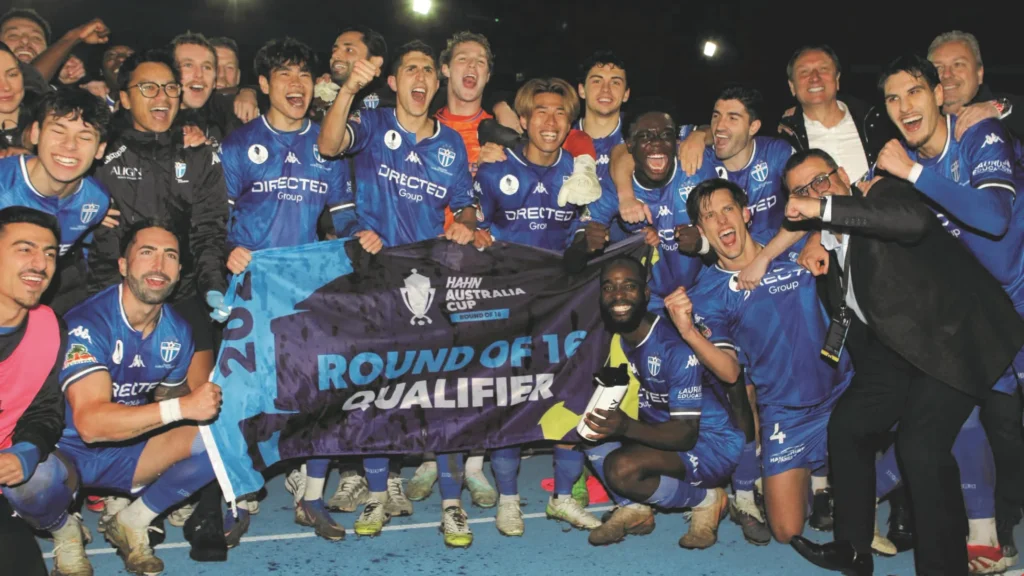
South Melbourne FC’s dramatic 2-1 victory over Adelaide United in the Hahn Australia Cup Round of 32 has reignited debate around promotion and relegation in Australian football, with Co-President Bill Papastergiadis stating the result is further proof that ambitious National Premier Leagues clubs deserve a pathway to the top tier.

The Victorian powerhouse produced one of the competition’s biggest upsets at Lakeside Stadium, overturning an early deficit to eliminate the Isuzu UTE A-League side and secure a place in the Round of 16.

While the result was celebrated as another example of the magic of the Australia Cup, Papastergiadis believes the victory carries a much broader message about the strength that exists outside Australia’s professional league.

Speaking following the win, Papastergiadis said South Melbourne’s performance demonstrated why the Australian football landscape should move towards a connected pyramid featuring promotion and relegation.

“The result was South Melbourne FC’s revenge 22 years in the making,” Papastergiadis said.

“It also demonstrates that clubs in the National Premier Leagues have the quality, professionalism and ambition to compete with A-League opposition when given the opportunity.”

For years, South Melbourne has been one of the strongest advocates for structural reform within Australian football, consistently calling for an open pyramid that rewards sporting merit rather than maintaining a closed league system.

Papastergiadis argued that Australia Cup fixtures continue to showcase the depth of talent throughout the domestic game, with NPL clubs regularly proving they can challenge and defeat professional opponents despite operating with significantly fewer resources.

He believes these performances should not simply be viewed as isolated “cupsets”, but as evidence that Australia’s football ecosystem is ready to embrace a promotion and relegation model that provides ambitious clubs with a genuine pathway to the top flight.

The result against Adelaide United adds another significant chapter to South Melbourne’s storied history. One of Australia’s most successful clubs, South Melbourne has long maintained aspirations of returning to the national stage, backed by a passionate supporter base, strong infrastructure and a proud footballing tradition.

For Papastergiadis, victories such as Thursday night’s reinforce the argument that clubs should earn opportunities through performances on the pitch.

“The Australia Cup continues to show what’s possible when clubs from different levels of the football pyramid compete against one another,” he said.

“Our football should be built on opportunity and merit. Clubs that perform consistently and invest in their communities should have the chance to progress to the highest level.”

South Melbourne will now turn its attention to the Round of 16, where it will look to continue its impressive cup run.

Beyond the result itself, however, the victory has once again fuelled discussion around the future of Australia’s football structure and whether the growing strength of clubs outside the A-League should accelerate the push towards a fully connected national competition.

Most Popular Topics

Editor Picks

Send this to a friend