


Football’s Growth Is Outpacing Council Planning and Clubs Are Paying the Price

Football is growing fast in Australia, but the infrastructure and planning behind it are not. In a Soccerscene-exclusive survey conducted between 19 and 30 January 2026, distributed through our 31,000-strong industry database, grassroots and semi-professional leaders raised consistent concerns that council consultation, long-term facility planning, and funding priorities are failing to match rising participation demand.

The risk is bigger than overcrowded pitches and volunteer burnout. If the foundations of the game cannot keep pace, Australia’s ability to develop talent, retain players, and remain competitive, particularly against structured football nations like Japan and South Korea, becomes harder to sustain.

Football participation in Australia continues to grow at a rapid pace. Local councils frequently emphasise their support for the game and its contribution to community life.

However, feedback from those responsible for administering football at club level suggests this support is not consistently reflected in long-term planning, effective consultation, or infrastructure funding that matches rising demand.

A growing game facing structural pressure

The disconnection can be seen in recent survey findings gathered from across Australia’s football ecosystem, including administrators, coaches, club executives and volunteers working predominantly at grassroots and semi-professionals levels. The results point to a consistent pattern of concern around how local councils are engaging with the game.

When asked how well their local council understands football participation demand, almost two-thirds of respondents (64 per cent) said councils had either a limited understanding or no understanding at all. Only one respondent indicated that their council understood participation demand “very well”.

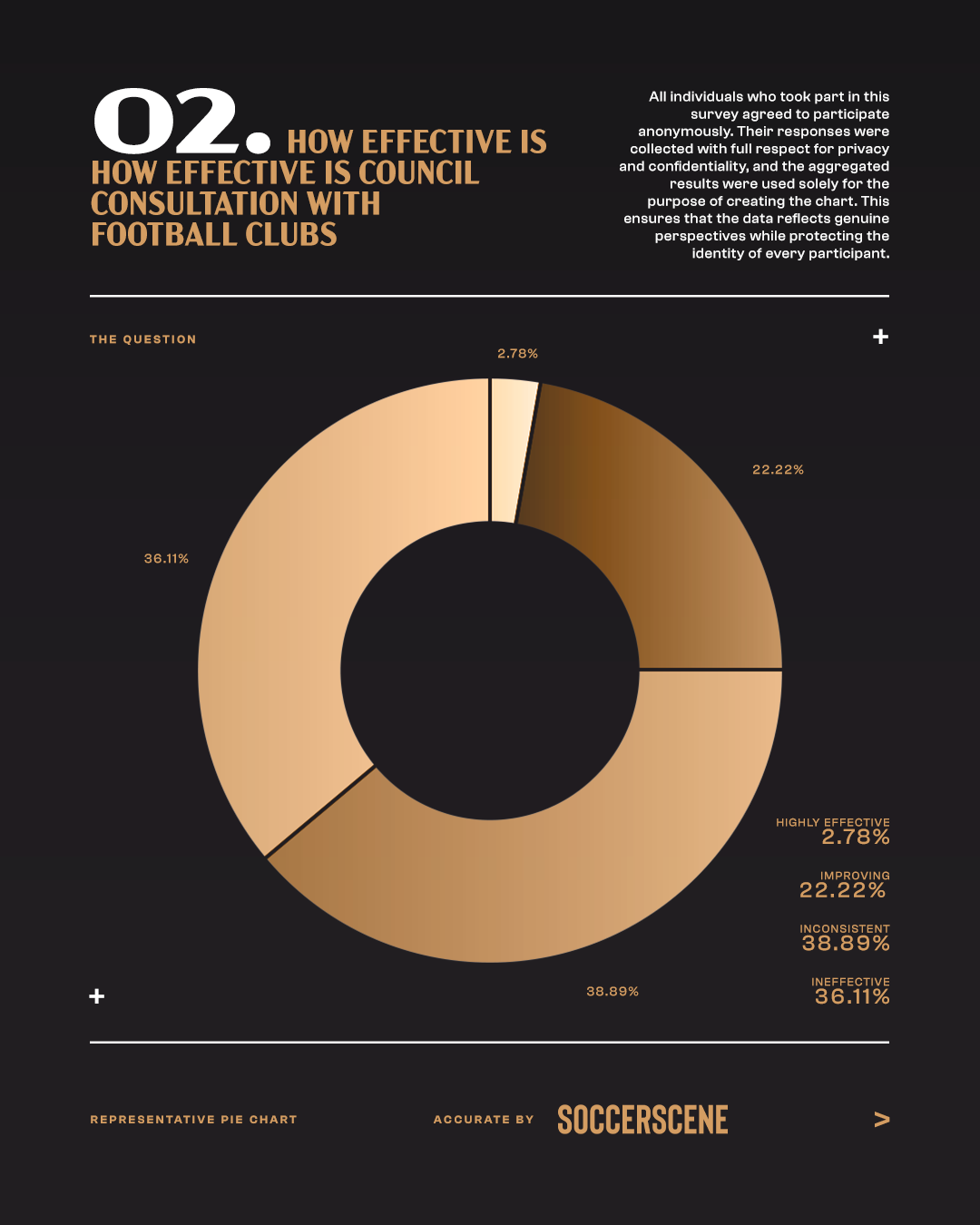
Concerns extend beyond awareness to process. Three-quarters of respondents (75 per cent) described council consultation with football clubs as either inconsistent or ineffective. This suggests that while engagement may occur, it is often fragmented, reactive or lacking meaningful follow-through.
 

Long-term planning failing to match participation growth

The implications of this are most evident in infrastructure planning. Half of respondents said football facilities are not being planned with long-term growth in mind, with a further 19 per cent indicating planning is short-term only. In other words, nearly seven in ten respondents believe current approaches fail to adequately account for future participation pressures.

Funding priorities continue to challenge football’s expansion

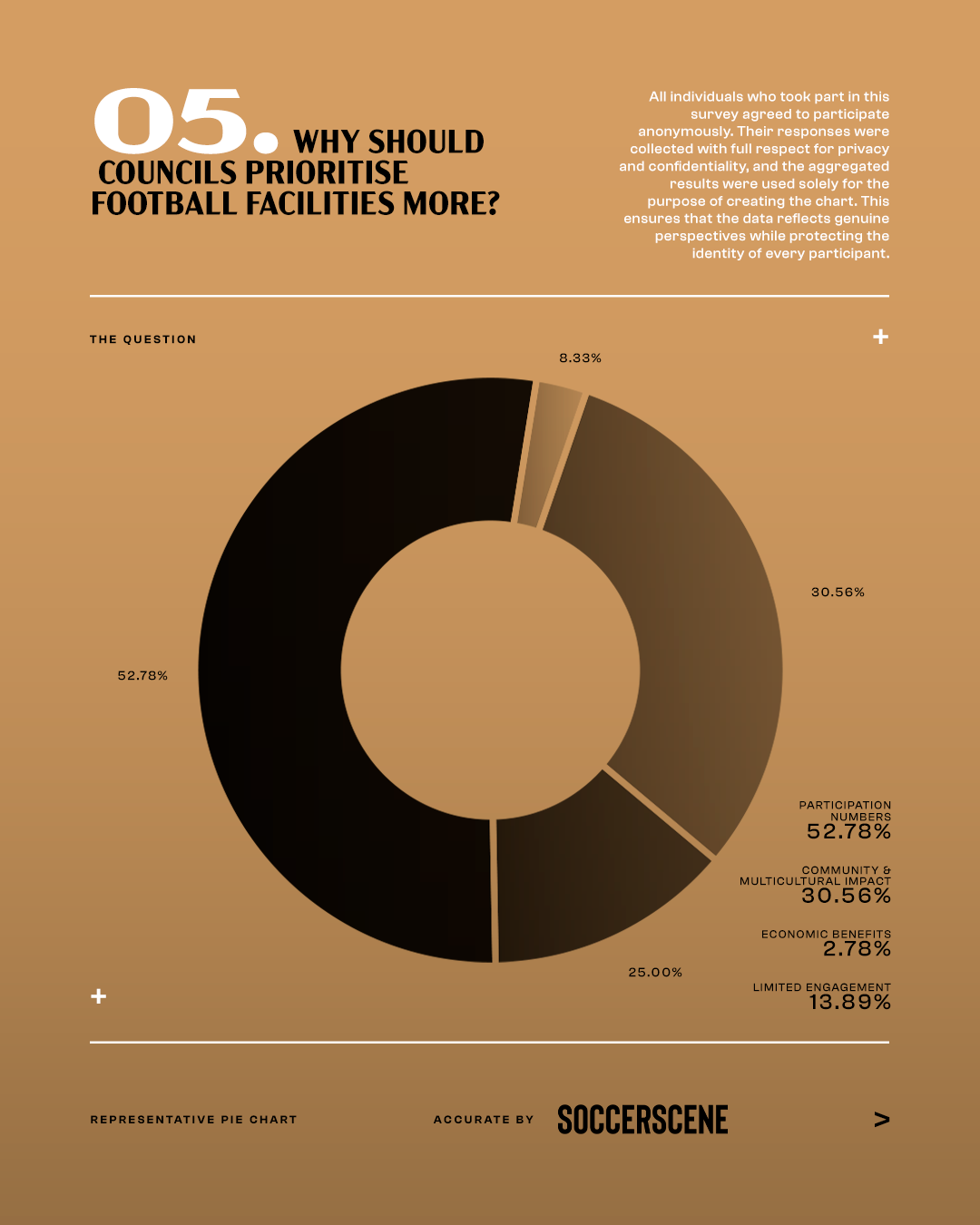
Funding priorities also emerged as a critical issue. Almost half or respondents (47 per cent) identified the lack of prioritised funding as the single biggest council-related challenge facing football, ahead of poor facility design, limited engagement and slow planning processes.


Importantly, these concerns were raised by people deeply embedded in the game. The majority of respondents represented grassroots or semi-professional clubs, many holding governance, leadership or operational roles. Underscoring that these findings reflect lived, on-the-ground experience rather than isolated dissatisfaction.

Taken together, the data suggests the issue is not one of individual councils falling short, but of a broader mismatch between football’s rapid participation growth and the frameworks councils use to plan, consult and invest.

The reality on the ground for clubs and communities

The consequences of this misalignment are already being felt on the ground. Findings in a 2024 audit undertaken by Football Victoria affirm that across many municipalities, football facilities are operating at or beyond capacity, with pitches heavily overused across multiple days and codes, increasing wear, limiting recovery time and compromising playing surfaces.

For clubs, this pressure is most visible in how access is allocated. Women’s teams are increasingly competing for already limited training and match slots, often scheduled later in the evening or displaced altogether, despite participation growth being strongest in the women’s game. Junior teams, meanwhile, are frequently compressed into unsuitable or undersized facilities, with multiple age groups sharing spaces not designed for that level of demand.

In the absence of sufficient council-led planning, clubs are left to absorb the consequences. Volunteer administrators are tasked with managing participation growth councils did not anticipate, juggling scheduling conflicts, maintaining deteriorating facilities, and responding to rising expectations from players and families.

Over time, these pressures risk undermining the very outcomes councils say they value. Participation pathways become constrained, equity of access is compromised, and clubs are forced into reactive decision-making simply to keep programs running. What emerges is not a failure of clubs to manage growth, but a system in which demand has outpaced the infrastructure frameworks designed to support it.

How councils interpret and respond to these challenges ultimately shapes how football infrastructure evolves at a local level.

How councils view the challenge

Longstanding Councillor of Merri-Bek, Oscar Yildiz, acknowledges that funding football infrastructure remains one of the most complex challenges facing local government, largely due to competing demands across multiple sporting codes.

“We get requests from AFL, cricket, bowling and a whole range of other sports,” Yildiz said. “With limited funding, councils are constantly trying to balance those competing priorities and direct investment where it will have the greatest impact.”

Yildiz also suggested that funding decisions are influenced not only by council budgets, but by broader political dynamics between local, state and federal governments.

“If all three levels of government aren’t working together, you’re going to have fractures,” he said. “And when that happens, clubs lose, players lose, and communities lose.”

Consultation, another major concern identified in the survey, is an area Yildiz believes councils must continually improve. While he noted that council officers often maintain strong working relationships with local clubs, he acknowledged that bureaucratic delays and staff turnover can weaken engagement and slow progress.

“The biggest issue with any level of government is time,” Yildiz said. “Clubs want issues resolved quickly, whether it’s facility access, maintenance or funding, but processes can be slow. During that time, clubs can lose members, resources and opportunities.”

In municipalities such as Moreland, where football plays a significant cultural and community role, Yildiz believes councils have an added responsibility to recognise the sport’s social value.

“Football engages thousands of people across culturally diverse communities,” he said. “It’s not just about sport – it’s about connection, wellbeing and participation.”
What happens if councils fail to keep pace?

Ultimately, Yildiz argues that the cost of failing to invest in football infrastructure extends far beyond financial considerations.

“It’s about the return on investment for families and communities,” he said. “If clubs aren’t supported to continue operating and growing, the long-term social and health impacts are something we all carry.”

While councils face genuine financial and political constraints, the survey findings highlight a growing expectation across the football industry that infrastructure planning, consultation processes and funding frameworks must evolve alongside participation growth.

The question is no longer whether football is growing. The question is whether council planning is prepared to grow with it.

Previous ArticleNext Article

Juan Mata Commits to Melbourne Victory’s Future with Ownership Stake

Melbourne Victory has announced that Spanish football icon Juan Mata has joined the club’s ownership group, marking one of the most significant investment moves by a current international footballer in Australian football history.

The agreement sees Mata acquire an ownership stake in Victory while continuing to weigh up whether he will extend his playing career beyond the 2025/26 A-League Men’s season. The investment is separate from any future playing contract and reflects a long-term commitment to both the club and the wider Australian football landscape.

Should Mata eventually retire from professional football, he will also take on a leadership role by chairing a newly established football committee at Melbourne Victory, helping shape the club’s football operations and strategic direction.

More than another football investment

While former elite players have increasingly entered football ownership around the world, Mata’s decision stands apart because he is investing directly into the club he currently represents.

The move places Melbourne Victory among a growing list of clubs benefiting from investment by globally recognised football figures. However, unlike celebrity ownership groups where players often become passive investors after retirement, Mata is embedding himself within the club while still competing at the highest domestic level.

Commercial terms of the transaction remain confidential, although the investment has been described as a significant long-term minority stake designed to strengthen the partnership between Mata and the club well beyond his playing career.

A vote of confidence in Australian football

Perhaps the most significant aspect of the announcement is what it says about the perception of Australian football internationally.

After arriving in Australia following spells with some of Europe’s biggest clubs, including Manchester United, Chelsea and Valencia, few would have predicted that Mata would choose to invest his own capital into an A-League club.

Instead, the 2010 FIFA World Cup winner has described Australian football as a competition with genuine long-term potential.

“Australian football has a future I genuinely believe in,” Mata said.

“From the moment I arrived at Melbourne Victory, I’ve felt the passion of this club and the potential of the A-Leagues, and I want to be part of building what comes next—not just for a season, but for the long term.”

Mata added that becoming a shareholder represented “the natural next step” after enjoying his first season at Victory.

Rewarding an outstanding first season

The investment follows what has been one of the finest individual campaigns by a marquee player in recent A-League history.

The 38-year-old registered five goals and 13 assists across 25 appearances during the 2025/26 season, earning the Johnny Warren Medal as the league’s best player while also claiming Melbourne Victory’s Player of the Year honours. His performances helped guide Victory back into the Finals Series and demonstrated that his influence extends far beyond his reputation.

Rather than treating Australia as a final destination before retirement, Mata has instead become increasingly involved in shaping the game’s future.

A growing portfolio of sporting investments

Melbourne Victory is not Mata’s first venture into sports ownership.

The Spaniard already holds ownership interests in Major League Soccer expansion club San Diego FC and Formula One outfit Alpine Racing. He has also invested in Mercury/13, the multi-club ownership group focused on developing women’s football globally.

These investments reflect a broader trend among modern footballers who are leveraging their experience and networks beyond their playing careers. For Melbourne Victory, securing someone with Mata’s global football knowledge, commercial experience and international connections represents an opportunity that extends well beyond the pitch.

Landmark moment for Melbourne Victory

Victory Chairman John Dovaston described Mata’s investment as a significant endorsement of both the club and the A-Leagues.

According to Dovaston, Mata is a discerning investor with stakes in elite sporting organisations worldwide, making his decision to back Melbourne Victory a strong signal of confidence in the club’s direction and the league’s future.

Managing Director Caroline Carnegie echoed those sentiments, describing the announcement as “genuinely groundbreaking” and highlighting Mata’s combination of world-class football intelligence, investor mindset and long-term commitment.

A statement beyond Melbourne

Australian football has long sought greater international credibility. Not only through marquee signings, but through meaningful long-term investment.

Mata’s decision represents something arguably more valuable than a headline player signing. By committing financially to Melbourne Victory, he is effectively betting on the future growth of both the club and the A-Leagues.

At a time when Australian football continues to pursue increased investment, stronger governance and greater global relevance, having one of the game’s most respected figures choose to become an owner may ultimately prove to be one of the competition’s most powerful endorsements.

Victorian Labor commits $500,000 to Thornbury Football Facility as State Election Advocacy Intensifies

The Victorian Labor Party has confirmed $500,000 in 2026-27 State Budget funding to upgrade facilities at Mayer Park in Thornbury, with Northcote MP Kat Theophanous joining Darebin United juniors for a training session earlier this month to mark the commitment. The funding follows a public campaign by Football Victoria highlighting the ground’s deteriorating conditions, and lands within an escalating advocacy effort by the sport ahead of the next Victorian election.

The money will go toward upgrading the playing surface and planning a new pavilion at a ground that has received no infrastructure investment in over a decade, according to Football Victoria, despite participation at Darebin United more than quadrupling in that time. The club fielded five teams in 2021. It now fields more than 20, with over 300 players including more than 130 children under 12 and over 70 female players.

That growth has collided directly with the limits of the ground itself. Mayer Park has no drainage and no synthetic surface, and Football Victoria reported that Darebin United lost 23 training sessions in 2024 alone due to unsafe, waterlogged conditions. Club President Michael Slaughter described a pitch that was uneven and at times dangerous, particularly for junior and female players.

“I have been there for six years, and the club is at a stage now that we need something new,” Slaughter said in comments to Football Victoria earlier this year. “There’s only so many training sessions you can cancel, and then there’s the cost of finding alternative grounds indoors or outdoors, which isn’t ideal.”

A campaign that found its target

Football Victoria published a dedicated article in March calling on Darebin City Council to urgently prioritise redevelopment of Mayer Park, explicitly linking the club’s case to its broader Level the Playing Field campaign. Three months later, the funding arrived, not from council, but from the state government, attached to the local member’s name and delivered with a photo opportunity on the training pitch.

A club’s need becomes visible through governing body advocacy, a local member adopts the cause, and the funding is announced as a direct response to community need rather than as a line item in a broader budget process. Theophanous’s own account of the announcement makes the local framing explicit, describing the investment alongside free public transport, school upgrades and registration discounts as part of what she has billed as “easier, safer and more affordable” support for Northcote.

“Community sporting clubs bring Northcote locals together,” Theophanous said in her budget statement. “Through our Get Active Kids voucher program, we’re making sure the cost of fees and equipment doesn’t keep kids from playing the sport they love. And we’re also investing to make local clubs even stronger.”

Earlier this year, Avondale FC secured $500,000 for lighting at Avenger Park and Hume City FC received $250,000 for upgrades at Nasiol Stadium, both delivered through the same budget cycle and both paired with local member announcements. Mayer Park follows the same pipeline, a state government commitment, a local seat, a community club whose growth has outpaced its facilities, and a governing body using the win as evidence in a larger campaign.

The equity dimension

What distinguishes the Mayer Park case is the explicit role gender and accessibility played in Football Victoria’s advocacy. The governing body noted that unsafe pitch conditions were particularly dangerous for junior and female players, and highlighted that Darebin United maintains 40% female representation on its committee with seven female coaches, alongside its status as one of Darebin’s first 2-Star Club Changer accredited clubs, a Football Victoria program recognising clubs that actively remove barriers to female participation.

A club building one of the more credible female participation pathways in the municipality was, until this announcement, doing so on a ground its own administrators described as unsafe. Infrastructure investment of this kind does not simply improve playing conditions. It determines whether programs explicitly designed to grow women’s and girls’ football can function as intended, or whether they remain constrained by the same ageing facilities that have shaped community football for a decade.

What it means for the campaign ahead

Football Victoria has framed the Mayer Park outcome as one data point within its Level the Playing Field campaign, which continues to call for more equitable government investment in football relative to other codes. The organisation has indicated further football-related announcements are expected from the 2026-27 Victorian State Budget, with the upcoming state election positioned as the decisive moment for the sport’s broader infrastructure future.

For Slaughter, the immediate outcome is more concrete. “The funding is extremely important,” he said. “It allows us to deliver our football program and to grow. This will give them a place to come, to have fun and to enjoy their soccer”.

Whether that template, governing body advocacy, local political adoption, budget announcement, repeats consistently enough to address the scale of Victoria’s grassroots facilities gap remains the open question Football Victoria’s campaign is designed to keep in front of both major parties as the election approaches.

Most Popular Topics

Editor Picks

Send this to a friend