




Indonesian Consul General hosted in WA by Football West

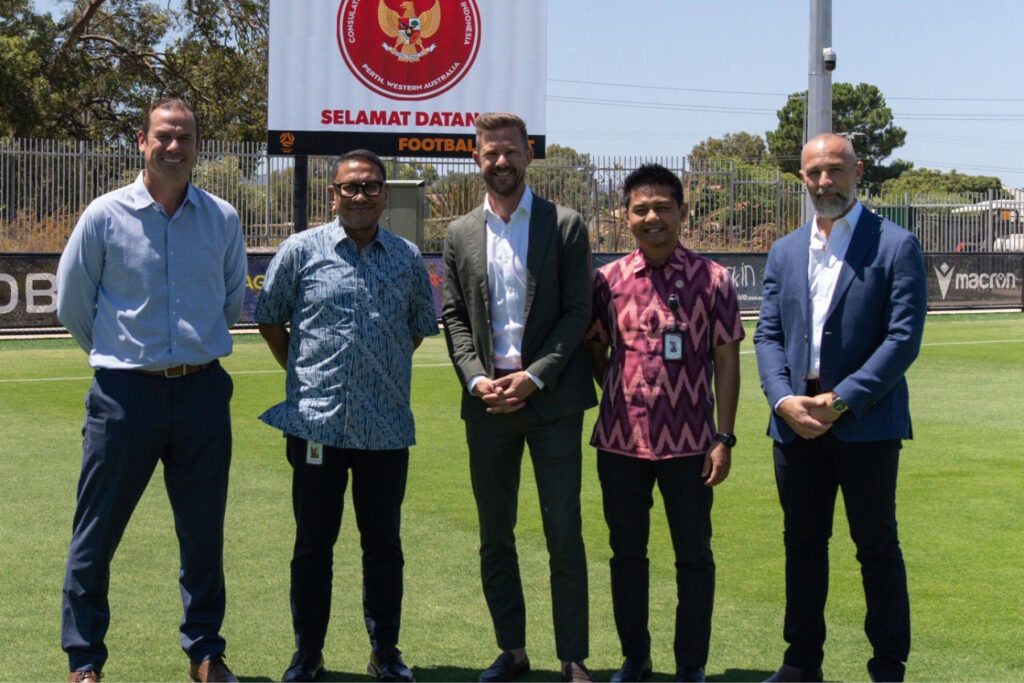
Football West has moved to strengthen its strategic footprint in Southeast Asia, hosting a high-level diplomatic delegation at the Sam Kerr Football Centre this week.

The newly appointed Consul General of Indonesia to Western Australia, Irvan Buchari, and Consul for Information and Cultural Social Affairs, Antonius Prawira Yudianto, met with Football West executives to map out the next phase of the state’s Asian Engagement Strategy.

Facilitated by Indonesia Institute President and former professional footballer Robbie Gaspar, the dialogue focused on leveraging the “world game” to deepen the sister-state relationship between Western Australia and East Java. This partnership was commercially validated last July during the historic exhibition match between the WA Men’s State Team and Liga 1 giants Persebaya Surabaya.

Operationalising Sports Diplomacy

Football West CEO Jamie Harnwell, who hosted the delegation alongside COO Perry Ielati, emphasised that the visit was about operationalising future opportunities rather than just a ceremonial tour.

“Football West has built very strong ties with Indonesia over the past decade… especially with our sister state East Java,” Harnwell said.

“We have sent many senior and junior sides to compete in Indonesia and hosted visiting teams. These occasions are great sporting and cultural experiences and help build mutual understanding and friendships.”

The meeting highlights the increasing role of sports diplomacy in state government relations. The Persebaya fixture notably attracted WA Premier Roger Cook and East Java Provincial Secretary Adhy Karyono, proving football’s unique capacity to open doors in the region.

Mr Gaspar, a key architect of the relationship, noted the potential for future growth.

“I look forward to continuing to work with Football West to grow the relationship and build meaningful, mutually beneficial partnerships with Indonesia,” Gaspar said. “Football is such a powerful platform for connection, trust, and long-term collaboration between our two countries.”

Football West acknowledges the vital backing of the WA Government in driving this strategy, ensuring the code remains a central pillar of Western Australia’s international outreach.

Previous ArticleNext Article

Football SA Commits $100,000 to Referee Fuel Subsidy as Cost-of-Living pressure Mounts

Football South Australia has announced a fuel subsidy scheme for match officials across its semi-professional competitions, allocating up to $100,000 for the remainder of the 2026 season in response to rising fuel costs that the governing body says are threatening the delivery of fixtures across the state.

The subsidy, effective immediately, covers referees officiating across the RAA National Premier League, Apex Steel Women’s National Premier League, Apex Steel Women’s State League, HPG Homes State League 1 and State League 2. The subsidy spans senior, reserves and under-18 competitions across both men’s and women’s football.

Under the metro scheme, reimbursements will be tiered against the average Adelaide unleaded petrol price recorded each Friday, applying to all matches played in the following seven-day period. Officials will receive $30 per match day when the average price sits at $3.25 or above, $25 between $2.75 and $3.24, and $20 between $2.35 and $2.74. No subsidy applies below $2.34. For regional matches, referees travelling to Port Pirie, Barossa and Whyalla will see their per-kilometre reimbursement rise from 88 cents to $1.26 when petrol prices exceed $2.35.

All subsidy payments will be funded directly by Football SA, with no cost passed to competing clubs.

The Economics behind the Whistle

Fuel prices in South Australia, as across much of Australia, have been running at elevated levels against the backdrop of an ongoing imperialist war on Iran that has sent shockwaves through global oil markets. Iran’s targeting of the Strait of Hormuz, through which a significant proportion of the world’s oil supply passes, has disrupted shipping and contributed to price surges that are being felt at service stations in Adelaide as acutely as anywhere.

For match officials, who are overwhelmingly volunteers or low-paid part-time workers travelling to multiple venues across a season, those price surges are not an abstraction. They are a direct financial disincentive to take on appointments, particularly in outer metropolitan and regional areas where travel distances are significant and the cost of attending a game can approach, or exceed the payment for officiating it.

The consequences are cancelled fixtures, forfeited points, disrupted seasons and players who stop turning up to clubs that cannot guarantee them a game.

“This initiative recognises the critical role match officials play in delivering competitions,” CEO Michael Carter said in the announcement, “and aims to reduce the impact of travel costs across the 2026 season.”

A Structural Problem, a Seasonal Solution

The subsidy applies only to the 2026 season. Football SA has been careful to frame it as a response to current conditions rather than a permanent structural change. The $100,000 allocation is described as subject to fuel prices remaining at current levels, with the final amount invested likely to vary as the weekly threshold calculations play out across the season.

That framing is honest about what the scheme is and isn’t. It does not resolve the underlying question of whether referee payments in community and semi-professional football are adequate relative to the demands placed on officials. It remains a question that transcends the current fuel price environment and will outlast it. What it does is buy time and goodwill in a moment when both are in short supply.

Sport, and football in particular, depends on a volunteer and semi-volunteer workforce that is increasingly being squeezed by the same cost-of-living pressures affecting every other part of Australian life. When the price of petrol rises, the people who feel it first are not the players or the clubs, it’s the officials, the committee members and the volunteers who make the infrastructure of community sport function.

Football SA’s decision to absorb that cost rather than pass it to clubs is a recognition that the referee pipeline is fragile in ways that are not always visible until it breaks. The SAPA review into South Australian football, released earlier this month, identified referee development and retention as one of the most pressing structural challenges facing the game in the state, recommending greater investment in recruitment and suggesting affiliation fee subsidies for clubs that bring new officials into the system.

Friday’s announcement does not go that far. But in a season already defined by uncertain economic and geopolitical circumstance, the levy sends a clear enough signal about where Football SA’s priorities lie.

The fuel levy will be calculated each Friday using average Adelaide prices listed on Fuel Price Australia, with payments made to officials on the regular weekly schedule.

Football West mourns passing of women’s football pioneer Barbara Gibson, aged 95

Football West has acknowledged the death of Barbara Gibson, an Honorary Life Member of the organisation whose administrative career across five decades fundamentally shaped the landscape of women’s football in Western Australia. She was 95.

Gibson’s contribution belongs to a period in Australian sport when women’s participation existed largely outside formal structures and was tolerated at the margins of a game whose governing bodies were built by and for men. That she spent decades building those structures anyway, and that the game in Western Australia is materially different because she did, is the measure of her legacy.

She did not begin playing football until her 40s, turning out for Inglewood Kiev before redirecting her energy almost entirely into administration. In 1975 she became Secretary of the Western Australian Women’s Soccer Association, a role she held for a decade alongside the position of Treasurer. As long-standing Manager of the Senior State Women’s Team, she oversaw international tours to Malaysia in 1977 and India in 1980.

Gibson was elected President of the WAWSA in 1986, the same year she joined the broader administration of the game as Assistant Secretary of the Soccer Federation of WA: a dual role that positioned her as a bridge between the women’s competition and the wider governing structure at a moment when that connection was neither guaranteed nor assumed.

Her influence extended beyond Western Australia. As the WAWSA’s representative at all Australian Women’s Soccer Association delegate meetings, she helped shape national policy at a time when the decisions made in those rooms determined whether women’s football in this country had a future at all.

Gibson was inducted into the Football Hall of Fame WA in 1996 and received the Australian Sports Medal in 2000.

“She gave decades of service to our game and to female football in particular,” said Football West CEO Jamie Harnwell. “When we marvel at the incredible spectacle of over 70,000 fans turning out to cheer on the Matildas in a major international final, we should also remember the pioneers of the women’s game, such as Barbara, who helped lay the foundation stones.”

The cultural legacy Gibson leaves is one of institutional persistence. The willingness to build, advocate and administer within systems that were not designed to accommodate the work she was doing. The women currently playing in Football West competitions, coaching junior teams, sitting on club boards and representing Western Australia at national level do so within structures that people like Gibson constructed from the outside in.

Most Popular Topics

Editor Picks

Send this to a friend